Knowledge hub
Corporate English Training: A Practical Guide for 2026
Corporate English training explained: formats, learner profiles, rollout plan, pricing, ROI and a vendor checklist for Moroccan and global teams.

In countries and territories where English is neither a native nor official language, more than two-thirds of employers consider English important to their business, and in many such markets the figure exceeds 95%, according to the Cambridge English and QS global workplace analysis. That breadth changes the decision. Corporate English training isn't only for multinational executives. It's for support agents, engineers, sales staff and administrators who need reliable English for recurring tasks. Almost one in five employers in that analysis considered more than 70% of their workforce to have an English skills gap, which means a vague general course rarely fixes the actual problem.
Table of Contents
- What Corporate English Training Covers and Its Main Types
- Business Benefits, Costs and ROI Estimates
- Learner Profiles and the Level Each Role Needs
- Sample Curricula and 60-Minute Lesson Structures
- How to Roll Out a Corporate English Program
- Frequently Asked Questions About Corporate English Training
- Choosing a Provider and Launching a Moroccan Pilot
What Corporate English Training Covers and Its Main Types
Corporate English training is structured English instruction arranged or paid for by an employer and built around the communication tasks a role needs, such as meetings, client calls, email, presentations and interviews. The syllabus starts from job tasks, not from a grammar sequence. Progress is then reported against those tasks as well as against CEFR levels.
General English works differently. It builds broad proficiency first and hopes learners transfer it to work later. That can help beginners, but it leaves a B2 employee who can already read reports still struggling to interrupt politely, clarify an instruction or close a call with clear next steps.
Formats of Corporate English Training Compared
| Format | How it runs | Best for | Main trade-off |
|---|---|---|---|
| In-house cohort | Group of 4 to 6 colleagues on one schedule | Teams doing the same tasks | Individual gaps get less attention |
| Open-enrolment group | Learners from several companies in one class | Small firms with a few staff | Content is less tailored to one company |
| Private one-to-one | One learner with custom goals and pace | Senior staff, specialists, interview prep | Higher cost per learner |
| Blended live and self-study | Live sessions plus tasks on a platform | Staff with irregular hours | Needs tracking to keep learners on track |
| Role-specific programme | Built around meetings, email, presentations | Sales, support, engineering, management | Needs a needs analysis before launch |
| Intensive short-course | Short daily or near-daily sessions over a few weeks | Pre-assignment or relocation | Hard to fit around a full workload |
The format matters less than most buyers think. Content match matters more. A well-taught general course still misses the events that create business risk if it never practices your team's escalation calls, proposal emails or project stand-ups.
A Practical Decision Rule
Choose a group cohort when colleagues share tasks, vocabulary and meeting types. They can practice together, hear each other's phrasing and build shared habits for summaries and handovers. Choose one-to-one when the goal is narrow and personal, such as a senior manager preparing for board presentations or a specialist preparing for an interview. Choose blended when shifts, travel or client coverage make fixed attendance unrealistic, but only if someone checks completion and brings self-study into the live sessions.
Intensives suit a deadline, not a long-term skill. They create momentum before a relocation, audit or launch, then performance drops if learners stop using the language. Open-enrolment groups solve a headcount problem for small firms, but you trade away examples drawn from your own emails and calls.
Practical rule: Buy the task syllabus first and the delivery format second. If a provider can't name the workplace events your team will practice, the format won't rescue the program.
Treat this purchase like any other capability investment. Before you approve hours, define what change you'd count as evidence that training worked. Resources on measuring ROI from employee training can help you frame that question in operational terms, such as fewer repeats, faster handovers or clearer action items, rather than in attendance alone.
I would start with the simplest format that lets learners speak in every session. Small groups and private lessons create speaking time. Large groups look efficient on a spreadsheet and then waste that saving because each learner waits too long to talk, gets too little correction and has no reason to prepare.
Business Benefits, Costs and ROI Estimates
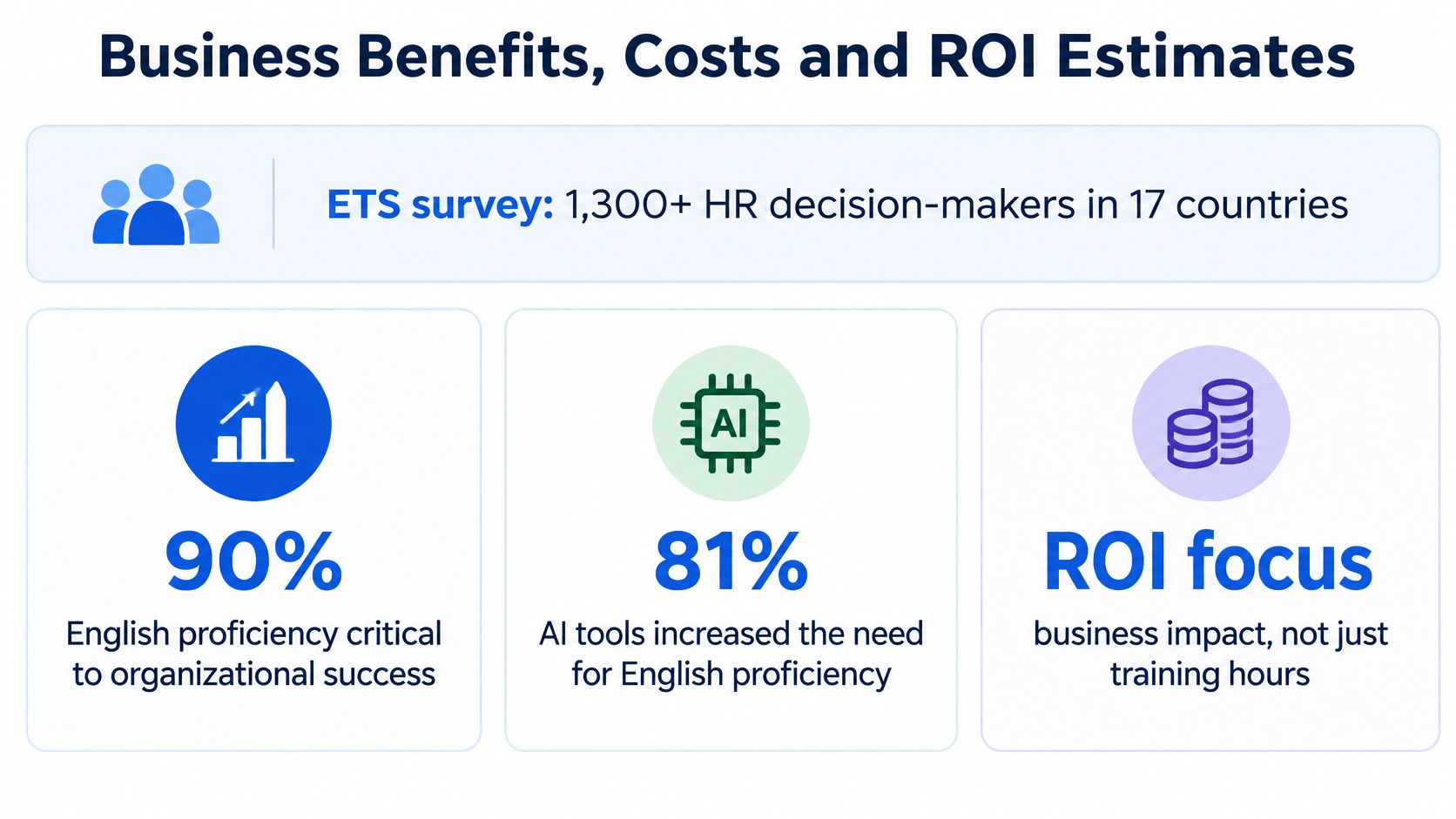
The business case strengthens when you link proficiency to productivity, retention and technology-enabled work rather than to abstract fluency. In the global ETS survey of more than 1,300 HR decision-makers across 17 countries, 90% considered English proficiency critical to organizational success, 92% said its importance had increased over the previous five years, and 81% said integrating AI tools increased the need for workplace English. ETS also reported that 83% of employers incur costs when hiring people with insufficient English, including lower productivity and retention, while 86% viewed organizations without fluent English speakers as competitively disadvantaged.
Why AI Raises the English Requirement
AI doesn't remove the need for judgment. Employees write precise prompts, evaluate AI-generated outputs, interpret English interfaces and documentation, and communicate decisions across multilingual teams. A tool can draft a paragraph, but it can't confirm whether a client understood the commitment, whether the tone sounds defensive or whether an ambiguous instruction still needs clarification.
That mechanism points training toward high-frequency events. Prioritize meetings, email escalation, presentations, interviews and AI-assisted workflows. Add immediate corrective feedback and observable benchmarks such as response accuracy, turn-taking, clarification behavior and task completion time. Those indicators tell managers more than a vocabulary quiz.
Say a support team produces unclear written summaries. Clients reply asking what happens next, agents send a second explanation and supervisors handle escalations that shouldn't have occurred. The useful training target isn't broader vocabulary. It's the ability to write a concise summary with the issue, action taken, owner and deadline. Measure clarification frequency, email turnaround, escalations and completion time as suggested indicators, not as universal benchmarks. Your baseline determines whether a change is meaningful.
Three Pricing Models
- Per learner per month: Simple to budget, but you must confirm how many live hours and reports each learner receives.
- Per group per term: Rewards stable cohorts and makes scheduling predictable, provided empty seats don't erase the saving.
- Per program scope: Prices assessment, delivery, reporting and coordination as one package, and it's how company programs are usually quoted.
Ask every provider to state hours, group size, assessment, reporting and cancellation terms in writing. A cheap headline price with undefined hours isn't a price you can compare.
Corporate English Cost Model and Illustrative Calculation
| Cost item | How to calculate | Illustrative example |
|---|---|---|
| Learner hours | Learners times hours per month times months | 12 x 4 x 3 = 144 hours |
| Direct tuition | Learner hours times agreed rate per hour | 144 x 100 MAD = 14,400 MAD |
| Release time | Paid working hours away from tasks | 144 learner hours if sessions sit inside paid time |
| Assessment and administration | Placement, baseline, reports and coordination | Hours for placement, two simulations and term reports |
| Estimated benefit | Hours saved per month times loaded hourly cost | Tracked incident time saved, multiplied by loaded cost |
| Net return estimate | Estimated benefit minus total program cost | Calculate after pilot data gives you a tracked benefit |
The tuition illustration uses 12 learners at 4 hours per month for 3 months, which gives 144 hours, or 14,400 MAD at Englify's individual reference rate of 100 MAD per hour, before corporate adjustments. Confirm the current rate before you budget from it. Corporate scope can change the rate because grouping, reporting volume and schedule protection change the work involved.
For ROI, use estimated hours saved per month times loaded hourly cost, minus total program cost. Loaded cost should include salary and employer costs, not only net pay. Don't invent the saved hours. Track specific incidents before and during the pilot, such as repeated clarification emails, long meeting overruns or rework from misunderstood handovers.
Benefits aren't automatic. Test them with a pre and post design using equivalent simulations, because attendance and satisfaction can rise while workplace performance stays flat.
Run the same timed email and meeting simulation at the start and end, score them with the same rubric and compare both language and task completion. That won't prove all business change came from training, but it's far more credible than reporting that learners enjoyed the course.
Learner Profiles and the Level Each Role Needs
The CEFR makes a vague goal usable. Instead of asking a provider to improve business English, you can specify that support agents should handle familiar calls independently or that managers should lead a discussion and summarize decisions. Its descriptors are can-do statements, so you can translate each level into workplace behavior.
A2 covers simple exchanges on familiar matters. B1 covers the main points of familiar workplace input and simple connected text. B2 supports more confident interaction and detailed writing. C1 supports flexible, spontaneous professional use, including nuanced argument and well-structured texts.
Why Skill Priority Changes by Role
Cambridge English's analysis of 5,373 employers across 38 countries in its English at Work executive summary found that employers value reading, writing, speaking and listening, but priority varies by industry. Reading ranked most important in 11 industries, while speaking ranked first in nine. The same source reported that 50% of employers associate good English with faster progression through job grades and 46% with higher salary increases.
Start with a job-task analysis. Identify whether employees mainly interpret technical documents, negotiate orally, write customer emails or join meetings. Then assess those competencies directly. A CEFR baseline plus a timed email, meeting simulation and short presentation reveals gaps that an overall level can conceal.
For HR teams that run interviews and internal communication in English, the task list needs its own detail, and this guide to Business English for HR professionals is a useful companion when you define those events.
Learner Profiles with Planning CEFR Ranges
| Learner profile | Typical tasks | Planning CEFR range | Priority skills |
|---|---|---|---|
| Customer support agent | Calls, chat, complaints, ticket notes | B1 to B2 | Listening and speaking under pressure |
| Sales or account manager | Proposals, client calls, negotiation | B2 to C1 | Persuasion, speaking, clear email |
| Engineer or technical specialist | Documentation, code reviews, stand-ups | B1 to B2 | Reading technical text, concise speaking |
| Manager or team lead | Meetings, feedback, reports, presentations | B2 to C1 | Facilitating, clarifying, presenting |
| Administrative or finance staff | Written reports, internal emails | B1 to B2 | Writing precision and accuracy |
| Graduate trainee | Onboarding, team presentations, shadowing | A2 to B1 | General fluency and confidence |
These ranges are planning guides, not official standards. A company must set its own threshold from the actual task. A support agent handling calm, scripted queries may perform well at B1, while another agent handling angry callers with varied accents needs stronger listening at the same nominal level.
Use a placement test for the baseline, then report progress by skill and task, not only by a single course grade. One course for all staff wastes time because a B1 support agent and a C1 manager need different practice. The weaker learner hides, the stronger learner gets bored and the teacher teaches to the middle.
A team average can also hide one critical gap. Suppose engineers read documentation without difficulty but miss decisions on calls because speakers talk quickly or overlap. Their level looks adequate until you test listening under realistic conditions. That's why I wouldn't buy training from a level label alone. Diagnose the event, set the target as a behavior and place learners where they'll get the right kind of repetition.
Sample Curricula and 60-Minute Lesson Structures
Build the curriculum from recurring communication events, then sequence the language needed to handle them. Listening and speaking deserve serious weight alongside reading and writing, especially for teams whose problems appear in live interaction rather than on paper.
A study of 77 employers across 10 Saudi workplaces found that employers ranked listening as the most important English skill, followed by speaking, writing and reading. Employers also highlighted interpersonal, intercultural, teamwork, lifelong-learning and business-ethics skills as relevant to workplace communication. For multinational or Arabic-speaking teams, that means practicing accents, clarification, turn-taking and client interaction, not only vocabulary lists.

A 12-Week Sample Term
- Weeks 1 and 2: Needs analysis and baseline tasks, including placement and a recorded simulation.
- Weeks 3 and 4: Meetings, covering opening, interrupting politely and summarizing decisions.
- Weeks 5 and 6: Email, covering requests, escalation and clear action items.
- Weeks 7 and 8: Calls and negotiation, including clarifying numbers, dates and commitments.
- Weeks 9 and 10: Presentations and handling questions, including signposting and buying time to think.
- Week 11: A role simulation that combines the term's events under time pressure.
- Week 12: A repeat of the baseline task, scored against the same criteria.
Three 60-minute sessions per week over 12 weeks gives 36 sessions and 36 hours. That dose creates enough repetition for habits to form, provided learners use the phrases between lessons. If your team can only protect two sessions per week, extend the term rather than compressing every topic into a survey nobody retains.
Meeting language needs precise, reusable chunks. Learners should practice starting, checking understanding, disagreeing without sounding abrupt and closing with owners and deadlines. This practical resource on English for meetings helps learners prepare those phrases outside class so live time can go to practice and correction.
Sample 60-Minute Corporate English Lesson Structure
| Minutes | Segment | Purpose | Example task |
|---|---|---|---|
| 0 to 5 | Warm-up | Activate target vocabulary | 30-second project status update |
| 5 to 15 | Input | Model the target language | Listen to a recorded client call and note key phrases |
| 15 to 30 | Guided practice | Drill phrases in pairs with the teacher | Rephrase three client objections politely |
| 30 to 45 | Role-play | Use the language under realistic pressure | Run a 5-minute escalation call with a colleague |
| 45 to 50 | Pronunciation check | Target pronunciation and intonation problems | Repeat key meeting phrases after the teacher |
| 50 to 57 | Feedback | Give specific corrective feedback | Note three fixes on pronunciation, structure and word choice |
| 57 to 60 | Action | Turn the lesson into a workplace habit | Write one follow-up email to a real colleague |
The warm-up creates a low-risk first contribution. Input shows learners how competent speakers phrase the move they're about to practice. Guided practice builds accuracy in short turns, and the role-play tests whether the language survives interruption, missing information and time pressure.
Don't let feedback become a long error list. Pick three fixes learners can apply immediately, such as stress on a key word, a clearer request structure and one inaccurate term. The final action matters because it moves the phrase from classroom performance into a real message or conversation.
Teams sharing a first language, Arabic or French for many Moroccan staff, often need focused work on pronunciation and intonation in meetings. Diagnose that need from recordings and simulations instead of assuming it. Some learners need sentence stress so listeners catch the important word. Others speak clearly but avoid interrupting, so their real gap is interaction strategy, not sound production.
A strong lesson ends with a workplace action learners can complete before the next session. Without that bridge, even lively practice becomes entertainment.
Use realistic materials whenever confidentiality allows. An anonymized client email, internal agenda or product update gives learners the exact names, abbreviations and decisions they face at work. Replace sensitive details, keep the communication problem and practice the response your company needs.
How to Roll Out a Corporate English Program
Rollout succeeds when somebody owns the decisions before the first lesson. HR can coordinate the program, but managers must protect time and define the events that matter. Without that split, the provider guesses, learners improvise attendance and reports describe activity instead of progress.
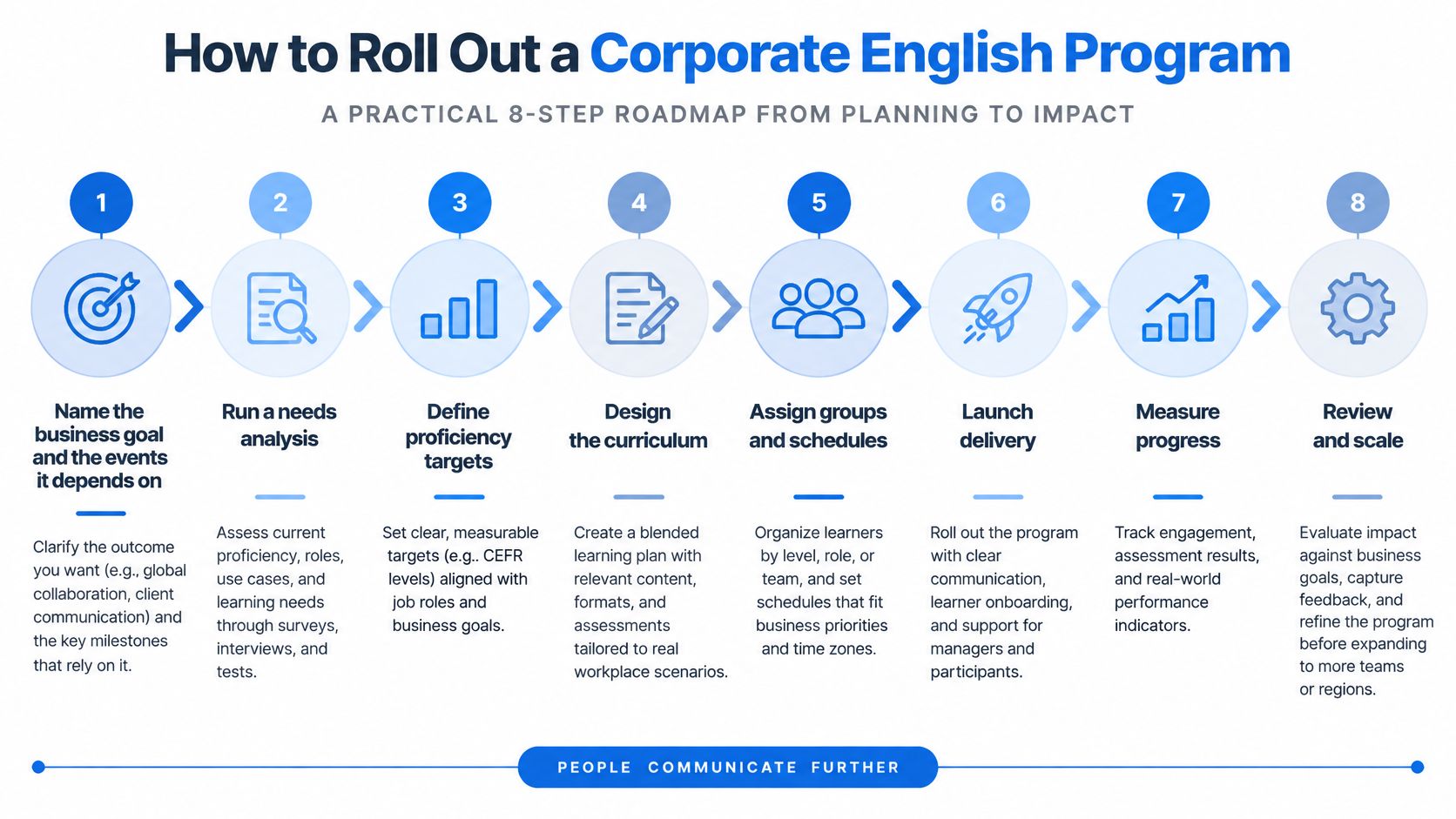
Eight Steps in Order
- Name the business goal and its events: Link training to client calls, internal meetings, proposal writing or another outcome managers can recognize.
- Run a needs analysis: Review recent missed handovers, weak client calls and silent meeting participation, then map tasks by role.
- Set a baseline: Combine a CEFR placement with a timed email, meeting simulation and short presentation.
- Form cohorts by role and level: Keep groups small enough for frequent speaking and useful correction.
- Pilot one group for six to eight weeks: Collect attendance, feedback and one workplace indicator before you expand.
- Schedule around work peaks: Offer morning, afternoon and evening slots, and agree protected learning time with managers.
- Roll out with named ownership: Give the program an internal sponsor and one point of contact for changes and absences.
- Measure at day 30, day 90 and term end: Review attendance, completion, task performance and workplace indicators, then use equivalent pre and post simulations for the final judgment.
Step 2 is where most programs succeed or fail. The task list determines content, grouping and measures. If you skip it, you'll group people who share a level but not a job problem, and every lesson becomes a compromise.
Start the needs analysis with incidents, not opinions. Ask managers for recent examples where English slowed work or created risk. Ask learners which moments they avoid, such as challenging a deadline on a call or asking a speaker to repeat a number. Compare both lists and select the few events that recur often enough to practice and measure.
Use a structured online English placement test to create the first CEFR picture, but don't let that score make the final grouping decision alone. Add a short speaking or writing task drawn from the role. Two B1 learners may need different cohorts if one writes accurately but can't follow calls and the other speaks confidently but produces unclear emails.
Protecting Attendance Without Policing Adults
Put sessions in calendars as work commitments, with a clear rule for client emergencies and rescheduling. Managers should know the schedule before launch, not discover that a weekly team meeting clashes with it. Track absence reasons. A pattern of operational clashes requires a new slot, while a pattern of low perceived relevance requires better task selection.
During the pilot, review quickly. At day 30, check whether learners attend, speak and complete workplace actions. At day 90, compare task performance and ask managers whether they see clearer summaries, better clarification or more active meeting participation. At term end, repeat the baseline simulations and decide whether to scale, redesign or stop.
I would not roll out to every department at once. A pilot exposes timetable clashes, grouping errors and weak reporting while the cost of fixing them is low. Scale only when the provider can show who improved, on which task and by what evidence.
Frequently Asked Questions About Corporate English Training
What If Staff Do Not Attend
Tie attendance to protected learning time agreed with managers and to tasks learners use the next day. Adults protect sessions that solve an immediate problem, such as tomorrow's client call. Track absence reasons so you can fix a schedule clash, workload peak or relevance problem instead of blaming motivation.
What If One Group Has a Wide Level Spread
Use placement results to form subgroups by skill or task instead of forcing one pace. Pair speaking practice by level for accuracy work, then mix levels only for structured simulations where stronger learners lead and weaker learners have a defined contribution. If the spread stays too wide, split the cohort rather than asking the teacher to serve two courses in one hour.
What If an Employee Leaves After Training
Agree in advance how progress records are kept and who receives reports. Design content around company tasks, templates and shared phrases so useful knowledge stays in the team even when one person leaves. A replacement can then join with a baseline and a clear record of what the group has already covered.
Is Online Training Enough for Mixed French and English Teams
Live online sessions can cover both languages if the task list defines which language each team uses in each recurring event. Train the language of the client call, internal report or supplier meeting as it occurs. A short pilot is the practical test for all four answers, because it shows whether staff attend, groups work, records help managers and online delivery supports real interaction.
Choosing a Provider and Launching a Moroccan Pilot
Choose a provider that measures, not one that promises. Fluent marketing language tells you nothing about whether your support team will write clearer summaries in eight weeks. Evidence starts with assessment.
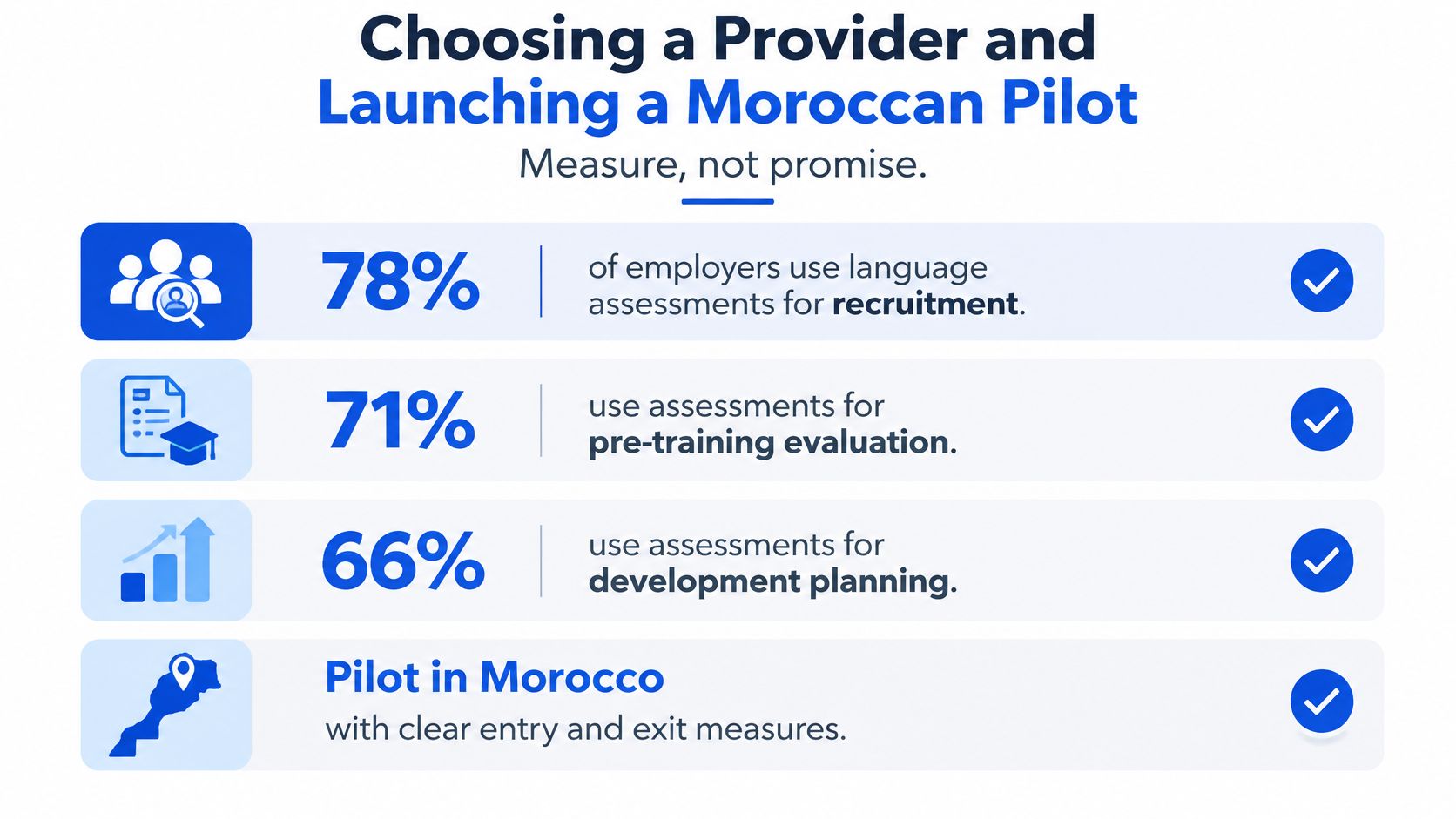
The 2025 ETS survey of more than 1,300 HR decision-makers across 17 countries reported that employers commonly use language assessments for recruitment at 78%, pre-training evaluation at 71% and promotion readiness at 66%. A serious provider should therefore test before training and again afterward, using tasks that reflect the job.
A Five-Group Provider Checklist
- Needs analysis: Does the provider map your tasks or only sell level packages?
- Assessment: Do you get a placement test plus role-based speaking and writing tasks, scored against clear criteria?
- Delivery: What's the group size, are sessions live, which platform is used and what's the recording policy?
- Reporting: How often do reports arrive, what do they contain and who receives them?
- Commercial clarity: Does the quote state an all-in price, defined hours, cancellation terms and rescheduling terms?
Ask four direct questions before you sign. How do you build the syllabus from our tasks? What does a learner report contain? How are teacher qualifications verified? Can we see a sample report with names removed? Evasive answers at this stage become expensive ambiguity later.
Reject clear red flags. Guaranteed fluency isn't a measurable offer. Prices without defined hours can't be compared. No baseline means no credible progress claim. No trial means you're asked to trust delivery quality without seeing interaction, feedback or reporting.
Four Moroccan Decisions to Settle First
Language of instruction needs a practical rule. Use English as the target language for practice, French where an explanation supports a company process and Arabic or Darija support when a learner is stuck. The goal is comprehension without turning the lesson into translation.
Scheduling should fit the Morocco time zone and real working patterns. Offer morning, afternoon and evening slots where possible, and agree adjustments for Ramadan and national holidays before the term begins. Budgets in MAD should confirm which items are included, such as placement, materials, reports and recordings. Live Google Meet classes let staff join across cities without travel, provided learners have a quiet place, a headset and protected time.
These details aren't administrative extras. They decide whether employees can attend consistently and whether managers can see value. A strong syllabus fails if sessions collide with closing time in finance, shift changes in support or school pickup for staff learning from home.
A Pilot Small Enough to Judge
Run one group of six or fewer learners who share a task, for six to eight weeks. Track attendance and one workplace indicator, such as clearer follow-up emails or more complete meeting summaries. Review the evidence with managers and the provider before expanding.
At the end, ask three questions. Did learners attend at a level that made progress plausible? Did the repeated task improve under the same scoring criteria? Did a manager observe a useful change at work? If the answer is no, redesign the task list, grouping or schedule before buying more hours.
A pilot isn't a discounted course. It's a decision tool with entry measures, exit measures and a meeting where you decide whether the evidence justifies scale.
Take three actions this week. First, have the pilot group take the free placement test so you start from a shared baseline. Second, request a free trial session built around one real event, such as an escalation call. Third, ask for a sample written session report so you can judge whether feedback names specific strengths, fixes and next actions.
Look for concrete delivery features you can verify, including CEFR-based levels from A0 to C1, small groups, private one-to-one options, live online sessions, session recordings where agreed, learner reports and personalized content. That checklist keeps the conversation on service design rather than promises, and it gives your pilot a fair chance to prove whether corporate English training changes the work your team does every day.
For Moroccan companies that want a measured pilot, Englify offers live Business English classes on Google Meet in small groups or private one-to-one format, with CEFR-based placement, personalized workplace content and learner reporting. Start with the free placement test or a free trial session, bring one recurring task from your team and use the session report to decide your next step.