Knowledge hub
Business English for HR Professionals: A Practical Guide
Business English for HR professionals: the core modules, CEFR levels, interview and email phrases, role-plays and lesson plans for HR teams.
You're about to explain a leave-policy change on Google Meet. You know the policy, but your English sounds vague: Your request will be handled soon. A clearer version gives the employee something useful: Your manager will review your request by Friday, and HR will email you the outcome.
That difference is the starting point for Business English for HR professionals. The aim isn't to sound impressive. It's to help candidates, employees and managers understand what's happening, what they can ask, and what happens next.
Table of Contents
- What Business English Means for HR Work
- Six Core Modules and the CEFR Level Each Needs
- Interview Questions and Onboarding Phrases That Work
- Emails, Meetings and Routine Performance Reviews
- Difficult Conversations Step by Step, with Role-Plays
- Inclusive and AI-Assisted HR Communication in English
- Lesson Plan, Timeline and How to Assess Progress
- Tips for Moroccan HR Teams and How to Start
What Business English Means for HR Work
Business English for HR is the language people professionals use to perform their jobs accurately, respectfully and clearly. It includes interpreting policies, interviewing candidates, explaining pay and benefits, running meetings, writing documentation and handling employee relations across borders.
General English helps you maintain a conversation. HR English helps you complete a professional task where wording can affect someone's understanding of a decision. A learner might handle small talk comfortably yet struggle to explain a disciplinary outcome without sounding either uncertain or unnecessarily harsh.
Why HR needs task-specific English
In a 2025 survey of 1,325 HR decision-makers across 17 countries, ETS reported that 90% considered English critical to organizational success, 83% said hiring people with insufficient English created measurable business costs, including lower productivity and weaker retention, and 81% said integrating AI tools increased the need for workplace English.
For an HR team, the practical response is to identify communication gaps within actual workflows. Can the recruiter clarify an incomplete answer? Can the coordinator explain an approval process? Can the HR business partner distinguish an allegation from an established fact?
Useful language performance includes:
- Clarity: The listener understands the decision and next step.
- Register: The wording fits the situation, whether welcoming or formal.
- Neutrality: The speaker separates evidence from assumptions.
- Confirmation: The employee has an opportunity to check or correct their understanding.
Practical rule: Assess what the learner can help another person understand or do, not just how many grammatical errors they make.
A useful curriculum therefore covers recruitment and interviewing, onboarding, performance reviews, meetings, emails and difficult conversations. Each module needs its own observable outcome, rather than a shared vocabulary test with different HR terms.
Six Core Modules and the CEFR Level Each Needs
Core HR Modules, Suggested CEFR Bands and Observable Tasks
The bands below are professional planning recommendations, not official CEFR requirements. The timings and word counts are proposed practice targets, not established proficiency standards.
| Module | Typical HR tasks | Suggested CEFR band | Observable task |
|---|---|---|---|
| Recruitment and interviewing | Job adverts, screening calls, structured interviews, candidate feedback | B2 | Run a 20-minute competency-based interview and write an evidence summary |
| Onboarding | Welcome sessions, policy walkthroughs, benefits explanation | B1+ to B2 | Explain a leave policy in five minutes without reading from notes |
| Performance reviews | Goal setting, balanced feedback, development plans | B2 | Give feedback on two goals and agree two development actions |
| Meetings | HR committees, team briefings, cross-department calls | B2 | Chair a 30-minute meeting and confirm the owner of each action |
| Emails and documentation | Policy notices, rejection messages, case notes | B1+ to B2 | Write a 150-word policy clarification that a non-specialist can follow |
| Difficult conversations | Grievances, disciplinary talks, restructuring briefings | B2+ | Paraphrase both positions and close with a summary of agreed actions |
Why the starting bands differ
Cambridge English's analysis of responses from 5,373 employers in 38 countries found that, where English was neither native nor official, 7% of job tasks required native-level English, 49% advanced, 33% intermediate and 8% basic; reading was the most important skill in 11 industries, and speaking in nine.
Those findings support differentiated training, but they don't establish the CEFR bands in this table. A predictable onboarding explanation allows preparation and familiar examples. A grievance discussion demands spontaneous listening, careful reformulation and responses to unexpected information.
A single company-wide language standard can therefore misclassify people. A coordinator who writes accurate routine notices may need different support from a recruiter who conducts exploratory interviews. Neither job title alone tells you which skill is missing.
How to use a row
Start with the observable task, then collect a performance sample. For onboarding, ask the learner to explain a sample policy and respond to an employee's follow-up question. Check whether they explain eligibility, approval and exceptions correctly, not whether they reproduce memorized wording.
At a lower starting level, reduce the task: explain a straightforward procedure with a prompt card before attempting an unscripted walkthrough. At a stronger level, introduce ambiguity, competing priorities or an unfamiliar question.
The academy's free placement test places learners within its A0–C1 learning pathway. Combine that placement with job samples, and use related Business English for managers activities when HR staff coach line managers.
Place people by the tasks they must perform, then group them by module.
Interview Questions and Onboarding Phrases That Work
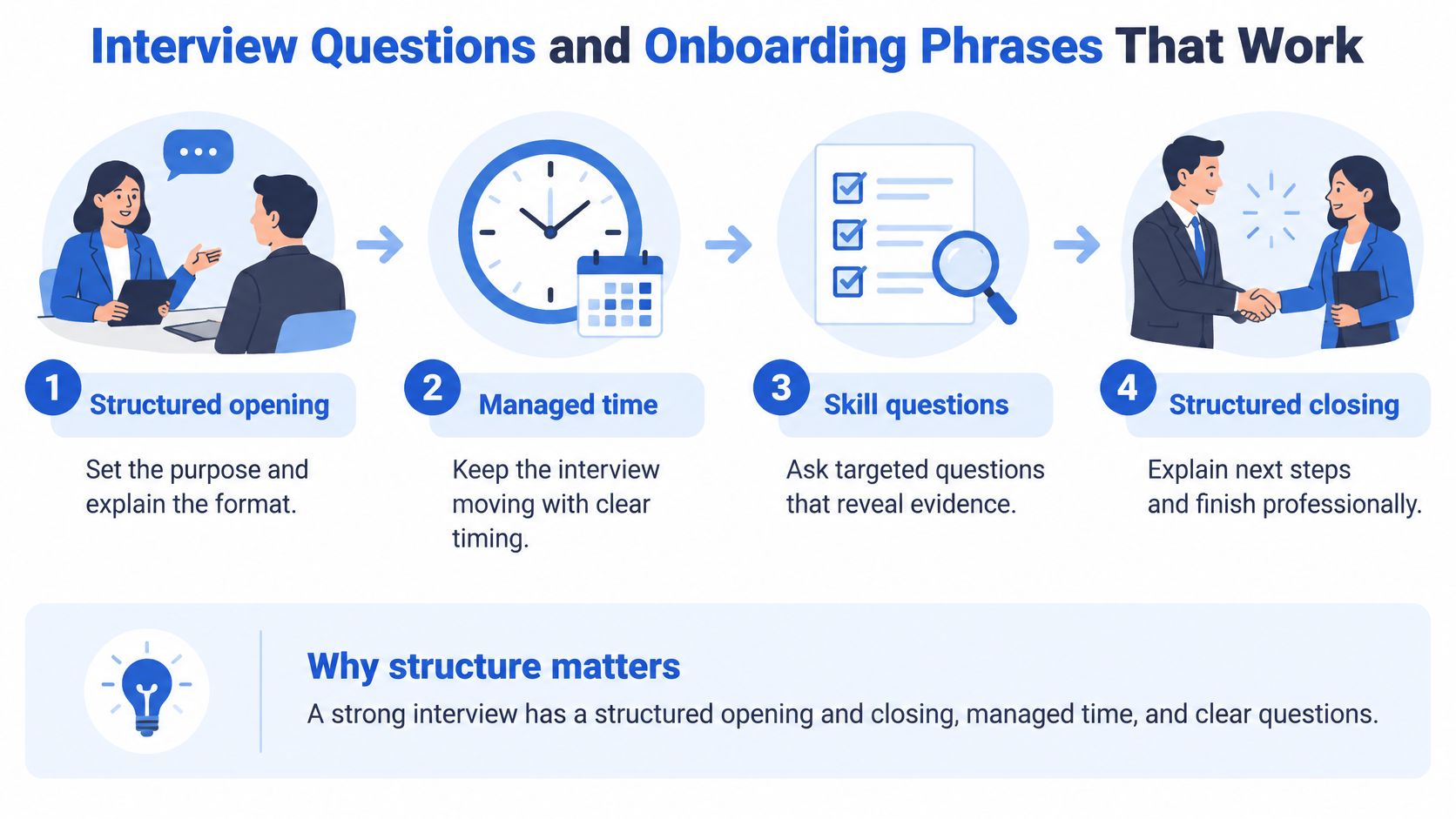
A friendly conversation isn't necessarily a useful selection interview. The CIPD people-practice standard identifies structured openings and closings, time management, rapport, active questioning, listening, note-taking and scoring against predetermined criteria, across face-to-face, telephone and web-conference interviews.
Interview Question Types and Example Phrases
These are practice examples, not quotations from the standard.
| Question type | Example phrase | Main purpose |
|---|---|---|
| Open | Tell me about a time you handled a tight deadline. | Start a topic and let the candidate speak freely |
| Closed | Did you lead that project yourself? | Confirm a specific fact |
| Probing | What exactly was your part in that decision? | Dig into a vague answer |
| Hypothetical | How would you handle a team member who missed three deadlines? | Test judgement in a realistic situation |
| Competency-based | Give me an example of a conflict you resolved at work. | Score the answer against defined criteria |
| Clarifying | Just to confirm, you were responsible for the budget? | Check your own understanding before scoring |
| Leading (avoid) | You enjoy teamwork, don't you? | Avoid it, because it signals the answer you want |
The categories can overlap. An open question can also be competency-based. A clarifying question checks meaning, while a probing question asks for missing detail.
Leading questions weaken the evidence because candidates can agree. For another perspective on linking prompts to role criteria, Synopsix's resource on data-driven interview question development offers a useful starting point for discussion.
A structured interview sequence
- Open professionally. Greet the candidate, establish rapport and check the connection: Can you confirm that you can hear me clearly?
- Explain the process and timing briefly, including when the candidate can ask questions.
- Follow the criteria. Ask competency-based questions in the planned order so candidates receive comparable opportunities.
- Probe incomplete answers: What exactly was your part in that decision?
- Record evidence. Note the action and outcome, rather than impressions such as confident or likeable.
- Score the evidence against the criteria before moving on. Close with: We will confirm the next step by email once the panel has met.
Practise the same sequence by telephone, on Google Meet and face to face. Without visual cues, interviewers need especially clear transitions and verbal confirmation.
For onboarding, replace interrogation with guided explanation. Try What questions do you have so far? and Could you tell me in your own words how the approval step works? Explain that you're checking your explanation, not testing the new employee.
As a suggested exercise, run a 10-minute mock interview. Use the table as a question-type checklist, then check whether the notes contain enough evidence to justify the score.
Emails, Meetings and Routine Performance Reviews
Use a repeatable email structure: purpose, required action, deadline and contact for questions. Put the purpose in the opening sentence rather than making the reader search through background information.
For example, a document request could read: I'm writing to complete your onboarding file. Could you send the signed form by Friday? If you need help completing it, please reply to this email.

Write for the employee's next decision
Different messages need different levels of detail. These sample phrases show the distinction:
- Policy clarification: This policy applies from 1 June, and it covers all permanent staff. This is a hypothetical example; substitute the actual approved date and employee group.
- Candidate rejection: Thank you for your time. We have decided not to move forward with your application.
- Document request: Could you send the signed form by Friday?
A rejection message shouldn't include invented praise or reasons that the selection panel hasn't documented. A policy clarification needs enough detail for the employee to act, including where to find the full policy and whom to contact about exceptions.
For more practice with subject lines, tone and paragraph order, use this guide to writing a professional email in English.
Move meetings toward a usable record
Open with the agenda and intended outcome: We need to confirm the onboarding responsibilities before we finish. During discussion, invite contributions without putting someone under unnecessary pressure: Layla, what's your view on this? You can also add a comment in the chat.
When a topic falls outside the agenda, give it a destination: Let's record that for the payroll discussion rather than resolve it here. Close by naming decisions, action owners and deadlines, then allow participants to correct the summary.
A meeting isn't complete just because everyone has stopped speaking. Participants need to know what they're responsible for next.
Keep routine reviews evidence-based
Start with the agreed goal: We agreed that you would update the recruitment tracker after each interview. Ask about obstacles before drawing conclusions: What got in the way of completing that consistently?
Then agree two development priorities as a practice target, with support and a review point for each. For example: Let's focus on concise interview notes and timely tracker updates. What support would help you maintain both?
Avoid vague endings such as we'll see or it's on the radar. Plain English is more useful than idiom when an employee needs a clear commitment.
Before sending an email or closing a meeting, check purpose, action, owner and date.
Difficult Conversations Step by Step, with Role-Plays
- State the purpose. I'd like to discuss the attendance concern and understand your perspective.
- Ask an open, neutral question: What has made arriving at the agreed time difficult?
- Paraphrase before responding. What I'm hearing is that the workload has increased. Have I understood that correctly?
- Name the needs on both sides: You need a workable schedule, and the team needs reliable coverage.
- Offer realistic options. We could review the shift arrangement or discuss another available support option.
- Summarize agreed actions: To confirm, you'll send the revised schedule by Monday, and I'll check the coverage arrangements.
These steps are a teaching sequence, not a substitute for the employer's procedures. Diplomatic language doesn't mean hiding a decision or implying that a mandatory requirement is optional.
What advanced interaction looks like
At B2+, the CEFR Companion Volume describes helping people in disagreement understand one another by restating and reframing positions, prioritizing needs, asking open-ended neutral questions and clearly summarizing agreements and responsibilities.
That makes paraphrasing and closing summaries useful assessment tasks. An HR professional should be able to represent an employee's position fairly without necessarily agreeing with it.
Role-play a salary request
Assign an HR lead, employee and observer. In this fictional scenario, the employee has taken on additional duties, but a salary increase can't be approved now.
Employee: My responsibilities have grown, and I'd like my salary to reflect that.
HR lead: You're asking for recognition of the additional responsibilities. Which duties have changed most?
Employee: I now coordinate onboarding as well as recruitment.
HR lead: I understand why you've raised this. We can't approve an increase now. We can document the role changes for the next review, or first meet with your manager to clarify the role scope.
Employee: Let's clarify the scope first.
HR lead: I'll arrange that discussion by Friday. You'll send the updated duties beforehand. That meeting won't guarantee a salary change.
The final sentence prevents a supportive conversation from becoming an unintended promise.
Role-play an attendance concern
Use the same roles, with a fictional record of repeated late arrivals.
HR lead: I'd like to discuss the late arrivals recorded in the attendance log. Is the record accurate?
Employee: The entries are accurate, but my transport arrangements changed.
HR lead: So the transport change has affected your arrival time. What arrangement could help you meet the agreed start time?
Employee: I can use an earlier service.
HR lead: You'll try that arrangement from Monday. I'll arrange a follow-up on Friday, when we'll review attendance and discuss any remaining difficulty.
The observer marks each item achieved, partly achieved or not yet achieved, adding evidence:
- Accuracy: Were facts and commitments represented correctly?
- Neutrality: Did the speaker avoid blame and unsupported conclusions?
- Paraphrasing: Did the employee confirm the reformulation?
- Complete summary: Were actions, owners and dates explicit?
Record a practice role-play with everyone's consent, using fictional information. Review the closing summary first: it often reveals whether the conversation produced a workable agreement.
Inclusive and AI-Assisted HR Communication in English
Language proficiency can affect participation and career opportunities, not just grammatical accuracy. In a survey of 1,175 HR and learning leaders at multinational companies, EF's language-inequality article reports that 7 in 10 respondents said employees with low English proficiency struggle to participate fully and are less likely to be promoted; 61% of those employees also reported feeling less included.
Separate fluency from evidence of competence
In interviews and promotion discussions, define which English skills the job requires. Don't treat a polished accent or rapid delivery as evidence of stronger professional judgement.
Useful practice language includes:
- Review criteria: Let's go through the evidence for each criterion together.
- Invite evidence: You can take a moment to organize your answer.
- Support development: What would help you show this skill in the next review cycle?
For Arabic-speaking learners, practise these moves with their own workplace examples. Diagnose individual needs rather than assuming everyone shares the same pronunciation or writing difficulties.
Keep humans accountable for AI-supported outputs
In a 2025 survey of more than 1,200 HR professionals, HRCI reported that communication and adaptability, each selected by 65%, ranked ahead of programming as leading skills for using AI in HR; its accompanying findings also report weekly AI use by more than three-quarters of HR professionals, while most had received little or no training.
A useful language exercise is explaining a low screening score without presenting it as an unquestionable verdict. The learner should explain the tool's limited role, accurately describe what a human reviewed, and invite relevant context.
For example: The screening tool flagged limited evidence of project coordination. A recruiter checked the relevant application sections. Is there experience you'd like us to consider that wasn't clear in your application?
Use that wording only if the review happened. Avoid The system decided, because the phrase obscures who remains responsible for the decision.
Lesson Plan, Timeline and How to Assess Progress
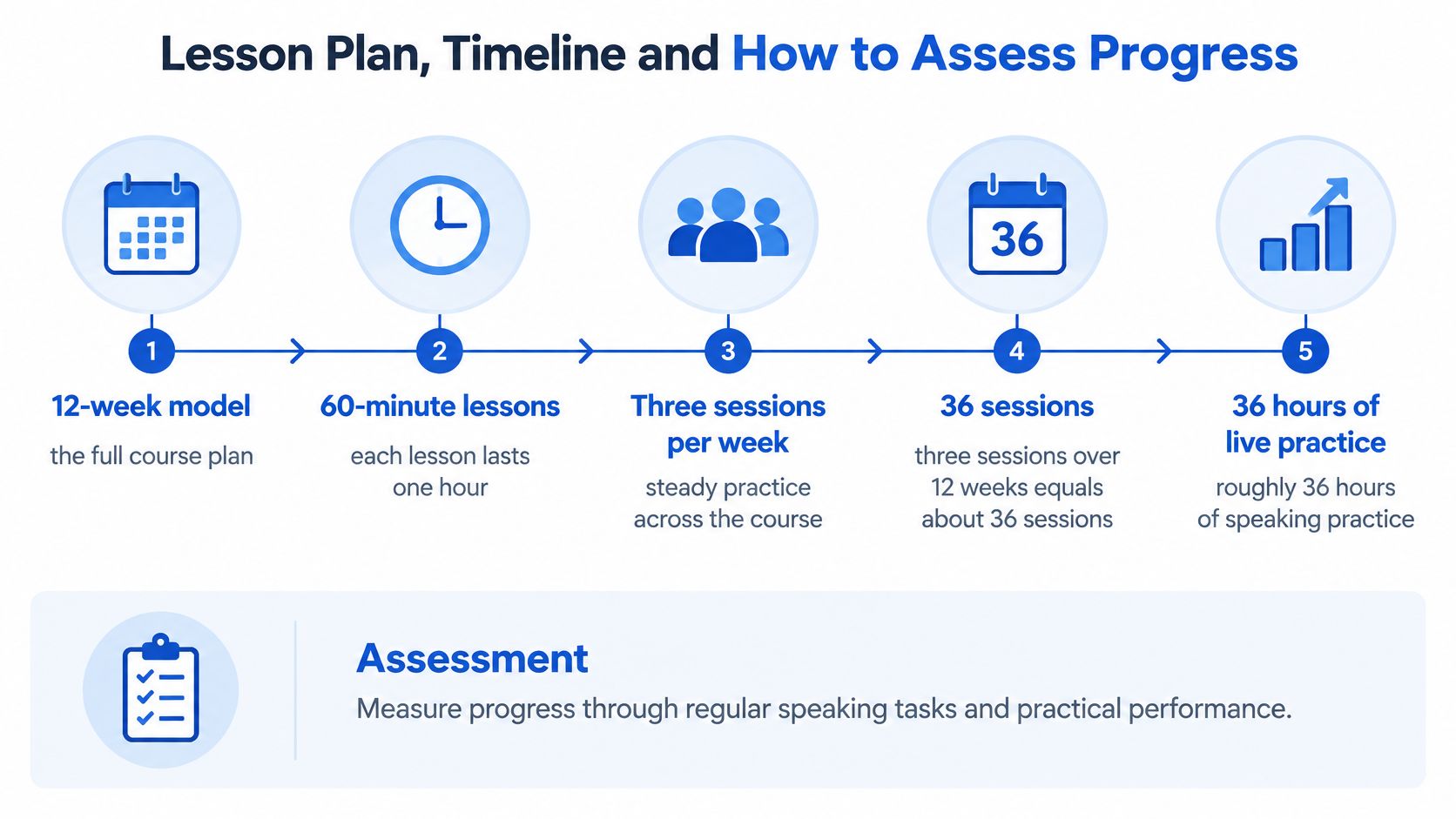
A suggested 12-week model, using 60-minute lessons three times per week, produces 36 sessions, or 36 hours of live practice. That's a planning calculation, not a promise of a CEFR-level increase or a fixed amount of individual speaking time.
12-Week Business English for HR Plan
All durations below are proposed classroom tasks.
| Weeks | Focus | Speaking task | Assessment |
|---|---|---|---|
| Weeks 1 to 3 | Interviews and onboarding | 10-minute mock competency interview; 10-minute onboarding talk | Question-type checklist and onboarding talk rubric |
| Weeks 4 to 6 | Emails, meetings and performance reviews | Chair a 20-minute team meeting; deliver a two-goal review | Meeting summary with owners, and review scored on the five criteria |
| Weeks 7 to 9 | Difficult conversations | Salary or attendance role-play with observer | Observer scoring sheet for neutrality and summary completeness |
| Weeks 10 to 12 | Inclusive decisions and AI-supported communication | Explain a screening result and handle follow-up questions | Integrated simulation and comparison with the initial performance sample |
Online interaction deserves deliberate practice. The Council of Europe's CEFR classroom-task guidance describes B2+ learners negotiating conditions, explaining complicated details and politely repairing misunderstandings in online exchanges, abilities directly relevant to remote onboarding and virtual HR briefings.
Agree on the rubric before teaching
Use these five criteria, with the same achieved, partly achieved and not yet achieved bands used by observers:
- Accuracy: Policy details, facts and commitments remain correct.
- Clarity: The listener can follow the explanation without unnecessary effort.
- Register: The tone fits the relationship and sensitivity of the topic.
- Questioning technique: Questions elicit relevant information without directing the answer.
- Confirming understanding: The learner checks meaning and resolves uncertainty.
For weeks devoted to difficult conversations, retain the existing observer sheet as supporting evidence. Map neutrality to register, paraphrasing to clarity, and summary completeness to confirming understanding rather than introducing competing scores.
Choose starting tasks through a needs discussion with employees and managers. LearnStream's guidance on how to design training around employee needs can support that discussion; an English course for employees should reflect the team's actual responsibilities.
Use session recordings and written learner reports to document specific changes, such as fewer unsupported assumptions or more complete action summaries. Obtain consent, control access and use fictional or anonymized cases rather than recording sensitive employee matters for classroom review.
Tips for Moroccan HR Teams and How to Start
For Moroccan HR practitioners working in multilingual organizations, a day may involve French, Arabic, Darija and English. The challenge is preserving the same meaning when explaining eligibility, approval, responsibility or an exception, whichever language the conversation started in.
A practical approach is to build a bilingual working glossary from approved company documents. Keep the English policy phrase beside its French equivalent, then add a plain-English explanation and a fictional employee question. Include the agreed inclusive alternatives as well, so nobody improvises wording during a live conversation. If a draft comes from an AI tool, compare it against the approved version before adding it. When an approved translation of legal or contractual wording exists, use that version rather than translating on the spot.
Make practice resemble the working day
- Pair policy phrases. Put key English wording next to the approved French version. Flag terms that do not translate neatly for internal clarification.
- Rehearse on the tool. Practise on the video platform used for remote interviews, such as Google Meet. Include connection checks, screen-sharing transitions and interruptions.
- Prioritize spoken tasks. Rehearse interviews and reviews aloud, then address the grammar errors that affect those performances.
- Define the finish line. Give each rehearsal an observable outcome, such as a policy explained in five minutes or a disagreement closed with agreed actions.
- End with a live summary. Ask a participant to restate the decision and their responsibility, then correct any mismatch immediately.
Choose the right starting format
Start with the free placement test to identify a suitable level, then use the free trial session to experience the teaching approach. Bring one real task, such as an interview prompt or a policy paragraph you use often, so the discussion stays connected to your work.
Small-group classes suit colleagues with shared tasks who need interaction practice. Private lessons allow closer attention to an individual's pace, responsibilities or sensitive communication needs.
Live online sessions on Google Meet and written learner reports can make practice easier to revisit between lessons. Whatever format you choose, tie each session to a task on your calendar so rehearsal feeds directly into live work.
Englify offers live online Business English classes through Google Meet, with small-group and private options and personalized content for workplace communication. Take the free placement test to identify your starting level and discuss the HR tasks you need to perform more confidently.