Knowledge hub
English for Hotel Staff: A Ready 10-Week Lesson Plan
English for hotel staff training: core vocabulary, CEFR levels, sample dialogues and a 10-week online lesson plan for Moroccan hotel teams.
A guest arrives tired, speaks quickly, and asks to change rooms before dinner because the air conditioning kept her awake. You know the standard greeting, but the next sentence is harder. You need to ask what must stay the same, when the move has to happen, and whether noise or bed type matters most, without promising a room you haven't checked. That's where practical English for hotel staff differs from general English. It's not about learning long dialogues by heart. It's about handling a task accurately, politely, and under pressure, then confirming every date, name, and room number before the guest walks away.
Table of Contents
- CEFR Levels Each Hotel Role Needs
- Core Phrases for Reception, Housekeeping and F&B
- Sample Dialogues and Classroom Role-Play Activities
- Handling Complaints and Refusals Without Admitting Fault
- A 10-Week Lesson Plan for Hotel Teams
- Tracking Progress With Assessments and Reports
- Group or One-to-One Online Training for Moroccan Teams
- Frequently Asked Questions About Hotel English
CEFR Levels Each Hotel Role Needs
Match each employee to a target before you choose lessons, phrases, or groups. CEFR, the Common European Framework of Reference, is a shared scale from A0 for a complete beginner to C1 for advanced use. Our English courses cover A0 to C1, and you can read the scale in detail in our guide to CEFR English levels. The levels below are planning targets, not fixed industry standards. Use them to spot gaps, then confirm each person's starting point.
| Role | Core tasks | Target CEFR level |
|---|---|---|
| Front desk, everyday service | Check-in, check-out, room requests, directions | A2 to B1 |
| Front desk, phone and formal written work | Telephone reservations, complaints, formal emails | B2 or higher |
| Housekeeping | Room status, guest requests, reporting to supervisors | A2 to B1 |
| Food and beverage | Taking orders, allergies, bill questions | A2 to B1 |
| Guest relations and supervisors | Explaining policy, handling escalations | B1 to B2 |
Why the Front Desk Sits Higher
The front desk handles the widest range of tasks in live exchanges, often with no visual clues on the phone. An ERIC study of hotel front-desk staff reported that taking reservations by phone, resolving complaints, and writing formal emails often required B2-level competence or higher. The same study rated receiving and resolving complaints at a mean of 3.40, promoting and selling products or services at 3.32, and providing concierge services at 3.30, which shows that these aren't simple greeting tasks.
Housekeeping and food and beverage work is still guest-facing, but the language repeats more often. Staff report room status, respond to towels or cleaning requests, take orders, and check allergies using a narrower set of phrases. That predictability is why A2 to B1 can work as a practical target, provided employees can clarify, repeat details back, and report problems clearly to a supervisor.
How to Use the Table
Build everyday service language first, then add the harder speaking, listening, and writing needed for complaints and telephone bookings. Customer service English is taught at A2 level and above, and the free placement test confirms the learner's level. That matters in Morocco, where most English-speaking support jobs expect a B1 to B2 level.
Planning rule: Match the person to the row, write down the current level, and name the gap. A housekeeper at A2 and a receptionist aiming for phone work at B1 don't need the same next ten weeks, even if they work in the same hotel.
Ask each team member to do that matching exercise now. You'll then know who needs confidence with predictable requests, who needs telephone practice, and who needs the language to explain policy when a guest asks for something the hotel can't approve.
Core Phrases for Reception, Housekeeping and F&B
A guest arrives at 11 p.m., says "Collins, two nights, quiet if you can," and starts toward the lift. The receptionist has a few seconds to greet, catch the name, and check the dates before the wrong room is given out. That moment is an operational task, not a memorised welcome.
A study of 26 hotel employees found that 86.4% of participants, 19 employees, agreed that English was mostly needed at the front desk. The same study showed wide differences inside one team. That finding describes where English is used most. It does not mean one phrase list fits every job. Plan phrases by task: check-in, room status, orders, and a clear limit when a request cannot be approved.
Reception Phrases That Prevent Errors
Work through check-in in the same order every time. A phrase works like a key card: it only opens the right door after the room number matches.
- Greeting and identity check: "Good evening, welcome. May I have your name and room number?"
- Confirming dates: "So that is a double room from 12 to 15 March, is that right?"
- Room request: "Would you like a quiet room, or is it more important to stay on this floor?"
- Directions: "Take the lift to the second floor, then turn left."
Training covers natural-sounding greetings and identity checks rather than memorised scripts, because a guest rarely gives the answer rehearsed in class. A greeting only helps if the employee follows it with a question about the missing detail. If the guest's English is limited, slow down and offer a choice: "Quiet room, or lower floor?"
When the hotel cannot approve a request, name the limit and the alternative together. "We have no connecting rooms tonight. I can offer two rooms on the same floor." That states a limit. It does not admit a fault the hotel has not accepted.
Housekeeping and Food and Beverage
Housekeeping language is shorter and repeats. "Would you like us to clean the room today, or should we leave the sign on the door?" gives a real choice. "I will come back in ten minutes" adds a time the guest can check. A missing item goes to a supervisor as a full sentence: "Room 204 has no towels on the top shelf."
In food and beverage, accuracy protects the guest and the kitchen. Confirm the order back. If an allergy comes up, ask "Does this dish contain nuts?" Explain a bill item by naming the dish, the quantity, and the price in a calm voice. For a guest who is not confident in English, point to the line on the bill as you say it. Conference teams who confirm headcounts and dietary needs before service can also follow separate planning guidance to reduce food waste at hotel events, because kitchens over-cater when those numbers stay vague.
A phrase is only useful when the staff member can adapt it. A check question such as "Do you mean...?" prevents most errors.
Across departments, practise "Could you repeat that, please?", spelling names letter by letter, and reading numbers and dates back before acting. Finish each department set with a one-page phrase card. Staff use the card while learning the task, then handle the same task when one detail changes, such as a different date or a nut allergy.
Sample Dialogues and Classroom Role-Play Activities
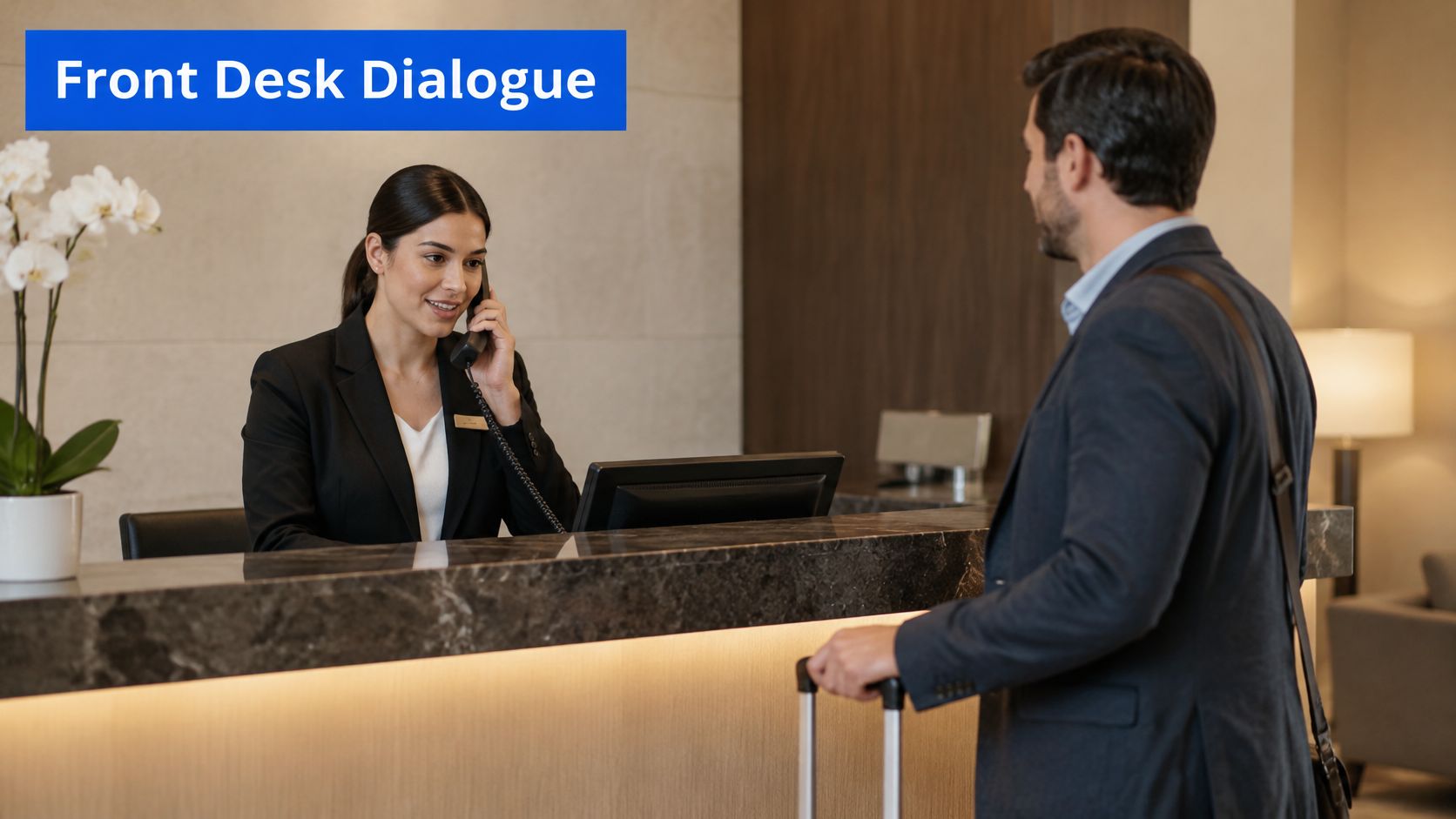
Use these dialogues as models, then change one detail so staff can't rely on memory alone.
Dialogue 1 Reservation at the Front Desk
Guest: I'd like a room for two adults from Friday, for three nights. Staff: Of course. That's Friday to Monday for two adults. May I have your name, please? Guest: Sara Collins. Staff: Thank you. Could you spell your family name, please? Guest: C, O, L, L, I, N, S. Staff: Thank you, Ms Collins. Would you like to pay by card? Guest: Yes. Staff: So that's a double room for two adults, three nights from Friday, and I'll repeat the total before we confirm payment. Is that correct?
Dialogue 2 Housekeeping Request
Guest: Could we have extra towels? Also, the Wi-Fi password doesn't work. Staff: Of course. That's extra towels, and the Wi-Fi password isn't working. How many towels would you like? Guest: Two, please. Staff: I'll bring two towels within ten minutes and check the Wi-Fi details for your room.
Four Activities That Build Transfer
- Information-gap role-play: Each partner holds half of a booking form, so questions are necessary, not decorative.
- Listening drill: Use short recordings with fast speech and different accents, then ask trainees to write the room number, date, and request.
- Timed simulation: Confirm a room number, date, and name within 60 seconds.
- Written reply practice: Answer a guest email so the key answer appears in the first two lines.
A case study of employees in four established hotels found that speaking and listening were considered the most important skills, yet also the most difficult, particularly in live interactions with guests. That's why drills should focus on operational scenes, varied accents, and clarification, not isolated vocabulary lists. Written support training covers short chat replies and email that answers in the first two lines. Accent work focuses on clarity, meaning speed, word stress and the specific words customers ask agents to repeat, not on replacing the learner's accent.
Score each role-play on accuracy of details, use of a clarifying question, politeness, and recovery after a misunderstanding. If a trainee gets the date wrong but notices and repairs it, mark the repair. In real service, recovery is part of the skill.
Handling Complaints and Refusals Without Admitting Fault
Complaint handling isn't a three-line script that ends after an apology. The language changes when the answer is no, when the problem can't be fixed immediately, or when the employee doesn't have authority to approve compensation.
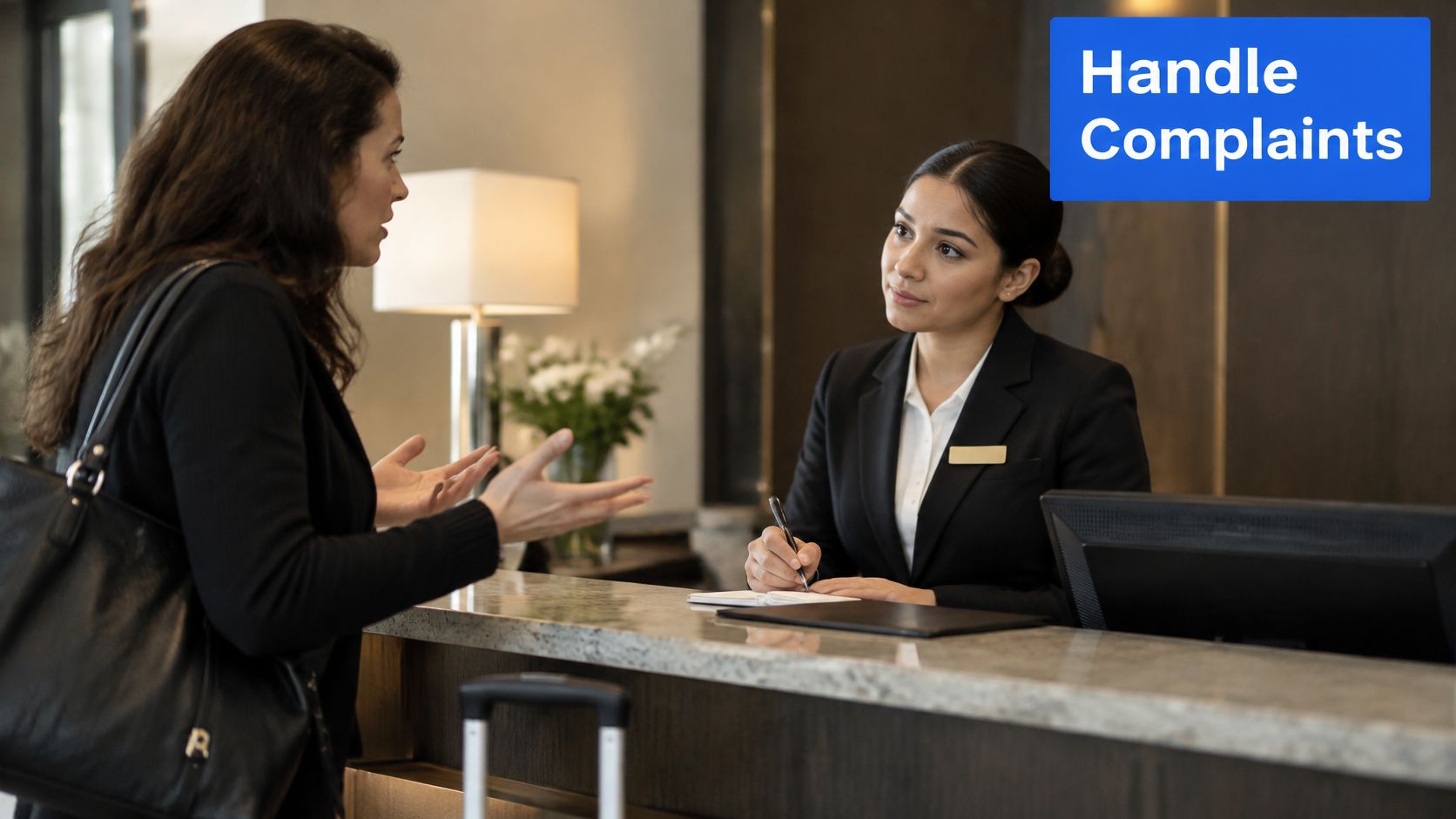
Use this sequence. Listen without interrupting, clarify the problem, acknowledge the concern, explain the available solution, and escalate when you lack authority.
- Acknowledge: "I understand the room is not what you expected."
- Apologise for impact: "I am sorry this has happened during your stay."
- Explain a refusal: "Our policy is that the late checkout fee applies, but let me check whether I can offer something else."
- Escalate: "I will ask my manager to look at this and call you back shortly."
Our customer service course covers greetings, active listening, apologising for impact without admitting a fault the company has not accepted, explaining delays or refusals, and de-escalating angry customers. If you want more language for heated moments, our guide on handling angry customers in English gives additional calming phrases.
Practise Five Difficult Situations
Practise a noisy room, Wi-Fi failure, overbooking, billing dispute, and delayed maintenance. For each one, prepare three versions. A calm guest can hear a fuller explanation. An upset guest needs shorter sentences and a time for the next step. An aggressive guest needs a slower pace, a firm boundary, and a polite close, such as "I want to help with this. I'll check now and call your room in ten minutes."
Culture changes how those lines land. A 2025 hospitality study found that 50.8% of surveyed guests believed cultural differences influenced their stay, while only 40.9% rated communication positively. Don't assume silence means agreement or directness means rudeness. Check meaning with "Do you mean the room was too warm?" The same careful listening applies in other guest settings, including handling hygiene concerns in fitness facilities, where staff must clarify the concern before acting. When shared vocabulary is limited, confirm key facts in writing as well.
A 10-Week Lesson Plan for Hotel Teams
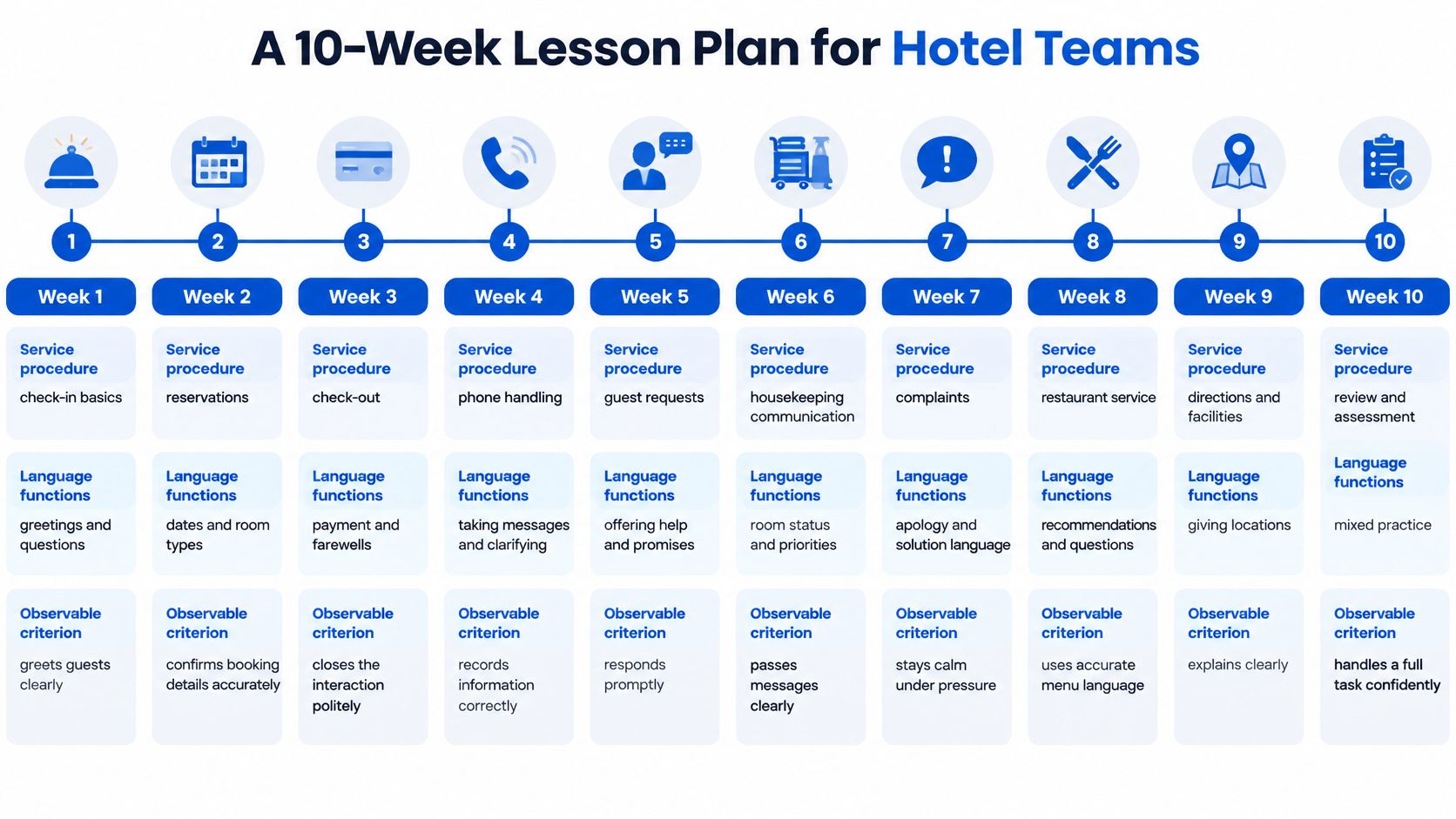
Read the plan as tasks, not topics. Each block combines one service procedure, the language functions it needs, and one observable output.
| Weeks | Focus | Practical output |
|---|---|---|
| 1-2 | Greetings, identity checks, check-in questions | Complete a check-in role-play |
| 3-4 | Reservations, dates, room numbers, spelling names | Confirm a booking with no errors |
| 5-6 | Housekeeping and food and beverage requests, directions | Take an order and give directions |
| 7-8 | Complaints, apologies, refusals | Handle a noisy-room complaint |
| 9-10 | Telephone calls, internal coordination, final practice | Pass a timed mixed role-play |
The Logic Behind the Plan
Early weeks build the high-frequency language most guests hear first. Staff learn to greet, check identity, ask check-in questions, and confirm the answer before moving on. Weeks 3 and 4 add the details that cause expensive mistakes, including dates, room numbers, occupancy, spelling, and payment details. A reservation isn't complete because a trainee sounded polite. It's complete when every booking detail is accurate.
Weeks 5 and 6 widen the work across departments. Housekeeping staff practise room status and guest requests, food and beverage staff practise orders and allergies, and everyone practises directions and recommendations. Weeks 7 and 8 then add pressure, because complaints, apologies, and refusals require judgement as well as vocabulary. The final block brings in telephone calls, messages to colleagues, and a timed mixed role-play that resembles a real shift.
Research on hotel and resort employees reported a 30% increase in average English scores after structured training, according to a study on task-based hotel English training. Treat that figure as evidence from another context, not a promise for your hotel. Measure your team against its own starting baseline.
As a planning assumption, three 60-minute sessions a week give about 30 hours of live practice over ten weeks. A suggested split is about 60 percent speaking, 20 percent listening, and 20 percent written replies. Run a role-play at the end of every second week, and move a trainee forward only after they meet that block's criterion. If levels are mixed, split the team into two groups using the level table rather than slowing everyone to the same pace.
Tracking Progress With Assessments and Reports
A night supervisor opens the shift list with one practical question: can this receptionist take a phone reservation alone, or does someone need to stand beside them? Assessment answers that question with evidence from the task, not with a general impression that the person speaks well. Three layers, used in order, make that evidence visible to the trainee, the trainer, and the manager.
Three Assessment Layers
Start with a placement check. Englify's free CEFR placement test, which includes a spoken part, gives each trainee a baseline before anyone shares a complaint lesson. A confident speaker and a beginner do not belong in the same refusal practice. Record the CEFR level, then add task evidence: can they spell a guest name, and can they confirm dates on the phone?
Weekly observation comes next. Score the role-play against that week's criterion. A reservation counts as correct only when dates, occupancy, guest name, and payment details are all confirmed. A housekeeping exchange counts when the request is repeated back, a clarifying question is asked, and a time is given. If one of those pieces is missing, the task is unfinished, however polite the tone was.
The third layer is an end-of-course timed role-play with a supervisor watching. Mix two tasks. A check-in that turns into a noise complaint shows whether the employee can keep listening, clarify, and escalate when the conversation changes direction. That mixed task is closer to a real desk than a single memorised exchange.
A Simple Scoring Method
- Score each criterion as not yet, developing, or ready.
- Pass a module after two consecutive successful role-plays. Treat that as a planning rule you can adjust for your hotel.
- Record specifics: accuracy of details, use of clarifying questions, pronunciation of problem words, and how fast the trainee recovers after a mistake.
- Write short summaries: one per trainee, and one team summary for the manager. Show how many staff moved up a CEFR band and what still needs practice.
Managers read short reports. Long ones stay in a folder. In Englify's classes, written learner reports and session summaries show what was practised, which criterion was met, and what the next step is. That record still works when the shift changes and a different supervisor needs to see who is ready for phone reservations, who is ready for everyday reception work, and who still needs support with complaint language.
A useful trainee line stays concrete: "Ready on dates and names. Developing on refusals. Next step: one timed noise complaint with a non-native guest." The team summary groups those lines so a manager can staff the desk from evidence rather than from memory of who sounded fluent last week.
Group or One-to-One Online Training for Moroccan Teams
| Factor | Group class | One-to-one class |
|---|---|---|
| Best for | Staff at a similar CEFR level | Supervisors or staff needing focused work |
| Group size | Small group, maximum 6 learners | 1 learner |
| Speaking time per learner | Shared across the group | Full lesson |
| Mixed levels | Harder to manage in one group | Easy to match to the learner |
| Practice with colleagues | Built in | Not included |
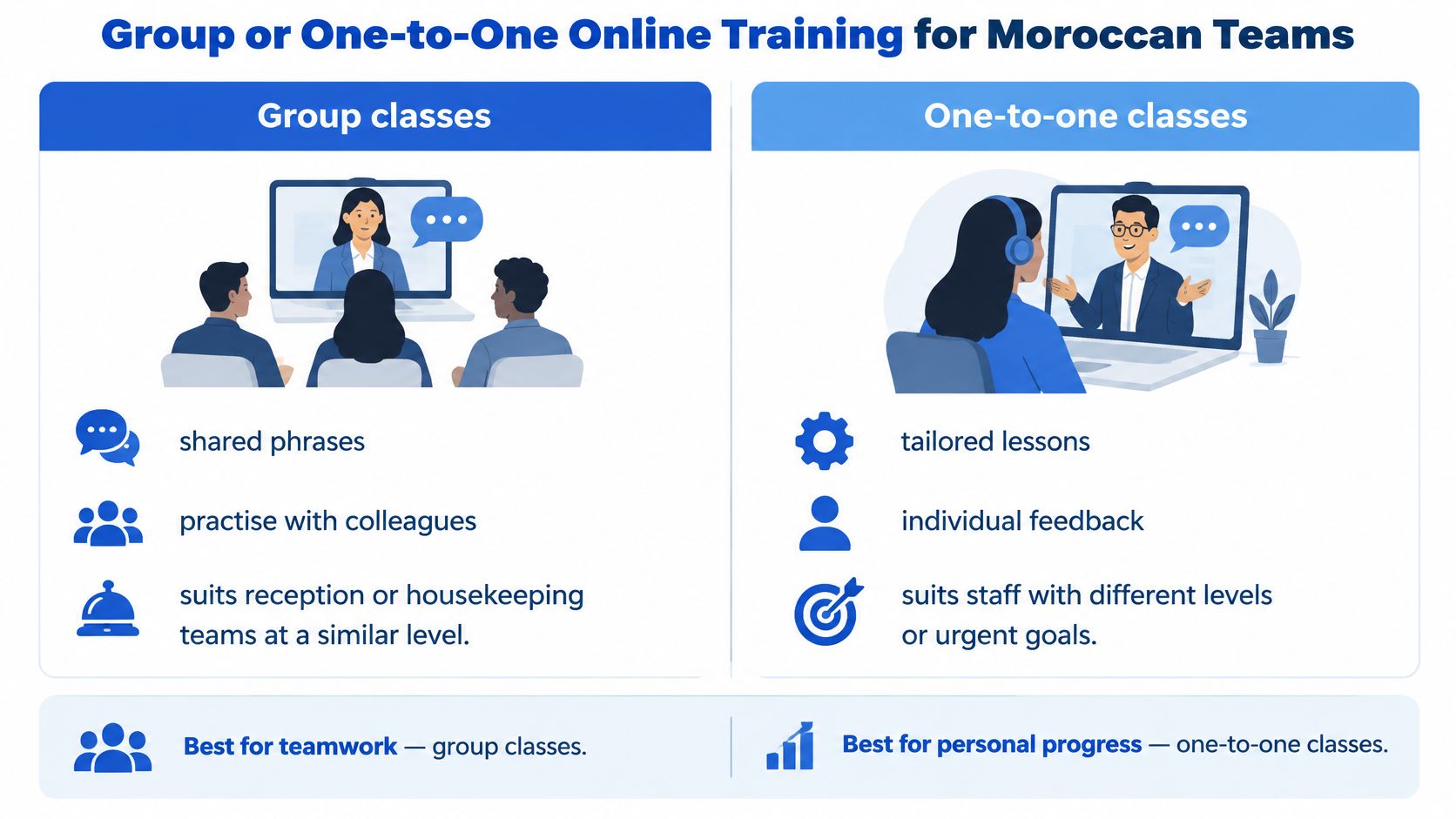
Group classes build shared phrases and let staff practise with colleagues, so they suit reception or housekeeping teams at a similar level. One-to-one classes suit a supervisor, or an employee who needs focused pronunciation or complaint-handling work before a busy season. We run online classes through Google Meet, in small groups and as private one-to-one lessons, for tourism, hotel and airline staff, team leaders and quality analysts, candidates preparing for customer service roles, and companies wanting group programmes.
Scheduling Rules for Either Format
- Book one fixed weekly slot per shift, whether morning, afternoon, or evening.
- Avoid peak check-in hours so the slot doesn't clash with arrivals.
- Check the slot against the duty roster before booking, not after staff have committed.
Reporting Rules
Send the hotel manager a written summary after each session or each week. Cover CEFR progress, the criterion each trainee met, and the next steps. This keeps training connected to staffing decisions, such as who can cover phone bookings next month.
Our teachers speak English, French and Darija, which can help when a Moroccan learner needs a quick explanation before returning to English practice. You can see how this fits wider workplace training in our overview of corporate English training.
Choose group classes for teams at a similar level, because shared practice builds consistent service language. Choose one-to-one for supervisors or reception staff preparing for telephone reservations and complaints, where personal feedback and pacing matter more than colleague practice.
Frequently Asked Questions About Hotel English
What English Level Does a Receptionist Need
A2 to B1 covers everyday check-ins, room requests, and directions. B2 or higher is the planning target for telephone reservations, complaints, and formal emails, because those tasks require faster listening, clearer explanation, and more precise writing.
Can Hotel Staff Learn English Online
Yes. We run live online classes on Google Meet, in small groups or one-to-one. Online delivery works well when lessons are built around role-play, listening to different accents, and written replies, rather than recordings that staff watch alone without feedback.
Which Team Should Start First
Start with the front desk. It's usually the most English-heavy role, and improving reception language affects check-in, reservations, complaints, directions, and payment questions. Add housekeeping and food and beverage once you've placed those staff by level and task.
Should We Choose Group or Private Classes
Group classes suit teams at a similar level who need shared phrases and practice with colleagues. One-to-one classes suit supervisors or staff needing focused work on pronunciation, telephone skills, or complaints. Mixed levels are the main reason to split a team.
How Do We Know Someone Is Ready
A trainee is ready when they meet the criterion in two consecutive role-plays and pass the final timed role-play. Readiness means the details are accurate, a clarifying question is used when needed, and the employee can recover after a misunderstanding.
Take our free CEFR placement test to set a baseline for each team member, then book a free trial session to see the lessons, role-plays, and reports before committing.
Build confident, guest-ready English for hotel staff across your hotel or riad with our live online lessons on Google Meet, shaped around check-in, reservations, housekeeping requests, complaints, and clear progress reports for managers. Visit Englify to take the free placement test, book a free trial session, and place every team member at the right CEFR level before training begins.