Knowledge hub
English for University Students: A Complete Guide
Master English for university students with practical strategies for academic writing, reading, and presentations. Boost your confidence and succeed in your

English for university students requires four academic skills at roughly CEFR B2: understanding lectures, taking effective notes, writing structured essays, and participating confidently in seminars. In England, international students represented 22.2% of all students, around 501,000 people, in 2020–21, so academic English support matters especially in multilingual university classrooms.
You may already understand everyday English, follow films, or perform well in a general English exam. Then your first university lecture begins. The professor speaks quickly, introduces unfamiliar terminology, refers to a reading you only partly understood, and expects you to write notes while identifying the main argument. You recognize most individual words, but the meaning still slips away.
That experience doesn't mean you aren't intelligent or hardworking. It usually means general English and academic English are different tools. University study demands faster listening, formal writing, discipline-specific vocabulary, critical reading, and the confidence to speak when your answer isn't perfect. For Arabic-speaking learners, the transition can feel sharper when the language of instruction changes from familiar classroom English to English-medium lectures, seminars, laboratory work, or research writing.
Table of Contents
- Why University English Feels Different
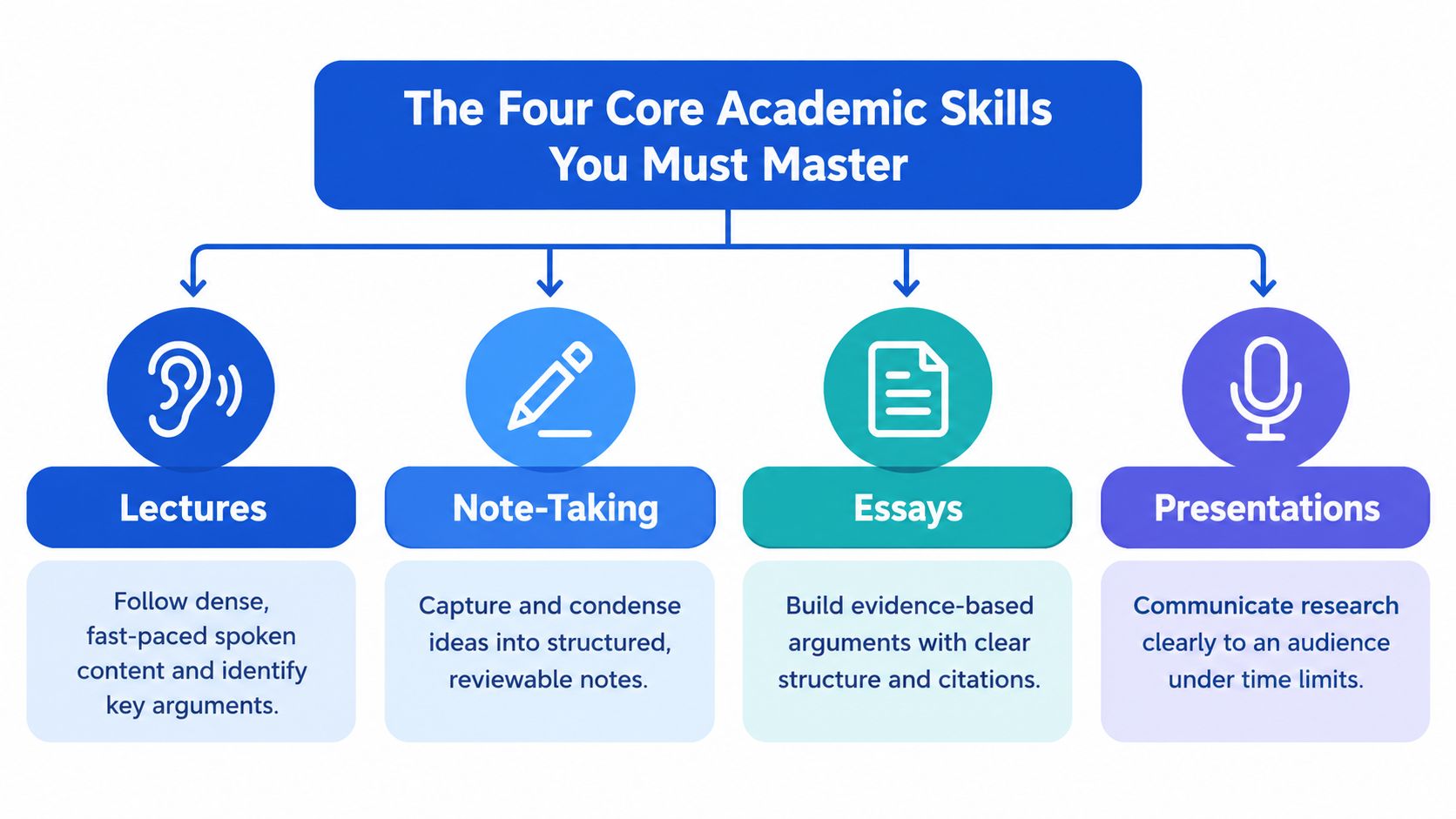
- The Four Core Academic Skills You Must Master
- Practical Strategies for Lectures and Note-Taking
- Writing and Presenting with Academic Confidence
- Understanding CEFR Levels for Academic Progress
- Choosing the Right Learning Approach for Your Goals
- Your 90-Day Academic English Progression Plan
Why University English Feels Different
A first-year student may arrive with strong grammar knowledge and a useful conversational vocabulary. In the first lecture, however, the professor might say:
“Today we'll examine the relationship between institutional power and social mobility, then evaluate two competing interpretations of the evidence.”
This sentence goes beyond testing vocabulary. The student must recognize the topic, understand the relationship between ideas, identify the academic verbs, and predict what information deserves a place in the notes. A conversation about weekend plans rarely requires that level of concentrated processing.
University English also uses a different register. Students need to distinguish between “This proves the idea is wrong” and “This evidence challenges the assumption.” The second version is more cautious and more suitable for academic discussion because it separates evidence from personal certainty.
The hidden demands of an EMI classroom
In an English-medium instruction classroom, the lecturer may not stop to translate every technical term. A psychology student could hear “cognitive bias,” “reinforcement,” and “working memory” in the same explanation. An engineering student may need to understand “load distribution,” “failure point,” and “experimental conditions” before writing a report.
A recent study of first-year students in Hong Kong identified language difficulties across writing, reading, speaking, and listening, including problems with vocabulary, academic and technical terminology, and exposure to different varieties of English. The findings are relevant to any learner entering an EMI or EAP environment because the challenge isn't only speaking more. Students must process specialized language quickly and use it accurately in their own work. You can read the study on language difficulties among first-year university students.
For students from Arabic-speaking backgrounds, this may involve moving between Arabic, French, and English terminology. Translation can help you understand a new concept, but translating every word during a lecture is too slow. A better habit is to capture the English term, add a short definition, and connect it to an example.
Why this matters beyond the classroom
Academic English affects more than examination results. It shapes whether you can ask a useful question, contribute to a seminar, understand feedback, contact a lecturer, and explain your research to another student. In England, international students made up 56.1% of full-time postgraduate students and 17.9% of full-time undergraduates in 2020–21, according to the higher-education enrolment dataset. Presentations, dissertations, seminars, and group projects therefore serve a large population studying in English as an additional language.
If you're preparing for university in Morocco, studying abroad, or already struggling with English-medium coursework, read this practical guide to English for university in Morocco. The key question isn't “How can I study harder?” It's “Which academic task is causing the breakdown, and which language skill will repair it?”

The Four Core Academic Skills You Must Master
University success depends on a connected system of skills. Listening affects note-taking. Notes become evidence for essays. Essays often become the foundation for presentations. If one part is weak, the other parts require more effort.
Official higher-education statistics recorded 546,110 full-time students, 75,870 part-time students, and 25,240 apprentices entering undergraduate education in England in 2021–22, with 70.4% of entrants under 21. These large cohorts include many students moving directly from school-style learning into unfamiliar expectations for academic reading, writing, and speaking. The Office for Students statistical overview illustrates why academic English is foundational rather than an optional extra.
Lectures require active listening
A lecture isn't an audio recording that you must transcribe. Your task is to identify the structure:
- Main argument: What is the lecturer trying to demonstrate?
- Evidence: Which study, example, quotation, or observation supports the point?
- Contrast: Is the lecturer comparing two theories or interpretations?
- Direction: What does the lecturer want you to read, question, or apply?
Listen for signal phrases such as “the central issue is,” “in contrast,” “this suggests,” and “the evidence indicates.” These phrases help you follow the argument even when individual vocabulary is unfamiliar.
Note-taking turns sound into usable knowledge
Effective notes are shorter than the lecture and more organized than a transcript. They should preserve key concepts, relationships, examples, and questions that you can revisit later.
For example, instead of writing:
“The lecturer says social media affects political participation because many people use it and there are different opinions about this.”
Write:
- Social media and political participation
- Increases access to political information
- Does not guarantee informed participation
- Debate: access versus quality of engagement
- Question: how is participation measured?
The second version is faster to write and more useful when you begin an essay.
Essays make your reasoning visible
Academic writing asks you to do more than present information. You need a position, a logical structure, relevant evidence, and language that shows the strength of each claim. A strong paragraph normally moves from a point to evidence, then explains why the evidence matters.
“Online learning is useful” is too broad for most university work. “Online learning can widen access to instruction when students have reliable technology and structured support” gives the reader a clearer claim that can be examined.
Presentations combine language and performance
A presentation tests pronunciation, organization, timing, visual explanation, and audience awareness at the same time. You need to introduce the topic, guide listeners through your argument, explain evidence, and respond to questions without reading every sentence from a slide.
Needs-analysis research in academic English shows that speaking and writing are often heavily used in coursework while remaining weaker than receptive skills such as reading and listening. One EAP study reported speaking as the most frequently used academic skill and also the area with the largest competence gap, with speaking and writing ability below receptive skills in its analysis. The EAP study on academic language needs supports a practical conclusion: students need frequent oral practice and structured writing feedback, not only more vocabulary exercises.
Practical Strategies for Lectures and Note-Taking
Start before the lecture. Read the title, scan the assigned material, and write down three terms you expect to hear. You don't need to understand every detail in advance. Your aim is to create a mental map so new information has somewhere to fit.
Use a three-part note system
The Cornell method works well for English-medium study when you adapt it to academic vocabulary. Divide the page into a wide notes area, a narrow cue column, and a short summary space at the bottom.
During the lecture, write ideas and examples in the main area. After the lecture, place questions or keywords in the cue column, then write a two or three-sentence summary without looking at the slides. This final step exposes gaps in understanding while the material is still fresh.
Use abbreviations consistently:
- Cause and result: use “→” for leads to, “↑” for increases, and “↓” for decreases.
- Comparison: use “vs.” for versus and “=” for a similarity.
- Uncertainty: use “?” beside a term or claim you need to verify.
- Important language: mark definitions with “def.” and examples with “ex.”
Don't abbreviate technical terms the first time you hear them. Write “cognitive load” in full, add a short meaning, and use “CL” later only if the abbreviation remains clear.
Listen for structure, not every word
Lecturers often announce their organization. “First,” “the next point,” “however,” “for example,” and “to conclude” tell you how ideas relate to one another. When you hear “this is important because,” stop trying to copy the previous sentence and prepare to capture the explanation.
If a lecturer speaks too quickly, leave a blank space and write a keyword. You can check the recording or textbook later. A missed phrase is less damaging than missing the next three minutes because you were trying to reconstruct one sentence.
Separate terminology from translation
Create a vocabulary record with four columns:
| English term | Short meaning | Example from your subject | Arabic or French support |
|---|---|---|---|
| Validity | Whether a test measures what it should measure | Validity of a survey instrument | Your preferred translation |
The English term should remain visible because you'll need to recognize it in lectures, readings, and exam questions. Translation is a support, not a replacement for using the academic word.
After class, spend a few minutes turning notes into questions. “What is validity?” is useful. “Why might a survey have reliability but low validity?” is better because it prepares you to apply the concept.
Writing and Presenting with Academic Confidence
Writing and speaking become easier when you replace vague confidence goals with repeatable language patterns. You don't need to sound like a professor. You need to make your meaning clear, show how your evidence supports your claim, and signal what your audience should notice.
Build an essay around an argument
Before drafting, write one sentence that answers the assignment question. Then create three supporting points and attach evidence to each one. A paragraph can follow this sequence:
- Claim: State the paragraph's main point.
- Evidence: Refer to a source, example, result, or concept.
- Analysis: Explain how the evidence supports your claim.
- Link: Connect the paragraph to the essay question.
Avoid treating quotations as a substitute for analysis. Introduce a quotation, explain its relevance, and then interpret it in your own words. Use cautious language where the evidence doesn't justify certainty:
- “This proves that” becomes “This suggests that.”
- “Students always prefer” becomes “Some students may prefer.”
- “The theory is wrong” becomes “The theory may not explain this result fully.”
This kind of hedging isn't weakness. It shows that you understand the limits of evidence.
Make presentations easy to follow
Use signposting to guide listeners:
- “I'll begin by defining the central concept.”
- “The second point concerns the evidence.”
- “This example matters because it shows…”
- “I'll now compare these two explanations.”
- “To conclude, the main implication is…”
A slide should support your speech, not compete with it. Put a short heading and key phrases on the slide, then explain the relationship aloud. If the audience must read a full paragraph while listening to you, they may miss both.
For questions, you can pause without apologizing. “That's an important distinction. My answer would be…” gives you time to organize your response. If you don't know, say, “I haven't examined that point, but based on the evidence I used, I would suggest…” Academic confidence includes honest boundaries.
Map progress to real tasks
At an emerging level, you may understand the topic but need a prepared script to speak. At an intermediate level, you can explain a familiar concept, organize a standard essay, and answer predictable questions. At an advanced level, you can compare interpretations, qualify claims, and respond spontaneously to a challenge.

Understanding CEFR Levels for Academic Progress
The CEFR gives students a practical language for describing progress. It organizes proficiency into six levels, from A1 to C2, across three bands: Basic User, Independent User, and Proficient User. The Council of Europe CEFR level descriptions are more useful than vague labels such as “good English” because they describe what learners can do.
What B1 looks like
A B1 learner can understand the main points of clear standard input on familiar matters and handle many everyday situations. The CEFR global scale describes B1 in terms of practical comprehension and communication.
In university, B1 may allow you to follow a well-organized lecture on a familiar topic when the speaker explains ideas clearly. You may write a simple structured response, but complex sources, rapid discussion, and discipline-specific terminology can still overload you. You might participate in a seminar after preparing your answer, while finding spontaneous disagreement difficult.
What B2 looks like
University English requirements are commonly benchmarked around CEFR B2 for undergraduate study, with some institutions requiring higher performance in selected skills. A B2 learner can understand the main ideas of complex texts, interact with some fluency, and produce clear, detailed writing on familiar academic topics, as explained in Coventry University's English requirements.
In practice, B2 is a useful target for standard academic work. You can follow the main line of a lecture, identify supporting points, write a structured essay, and contribute to a seminar without preparing every sentence. You may still need help with fast accents, unfamiliar research articles, subtle disagreement, and precise academic style.
What C1 adds
C1 learners can understand demanding longer texts, recognize implicit meaning, speak fluently and spontaneously, and use language flexibly for academic and professional purposes. At this level, you can compare theories in a seminar, respond to an unexpected question, summarize a difficult reading, and adjust your language for a lecturer, peer group, or formal presentation.
| Skill | B1 | B2 | C1 |
|---|---|---|---|
| Lectures | Follow clear, familiar content | Follow standard lectures and identify the main argument | Handle dense content, implied meaning, and varied delivery |
| Notes | Record basic points and examples | Condense arguments and organize evidence | Capture nuance, qualifications, and competing interpretations |
| Essays | Write connected responses | Develop clear arguments with appropriate support | Synthesize sources and control academic style precisely |
| Seminars | Speak with preparation | Explain opinions and respond to others | Debate spontaneously and qualify complex positions |
A placement test can establish a starting point more reliably than self-confidence alone. One adaptive online test assigns learners across 14 CEFR bands from Pre-A1 to C1 and reports separate scores for Overall, Listening, Reading, and Language Use. A CEFR-based placement test report can help identify whether your main need is lecture comprehension, language accuracy, or productive communication.
For a clearer explanation of the framework, use this guide to English levels and the CEFR.
Choosing the Right Learning Approach for Your Goals
Unstructured self-study can build vocabulary and expose you to English, but academic performance requires more than exposure. You need someone or something to notice whether your notes capture the main argument, whether your essay supports its claims, and whether your spoken explanation is understandable.
Structured practice works because it creates a cycle: attempt the task, receive specific feedback, revise the language, and attempt it again in a slightly different context. Small-group learning can add peer interaction, while private classes can focus closely on an individual weakness.
Research on cooperative learning has associated small-group formats with stronger improvement in listening, reading comprehension, grammar, and vocabulary than traditional teacher-centered classes. The review of cooperative learning studies supports the value of interaction, but the right format still depends on your goal and learning habits.
Compare the two formats
| Format | Best For | Interaction Time | Feedback Type | Flexibility |
|---|---|---|---|---|
| Small group | Seminar practice, discussion, peer learning, general academic development | You speak with classmates and respond to different ideas | Teacher feedback plus peer comparison | Based on the group's schedule and level |
| Private class | A specific weakness, urgent deadline, specialized subject, or presentation rehearsal | Most practice is directed to your needs | Individual correction on language, structure, and delivery | Easier to adapt pace, content, and timing |
Small groups suit students who need to become comfortable speaking in front of other people. A classmate's question may prepare you for the unpredictability of a seminar better than a worksheet can. The risk is that you may remain quiet unless the teacher uses clear turn-taking and gives every learner speaking time.
Private lessons suit students who need targeted correction. You can bring a dissertation paragraph, rehearse a presentation, practice answering questions, or work through a lecture from your field. The risk is that one-to-one practice may not fully reproduce the pressure of a group discussion, so you should include simulated seminar tasks.
Choose according to the problem
Choose small-group classes when your priority is interaction, discussion, and hearing other learners express different ideas. Choose private classes when you have a fixed academic deadline, a highly specialized subject, or a recurring weakness that needs concentrated feedback. Many students benefit from combining independent reading with one of these structured formats.
Englify offers live online English sessions through Google Meet, including small groups, private classes, CEFR-based levels from A0 to C1, session recordings, learner reports, personalized content, a free placement test, and a free trial session. These are practical features to compare with any academic English provider, particularly if you need support with lectures, note-taking, writing, or speaking. For broader guidance on selecting online lessons, see how to learn English online.
Your 90-Day Academic English Progression Plan
Use a 12-week plan that gives every skill a place.
- Weeks 1 to 4: Take a placement test, collect vocabulary from your subject, listen to short university lectures, and write one structured paragraph each week. Record a short explanation of a concept and review your clarity.
- Weeks 5 to 8: Use Cornell notes for full lectures, write complete body paragraphs with evidence and analysis, and join a weekly discussion. At week 8, repeat a comparable listening or writing task and compare organization, vocabulary, and confidence.
- Weeks 9 to 12: Prepare a short academic presentation, rehearse questions, write a complete essay, and summarize a demanding reading. At week 12, review your recordings, notes, and writing against your starting point.
Don't measure progress only by how many words you memorize. Track whether you can identify a lecture's argument, explain a technical term, produce a clear paragraph, and respond to a question without translating every sentence. If the same difficulty remains after repeated practice, seek professional feedback rather than repeating the same self-study routine.
Take the free placement test with Englify to identify your current CEFR level and academic English priorities. You can then book a free trial session and practise lecture listening, note-taking, academic writing, or seminar speaking through live online classes designed around your goals.