Knowledge hub
Online English Classes for Adults: How to Choose
Compare online English classes for adults by format, CEFR level, and speaking support, plus Morocco timing and a free trial.

A large share of non-formal adult learning now happens online or in blended formats, according to the OECD's 2025 analysis. The OECD's 2025 analysis of participating OECD countries found that about 40% of adults take part in formal or non-formal learning during a typical year, and that 34% of non-formal adult-learning activity takes place online, while 14% uses a blended model and 53% is face-to-face. Online English classes for adults sit inside that shift.
Scale still leaves the practical question open. A busy adult needs to know who corrects their speech, what level they are working toward, how much they will talk, and what happens when work, family, or a weak connection interrupts the plan. Ask also whether the class feels safe enough to risk mistakes, and whether missing one week means losing the thread or finding a clear way back. Those supports matter as much as class size, price, or a teacher certificate.
Table of Contents
- What Online English Classes for Adults Cover
- CEFR Levels Adults Can Actually Reach
- Group Private and Recorded Class Formats
- Speaking Practice Without High Pressure
- Conversation Work and Exams in Morocco
- Verify the Provider and Enrol in Six Steps
What Online English Classes for Adults Cover
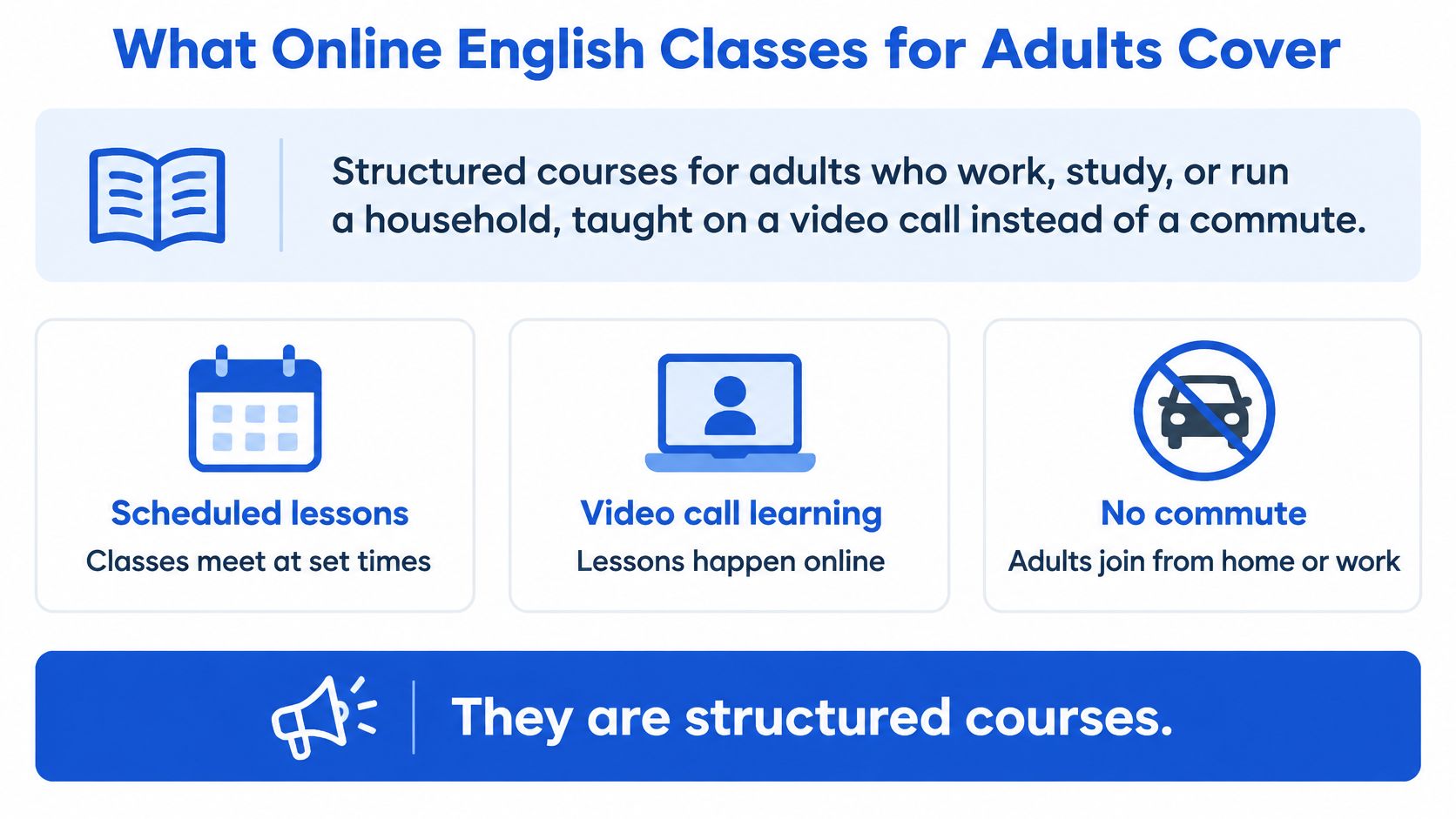
Online English classes for adults are structured courses for people who work, study, or run a household, taught on a video call instead of a commute. A teacher meets you at scheduled times, hears you speak, corrects you live, and records progress against a level scale. That's different from buying access to videos or an app and hoping you'll use them.
Advertisements often blend three separate claims. Separate them before you judge any provider.
- Flexibility: You join from home or work and skip travel time, but a convenient timetable alone doesn't build speech.
- Live correction: A teacher hears your pronunciation, word choice, and grammar as you produce them and helps you repair the sentence.
- A visible level path: Placement, lesson targets, and reports show what you can do now and what comes next.
Flexibility gets you into the room. Correction and a clear path are what change how you speak once you're there.
The Model Used for Learners in Morocco
At Englify, the concrete version of this model is live sessions on Google Meet, organized in three-month terms, in a small group or one to one, aligned to CEFR bands from A0 to C1. You start with a free placement test and a free trial session before payment, so the level and the teaching style are tested, not assumed.
Confirm session length, weekly frequency, term length, and the group cap on the academy's current website before you enrol, because those details decide whether the course fits a real week. College courses make a useful contrast here. If you're comparing academy lessons with formal study, the ClassLecture.ai guide to college English courses explains what English 101 and 102 typically cover, which helps you see that adult speaking classes are built around live use rather than essay units.
Your first real decision isn't a provider name. It's format, and the comparison table in the format section below is where that decision becomes concrete.
CEFR Levels Adults Can Actually Reach
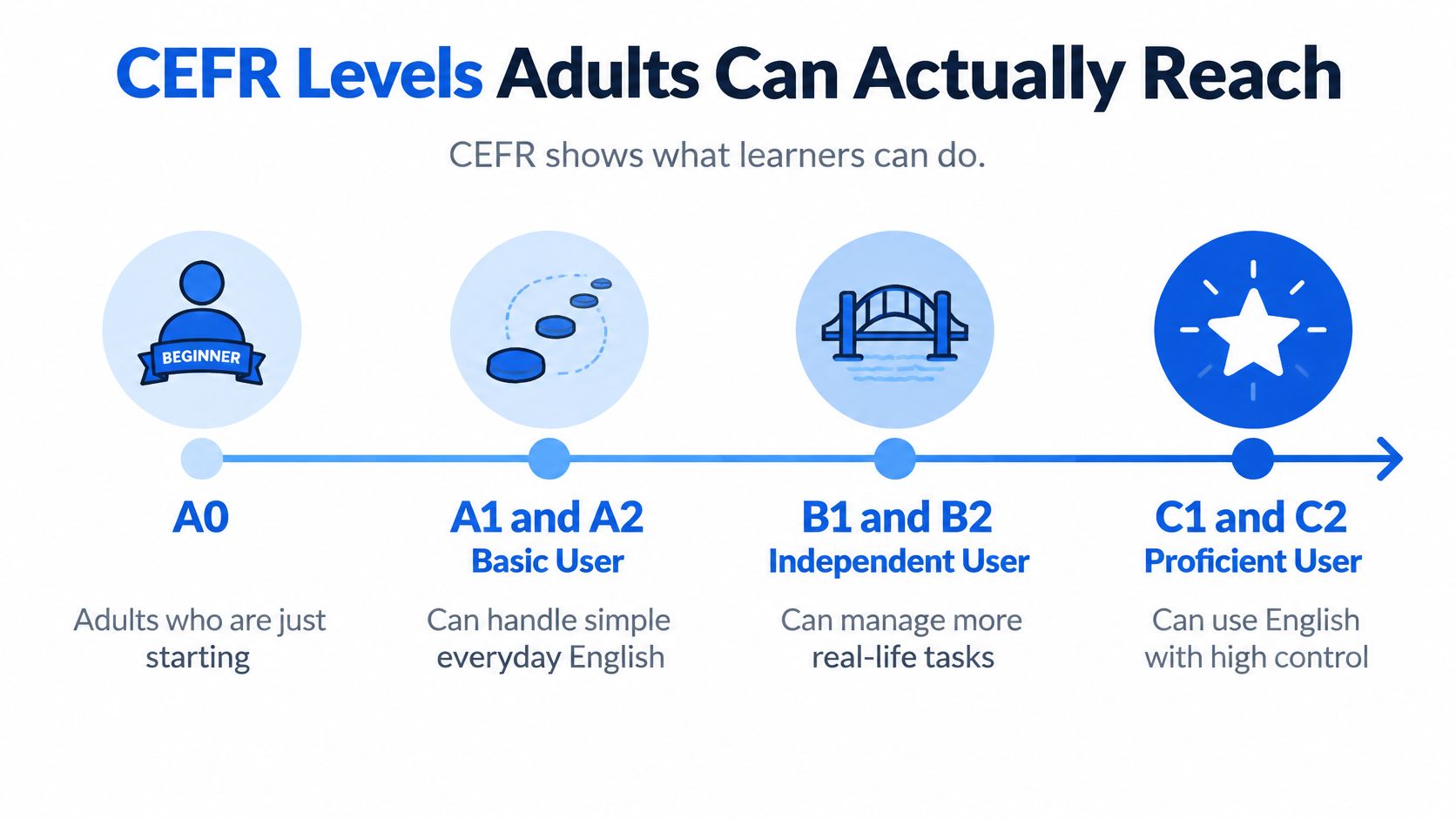
The Common European Framework of Reference for Languages, or CEFR, is a can-do scale, not a pile of grammar chapters. The Council of Europe's CEFR level descriptions divide proficiency into six ascending levels, A1, A2, B1, B2, C1, and C2, grouped as Basic User, Independent User, and Proficient User and defined through "can-do" descriptors.
An academy entry point called A0 sits before A1. It covers sounds, greetings, spelling your name, and the basic confidence to unmute, because A1 tasks don't make sense until you can copy a slow model aloud. C2 exists at the top of the official scale and sits beyond the A0 to C1 range described here.
| Level | Band | Adult can-do | Class focus |
|---|---|---|---|
| A0 | Pre-A1 academy entry | Greet, spell a name, copy a slow model | Sounds, survival phrases, unmuting |
| A1 | Basic User | Meet simple needs if the partner is patient | Routine questions and short answers |
| A2 | Basic User | Handle routine tasks and a simple past event | Travel, shopping, short work updates |
| B1 | Independent User | Describe experiences and manage familiar travel | Prepared meetings and opinions |
| B2 | Independent User | Interact with some fluency on familiar topics | Presentations and spoken summaries |
| C1 | Proficient User | Use English flexibly for social, study, and work purposes | Implicit meaning and spontaneous repair |
Read the table as scenes, not labels. A1 is giving your name and phone number clearly. A2 is handling a shop or clinic exchange and saying what happened yesterday. B1 is giving a short work update without reading it. B2 is joining a prepared meeting and defending a point when someone asks why. C1 is following implied meaning, speaking spontaneously, and adjusting your wording for a social, academic, or professional purpose.
Why One Level Is Rarely the Whole Story
Assessment splits language into reception, production, and interaction. Reception is listening and reading. Production is speaking and writing on your own. Interaction is the back and forth with another person, where you must respond, clarify, and repair misunderstandings.
That split explains a common adult profile. You may read emails at B1 and still be A2 in spoken interaction because nobody has made you answer aloud under mild time pressure. Updated CEFR descriptors also cover online conversation, goal-oriented online transactions, and collaboration, which match a Google Meet lesson better than a written quiz does. A fuller walk through the bands is available in this guide to English levels and the CEFR scale.
Treat a free placement result as a starting band, not a verdict. Judge later progress by tasks you can finish aloud, not by worksheets you've completed.
Group Private and Recorded Class Formats
The format you pick decides how much you speak, who corrects you, and whether the habit survives a busy month. The table shows what each option gives up. Recommendation comes after.
| Format | Best when | Speaking time | Schedule reality | Main risk |
|---|---|---|---|---|
| Live small group | You want peers and a fixed habit | Shared, with assigned turns | Fixed morning, afternoon, or evening slots | Weak placement lets stronger students dominate |
| Private 1-to-1 | Interview, business task, or uneven skills | Nearly the full hour | Can move around shifts | Higher cost per hour |
| Recorded lessons alone | Extra review between real classes | None unless you record yourself | Any time | No correction and easy to stop |
| Live class plus replay access | You may miss a session | Live first, replay second | Fixed live slot plus catch-up | Replay replaces speaking if overused |
A live small group, capped at six in the model described here, gives you peer models and a repeating appointment that protects attendance. You hear how another A2 learner repairs a sentence, which normalizes mistakes and lowers the cost of trying out loud. The format fails when placement is loose. If a B2 speaker sits with A1 learners, the teacher either slows down for one person or lets the confident voice fill every silence. Assigned turns matter more than a friendly atmosphere.
When Private Lessons Earn Their Cost
Private one-to-one lessons, published from 100 MAD per hour, fit a deadline or a narrow task. Say you have an interview in three weeks, or you read well but freeze when a manager asks a follow-up question. The teacher can spend the full hour on your answers, your pronunciation, and your gaps, and the slot can move when a shift changes.
The trade-off is plain. You pay more per hour, and you lose peer practice. For general conversation over a long term, that cost may buy less than a well-placed group. For a specific presentation, business meeting routine, or uneven skill profile, it's often the cleaner tool. A side by side discussion in this comparison of group and private English classes helps if you're torn between the two.
Recorded lessons sit in a different category. They're useful between live sessions for listening again, shadowing a phrase, or reviewing vocabulary before class. As the only plan, they fail for a simple reason. Nobody hears you, so nobody corrects the sound you keep repeating wrong.
Some academies pair a live class with replay access so you can revisit an explanation you missed. Replay policies vary, so ask each provider directly whether recordings are included before you count on them. The model described here runs live classes on Google Meet, where the value sits in the turn where you produce the sentence yourself. A replay shows you the sentence again. It never makes you say it.
Practical rule: Choose private lessons if safety or a deadline matters most, a small group if a repeating slot will keep you attending, and don't buy a long term before a trial shows you how correction feels.
Use your placement band to test group fit. Ask whether everyone in the group sits close enough in level that each learner can speak without the lesson splitting into two speeds. If the answer is vague, the group cap on the website won't save the class.
Speaking Practice Without High Pressure
Yes, online classes can help if you're embarrassed to speak, but only when the first month moves from controlled practice to spontaneous conversation. Throwing an anxious adult into free discussion on day one usually produces silence, not fluency.
More talking isn't automatically the cure. A Cambridge study of foreign language speaking anxiety online reporting research on 307 adult online language learners found that speaking-anxiety triggers are partly specific to synchronous learning, and that breakout rooms themselves could increase anxiety rather than automatically improving participation. A separate 2025 study of 262 language students in the same source found vocabulary retrieval was a common anxiety trigger, and learners with mental-health conditions were more likely to avoid spontaneous speaking or synchronous sessions.

A Safer Speaking Sequence
- Preview the task: The teacher shows the situation and useful phrases before anyone speaks.
- Rehearse briefly: You prepare a short answer, aloud or in writing, instead of improvising cold.
- Make turns predictable: You know when your turn is coming, so you aren't ambushed.
- Correct after the turn: Pronunciation and grammar feedback comes after you finish, or privately, not as a public interruption mid-sentence.
- Raise expectations gradually: Camera and microphone participation increases once you can complete a sentence reliably.
- Treat mistakes as evidence: Errors show the teacher what to teach next. They aren't a performance failure.
Take a work example. Before a real project meeting, you practise one repair phrase until it's automatic: "Could you clarify the deadline?" You hear it, repeat it, use it in a short exchange, then use it when the teacher deliberately gives an unclear date. In the actual meeting, you aren't inventing the sentence under stress. You're retrieving one you've already said.
Convenience and safety are different things. A flexible timetable doesn't help if the first correction humiliates you in front of five strangers and you stop attending. When you speak to a provider, ask how the teacher handles the first correction and the first long silence, not only what times are available.
Conversation Work and Exams in Morocco
Conversation work starts with short, repeatable exchanges. Say you need English for cafés, clinics, travel, and family visits. In class you practise asking for an appointment, explaining a symptom, and repairing a misunderstanding with "Sorry, could you say that again?" The goal isn't a long speech. It's finishing the exchange without switching languages at the first difficulty.
Business English uses different scenes. An employee in Morocco or abroad rehearses a two-minute status update, summarises an email aloud instead of reading it, gives a short presentation, and answers interview questions with a follow-up. Each task maps to a CEFR can-do, so progress is visible in what the person can handle in a meeting.

Exam preparation adds timing and scoring-criteria awareness to the same speaking-first lessons. You practise answering within a set time, organizing a longer turn, and hearing how examiners judge fluency, vocabulary, grammar, and pronunciation. No score is promised, and you should confirm the exact exam routines on offer, including through the academy's IELTS preparation in Morocco page, before you enrol for that purpose.
Why Working Adults Drive Most Demand
The OECD analysis of who is missing out on adult learning shows 51% of adults aged 25 to 34 participate in adult learning within a 12-month period, compared with 43% of those aged 35 to 54 and 26% of adults aged 55 to 65, and 43% of employed adults participate versus 14% of inactive adults. Early and mid-career adults are therefore the core audience for workplace communication, interviews, and presentations. That explains demand. It doesn't promise anyone a promotion.
For Arabic-speaking learners, friction often sits in English stress and rhythm, consonant clusters at the ends of words, and fear of being judged while speaking. Many adults read more easily than they speak because school rewarded written answers. Lessons should name the stuck point directly, drill the sound or pattern, and return to a real exchange.
Local fit matters in practical ways. You join on Google Meet from home, discuss prices in dirhams, and can get a stuck point explained in Arabic, French, or Darija where that support is confirmed. That support should clarify the English, not replace speaking it.
Verify the Provider and Enrol in Six Steps
Adults rarely quit because English is impossible. They quit because the support around the lessons is thin. A 2025 adult-learner study found 55% of participants struggled with self-discipline or motivation, 40% reported technology or connectivity problems, and 35% were concerned about insufficient real-time interaction with teachers or peers. Work and time pressures were the most common participation barrier in the adult-learning research it discusses.
Check any provider against those failure points before you pay.
| Check | What to verify | If it is missing |
|---|---|---|
| Teacher | Stated qualifications and online classroom experience, requested in writing | Corrections stay vague |
| Class size | A stated group cap; confirm the cap on the website before enrolling | Few real speaking turns |
| Schedule | Morning, afternoon, or evening groups, or private rescheduling | Work clashes end the course |
| Technology | Google Meet plus a fallback when bandwidth drops | Lessons become no-shows |
| Price | Full price in MAD confirmed in writing, with the group rate stated before payment | Surprise cost after the trial |
| Trial and placement | Free placement test and free trial before the term | Wrong level from week one |
| Aftercare | Written reports, session recordings, and Arabic, French, or Darija support | Motivation fades after month one |
Enrol in Six Steps
- Take the free online placement test and note the band, including any gap between reading and speaking.
- Book the free trial on Google Meet and judge three things only: how correction feels, whether turns are assigned fairly, and whether the pace lets you finish sentences.
- Choose group or private using the format comparison and your trial notes, not the sales conversation.
- Protect a repeating slot for the term. If your shifts move, choose private lessons instead of pretending a fixed group will work.
- Confirm the MAD price in writing before paying, including what happens after a missed class.
- Review after the first month with the written report and one session recording. Check whether your speaking time and the length of your turns are rising.
If you miss a class, message the teacher, watch the recording, set one speaking goal for the next session, and attend. Don't restart from zero because one week went wrong.
For weak bandwidth, agree on a fallback before the term starts. Turning off your camera for part of a lesson, joining by phone audio, or moving closer to the router can keep a session alive. A provider that has no answer for a dropped connection is selling a platform, not a support system.
If you want structured online English classes for adults with live correction, a CEFR level path from A0 to C1, and a trial before you commit to a term, visit Englify to take the free placement test and book a free trial session on Google Meet. Use that trial to judge your speaking time, the way you're corrected, and whether the schedule survives a normal working week.