Knowledge hub
English Classes for Teens: How to Choose the Right Course
English classes for teens: how to pick the right level, format, teacher and trial, with questions to ask providers and a free placement test.

Your teenager understands the English lesson, copies the grammar correctly, then goes quiet when the teacher asks a simple question. At home, the same pattern repeats. They can read a page, but they won't risk two sentences out loud.
That's the problem most parents are trying to solve when they search for English classes for teens. The monthly price matters, but it's the last check, not the first. Work through the goal, the level, the format, the schedule and the trial in that order, and you'll know quickly whether a course can produce speaking confidence, not just more completed exercises.
Table of Contents
- Name Your Teen's Level and Goal
- Match CEFR Levels to Exam Targets
- Choose Online or In-Person, Group or One-to-One
- Plan Schedule and Budget Around Real Life
- Judge the Teacher, the Method and the Trial
- Frequent Questions About Teen English Classes
- Book a Free Placement Test and Trial
Name Your Teen's Level and Goal
Name the goal first, then check the level, then compare providers. English is already present in most secondary schools, so extra classes only help if they fix a specific gap. The Eurostat foreign language learning statistics reported that 97.6% of pupils in lower-secondary education across the European Union were learning English as a foreign language in 2024. If your teen's already studying it at school, ask why those lessons aren't producing confident speech.
Match The Goal To What You See At Home
| Goal | Class priority | Sign at home |
|---|---|---|
| School grades | Reading, grammar and written tasks linked to schoolwork | Marks drop in English while speaking seems fine |
| Exam preparation | Timed speaking and writing in the exam format | An exam date within the next months |
| Speaking confidence | Talking without memorised answers, with feedback | Understands class but avoids speaking aloud |
| University or work readiness | Presentations, discussion and formal email | Planning to study abroad or apply for part-time work |
If the weakness is written analysis rather than spoken English, look separately at English Literature support for high schoolers and don't expect a conversation class to fix essay marks. The reverse is also true. A grades-focused course won't make a silent teen talk.
Run Four Checks This Week
- Pull the last two English marks. Note which skill drops, reading, writing or speaking, instead of looking only at the total.
- Record a two-minute sample. Ask your teen to describe a recent weekend in English on a phone. Listen for pauses, memorised phrases and one-word answers.
- Write down any exam date. Count the weeks left, because that decides whether you need steady progress or focused exam practice.
- Match your notes to the table. Pick one primary goal, even if a second goal matters later.
Now write one sentence you can give to any provider, such as speaking about school projects without notes by June. Formal CEFR placement comes later. It'll be useful only when you know what the level needs to achieve.
Match CEFR Levels to Exam Targets
CEFR levels describe what a learner can do, not how many years they've studied. A teen can spend four years in school English and still be A2 when speaking, because reading worksheets doesn't prove they can hold a conversation, explain an opinion or react to a follow-up question.
The CEFR Companion Volume published by the Council of Europe introduced a new Pre-A1 level in 2020 and added descriptor scales for phonological competence, mediation and online interaction. That's why a useful report shouldn't stop at beginner, intermediate or advanced. It should say whether your teen can interact online, pass on information clearly and use pronunciation that other people understand. Our levels run from A0 to C1, and this guide to CEFR levels and what each level means in practice breaks down the can-do language behind each label.
Find The Likely Level And Exam
| CEFR level | Typical teen ability | Common exam reference |
|---|---|---|
| A0 complete beginner | Basic greetings and simple personal details | No standard exam, placement test decides |
| A1 beginner | Simple questions and answers on everyday topics | Younger-learner Cambridge exams, for example Movers |
| A2 elementary | Everyday exchanges and short descriptions | Cambridge A2 Key (KET) |
| B1 intermediate | Connected speech on familiar topics and personal opinions | Cambridge B1 Preliminary (PET) |
| B2 upper-intermediate | Extended speech, opinions and discussion | Cambridge B2 First (FCE) and B2 First for Schools |
| C1 advanced | Fluent, flexible and precise speech in most situations | Cambridge C1 Advanced (CAE) |
Watch For A Level And Deadline Mismatch
Say placement puts your teen at solid A2, but the family target is B2 First. That's not a reason to buy more hours of the same general class. The learner first needs B1 skills, connected speech on familiar topics, opinions with reasons and better control of everyday vocabulary. Only then does timed B2 discussion practice make sense.
Ask us, or any provider you're comparing, three direct questions. Is placement given as a CEFR level? Does the report name speaking, grammar, vocabulary, pronunciation and interaction separately? Are mock exams and exam-style speaking tasks included, or sold later?
Practical rule: Confirm the starting level, target CEFR level and deadline in writing before you choose a course.
That single written line protects you from an open-ended course that feels busy but never arrives at the exam your teen needs.
Choose Online or In-Person, Group or One-to-One
Choose a small live group if your teen's comfortable with peers and can keep a fixed weekly slot. Choose one-to-one if they're shy, they have one clear exam goal, or no group timetable fits. Private classes give you a flexible schedule and a programme aimed at one goal, normally an exam date, a job interview, a work situation or a schedule no group fits.
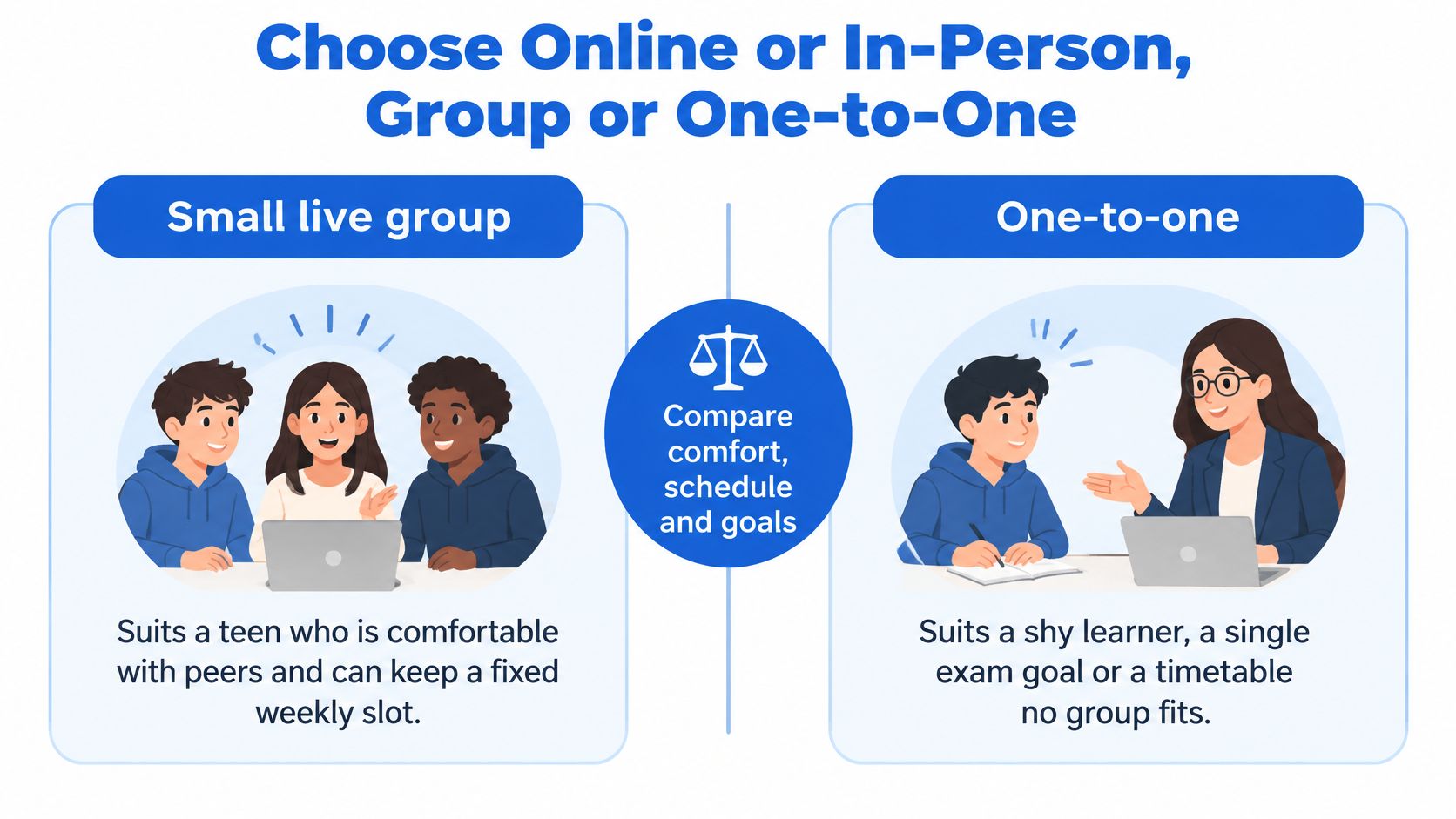
| Criterion | Small live group | One-to-one private class |
|---|---|---|
| Speaking time per learner | About 10 of 60 minutes in a group of six | Nearly the whole lesson |
| Peer interaction | Pair and group tasks with classmates | Teacher-led with no peer audience |
| Best fit | Teen comfortable speaking with peers and a fixed slot | Speaking anxiety, a single exam goal or an unusual timetable |
| Cost per lesson | Lower, because learners share the teacher's hour | Higher, because you pay for the whole hour |
The speaking arithmetic matters. If six learners share turns equally, each one gets roughly 10 minutes of talk in a 60-minute lesson. Pair work increases that, because several pairs speak at once, but no group matches one-to-one for raw speaking minutes. A group does offer something private lessons can't, real reactions from peers, disagreement, clarification and turn-taking. This comparison of group and private English classes works through that trade-off in more detail.
Test Online Readiness Before You Pay
Online lessons remove travel, but they aren't automatically easier. A 2026 case study of junior-high learners found that multimedia and repeated practice improved engagement, while learners still reported navigation difficulties and unfamiliar vocabulary, making teacher guidance, an initial platform orientation and vocabulary support important.
Before enrolling, book a short test call and check these basics.
- Dedicated device: Your teen isn't waiting for a sibling to finish with the family laptop.
- Headset and quiet room: The teacher can hear pronunciation clearly, and your teen isn't embarrassed by people listening nearby.
- Stable connection and login: Your teen can open Google Meet alone, turn the camera on and rejoin if the call drops.
- Backup plan: You know what happens after a missed or disrupted lesson, and vocabulary can be reviewed offline.
In-person classes remove device and connection risk, but they add travel and a fixed venue. Pick the format your household can run reliably every week, not the one that sounds most modern.
Plan Schedule and Budget Around Real Life
Judge a course by weekly contact time and cost per lesson, not the monthly headline price. Two plans can carry the same monthly figure and deliver very different amounts of teaching.
Here's a clearly hypothetical example. A plan costing 600 units a month for eight 60-minute lessons works out to 75 units per lesson. The same 600 units spread over twelve lessons is 50 units per lesson. The second plan also gives your teen more weekly speaking practice, which usually matters more than a small price difference.
Check The Slot Against A Real Week
| Check | What to verify |
|---|---|
| Fixed weekly slot | It survives homework peaks, sports and school exam periods |
| Time of day | Your teen isn't too tired after school to speak and concentrate |
| Makeup rules | You know how missed lessons are rescheduled or recovered |
| Commitment length | Monthly or term payment fits family plans for the year |
| Extra costs | Materials, reports and exam fees are included or priced separately |
Late-evening lessons look convenient on paper. In practice, a tired teen gives shorter answers, avoids difficult vocabulary and remembers less feedback. Protect one slot they can attend alert, every week, for the whole term.
Exam periods need the same honesty. If school tests cluster in certain weeks, decide now whether English continues, pauses or moves. This advice on how students can manage exam deadlines without last-minute cramming is useful when you're building that weekly plan with your teen, rather than imposing it.
Ask about makeup lessons before paying, not after the first absence. A missed general lesson can often be caught up from notes or a recording. A missed exam-prep speaking session is harder to recover because the live practice was the point.
Finish with a simple test. Shortlist two courses, write down the one weekly slot your teen can keep, then compare cost per lesson, minutes per week and makeup rules side by side. If a provider won't give those details clearly, don't fill the gaps with optimism.
Judge the Teacher, the Method and the Trial
A useful teen teacher combines a recognised teaching qualification, such as TEFL, TESOL or a teaching diploma, with experience teaching teenagers and practising exam speaking tasks. Ask which qualification the teacher holds. Ask whether they've taught your teen's age group before. A strong adult business teacher isn't automatically the right person for a nervous 14-year-old.

Speaking First Should Not Mean Public Performance
Many parents hear speaking-first and imagine their shy teen being put on the spot. Good teaching does the opposite. Students talk from the first lesson, but the teacher controls the pressure through private rehearsal, low-stakes pair work, structured turn-taking and gradual participation targets.
That care is necessary because adolescent speaking anxiety is real. A 2025 study of 95 learners aged 16 to 18 investigated speaking-related foreign-language anxiety, and research on adolescent learners identifies fear of negative evaluation, low confidence, fear of mistakes, public speaking and insufficient practice as major causes. Anxiety can reduce performance, motivation and emotional well-being, so ask exactly how a silent student is handled.
Use these questions in the first conversation.
- Correction timing: Do you correct during an answer, or note errors and correct after the turn?
- Speaking turns: How many chances does each learner get in one lesson?
- Quiet learners: What happens if my teen only says yes or no for the first three weeks?
- Confidence signs: How will I see progress beyond grammar scores?
Say a 14-year-old answers yes or no for three weeks, then offers a full unprompted sentence in a small group. That's progress. So are longer answers, sentences started without prompting and less reliance on memorised phrases. If a report never mentions participation or confidence, you're not seeing the whole picture.
Use The Trial As Evidence
After booking a free trial lesson with us, your teen takes a level test, the teacher evaluates their speaking level, and then you receive suitable group options with exact times and prices, or private lesson prices based on monthly hours, with no obligation to enroll. Read what to expect from a free trial English class before you book, so you can judge the session instead of being sold during it.
A report that says only good speaking tells you almost nothing. Ask for separate comments you can act on.
Use Cambridge's B2 First for Schools speaking assessment as a model, because it evaluates Grammar and Vocabulary, Discourse Management, Pronunciation and Interactive Communication as four separate criteria. A good trial report follows that logic at your teen's level. It gives a CEFR level, separate notes on grammar and vocabulary, pronunciation, interaction and fluency, plus concrete next steps.
Before enrolling, also confirm report frequency, missed lesson rules, level placement and refund or cancellation terms. Polite vagueness at this stage usually becomes frustration later.
Frequent Questions About Teen English Classes
Is English A Common School Subject For Teens
Yes. Most teenagers already meet English at school, so extra classes should solve a named problem such as weak speaking, falling written marks or an approaching exam. Don't buy more of the same lesson if the current one isn't working.
Should We Choose Online Or In-Person Lessons
Online works when your teen has a dedicated device, a headset, a quiet room and a stable connection they can manage alone. In-person removes that technical risk, but adds travel time and a fixed venue. Test the online setup before you commit.
Is A Group Or One-To-One Better
A small group suits a teen who speaks readily with peers and benefits from discussion, pair tasks and a fixed routine. One-to-one suits speaking anxiety, a single exam goal or an unusual timetable. The best format is the one that produces regular, supported speaking.
What Does CEFR Mean
CEFR is the Common European Framework of Reference for Languages. It describes what a learner can do, from beginner to advanced, rather than how many years they've studied. At Englify, English runs from A0 to C1.
How Should I Judge The Price
Compare cost per lesson and weekly contact time, not the monthly headline. Then add makeup rules, materials and any exam fees. A cheaper month with fewer speaking minutes can be poorer value.
What Should A Trial Show
An honest level check, a teacher's speaking assessment and clear options without pressure. You should leave knowing the starting level, the main weaknesses and the next step.
Which Exam Level Fits My Teen
Match the target exam to the CEFR table, then confirm the level and deadline in writing before choosing a course. A large gap needs a staged plan, not last-minute exam drilling.
Book a Free Placement Test and Trial
Take the free placement test first, then book the free trial class and compare what you see against the checks you've just run. The test gives a CEFR-based starting level. The trial shows how your teen speaks with a teacher, which is the evidence parents usually miss.
Our teen classes include school support, BAC preparation and speaking. Group English classes have a maximum of 6 students and include 3 lessons of 60 minutes each per week with a fixed schedule. That structure suits a teen who can keep the same slot and is ready to practise with peers.
For group classes, adults, teens and kids pay 250 MAD for one month, 650 MAD for three months, 1,000 MAD for six months and 1,400 MAD for nine months. Check current prices, group details and schedules again at enrolment rather than relying on figures you noted earlier. Prices and available slots can matter to your final choice, and you should confirm them before paying.
Before you decide, put the shortlisted options on one page.
- Target and deadline: Starting CEFR level, target level and any exam date, confirmed in writing.
- Real cost: Cost per lesson, weekly contact time and any extra fees.
- Workable routine: One fixed slot your teen can attend, plus clear makeup rules.
- Useful feedback: A report format that separates speaking, pronunciation, grammar, vocabulary and interaction.
Apply the format rule one last time. Choose the group if your teen speaks readily with peers and the fixed schedule fits. Choose one-to-one if speaking anxiety or one exam goal dominates.
Save the trial report. At the end of the first term, compare it with a new speaking sample and ask whether answers are longer, less memorised and started more willingly. That's how you judge English classes for teens by progress, not promises.
Start with our free placement test and free trial session, where a teacher assesses your teen's speaking and confirms a CEFR level from A0 to C1 before you choose a small group or private plan. You'll receive clear options, exact times and prices with no obligation to enroll, so you can decide using evidence. Visit Englify to book the free trial and give your teen a practical route to speaking with confidence.