Knowledge hub
English Email Writing Course: What You'll Learn
Master professional email writing with this English email writing course. Learn tone, structure, and etiquette for effective workplace communication.
You've rewritten the same short email five times. You're a professional in Casablanca writing to a supplier abroad, or a student asking a foreign university about an application, and every version sounds either too direct or too formal. The grammar isn't really the problem. You're not sure what to put first, how to ask clearly, or how you'll sound to the reader. That's the gap an English email writing course is built to close.
Table of Contents
- What an English Email Writing Course Actually Fixes
- The Core Skills a Strong Email Course Builds
- CEFR Alignment and What Each Level Can Actually Write
- A Sample 8-Week Course Outline You Can Picture
- Four Email Templates Worth Memorizing and Why
- Self-Paced Apps vs Group Courses vs Private Coaching
- How to Pick the Right Course for Your Situation
- Choosing a Course That Fits Learners in Morocco
What an English Email Writing Course Actually Fixes
A purchasing assistant needs a supplier to confirm a delivery date. She writes three paragraphs of background, apologizes twice, and buries her actual question in the final line. The supplier replies with a polite thank you and no date. Nothing in her English was seriously wrong, but the message didn't produce the action she needed.
This is the difference between knowing English and writing a working email. A strong course trains the second skill. It teaches you to decide your purpose before you write, judge how well you know the reader, and order information so a busy person can respond on the first read.
The Real Problems Behind a Stalled Email
Most weak emails fail in predictable places. The subject says "Question" instead of naming the topic. The request arrives late, or it's hidden inside a long explanation. The tone misfires, so a simple reminder reads as irritation, or a complaint sounds so soft that nobody acts on it.
There's also the follow through problem. Learners often don't know how to remind someone who hasn't replied, confirm what was agreed, or close a thread cleanly. A course that only drills greetings and sign offs leaves all of that untouched.
A good email isn't judged by how correct it looks. It's judged by whether the reader knows exactly what to do next.
What You'll Actually Work On
Expect five connected skill areas. You'll practice specific subject lines, purpose first structure, polite but direct requests, tone control for different readers, and editing habits that catch problems before you send.
These skills matter whether you're emailing a client, a professor, a hiring manager, or a colleague in another country. Email is still how formal decisions get recorded, even when chat tools handle quick updates. By the end of a serious course, you shouldn't just recognize a good email. You should be able to produce one, revise it, and explain why your version works.
The Core Skills a Strong Email Course Builds
Think of grammar drills as learning individual piano notes. Useful, but they don't teach you to play a song someone asked for. Email writing is a performance skill, so a quality syllabus is organized around what the finished message must do, not around isolated rules.
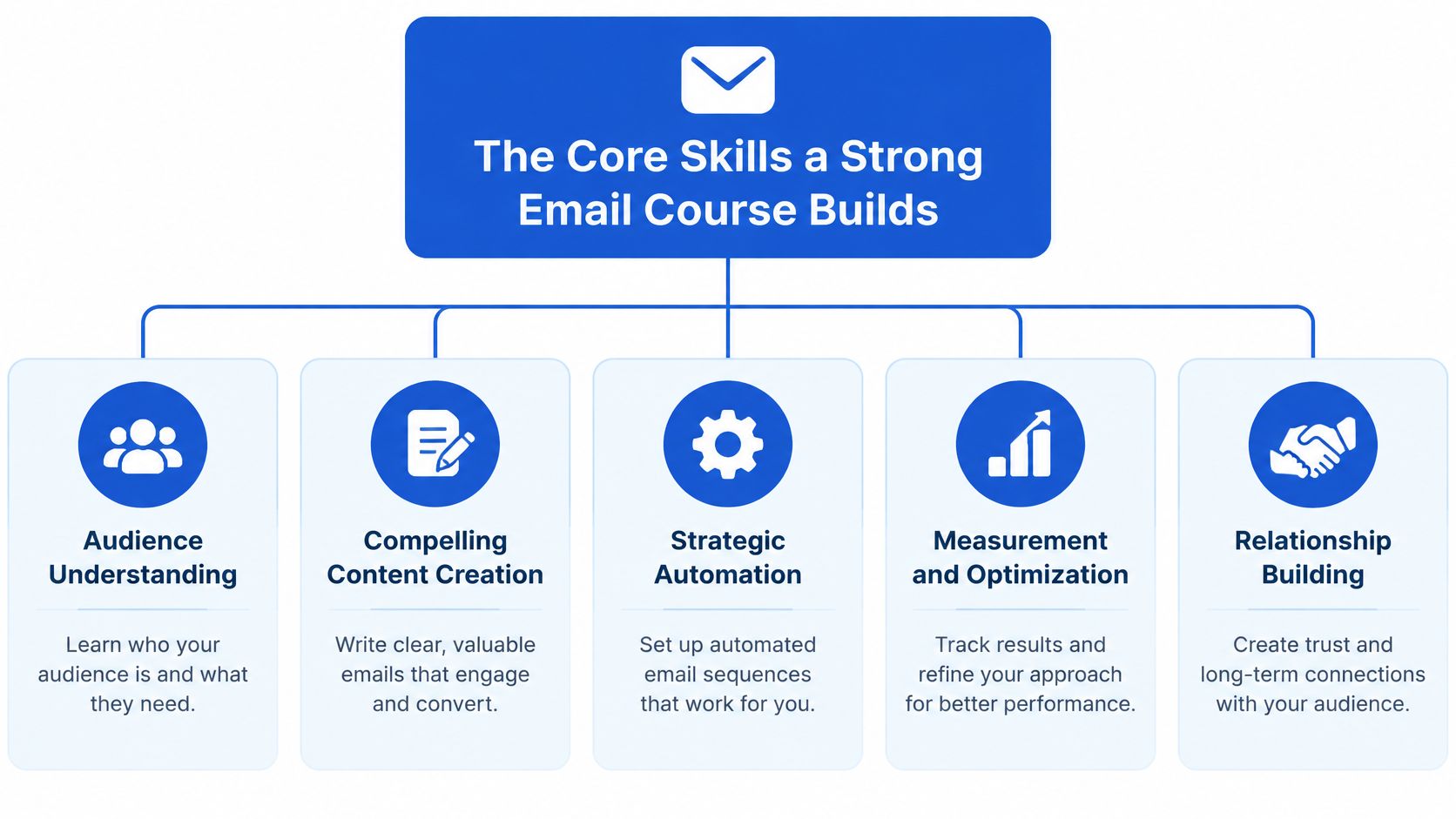
Five Skill Blocks to Look For
- Subject line strategy: You learn to name the action and topic, so "Question" becomes "Request to reschedule Tuesday's interview." Purdue OWL guidance on meaningful subject lines supports this, along with short paragraphs and direct communication.
- Message structure: You'll compare purpose first and context first openings. For most workplace messages, the reader should meet your reason for writing in the first sentence or two.
- Tone and politeness calibration: A synthesis cited in professional communication guidance reports that recipients correctly interpret email tone only about 56% of the time, while messages of approximately 50 to 125 words show stronger response performance, as summarized in WordRake guidance on editing business emails.
- Action clarity: Every request needs an owner and a deadline. "Please review this soon" becomes "Please confirm by Thursday whether the price includes delivery."
- Revision habits: You'll build a short checklist you run before sending, covering purpose, one primary request, attachments, and next steps.
Patterns That Trip Up Arabic Speaking Learners
Many learners overuse formal openings and repeated apologies because those feel respectful. In English they can read as distant or unsure. Others translate a direct style that works fine in their first language, then discover it sounds blunt without a softening phrase such as "please" or "could you."
Neither pattern is a grammar failure. Both are register choices, and they're teachable. If your goals sit inside a wider professional program, business English training for Moroccan professionals connects email work to meetings, presentations, and interviews. You can self audit a draft today by asking one question. Could the reader act without replying to ask what you want?
CEFR Alignment and What Each Level Can Actually Write
Level labels only help if they describe real tasks. The CEFR Companion Volume provides updated descriptors for written production and interaction, enabling instructors to assess whether learners can produce coherent, appropriately structured correspondence and adapt register, politeness, and formality at higher levels, as set out in the Council of Europe CEFR Companion Volume. That turns "improve your email English" into observable behavior.
What Each Level Handles
At A2, you write short, polite transactional messages. You can ask for basic information and confirm a time using simple, correct sentences and a fixed closing. Length and variety stay limited, and that's appropriate for the level.
At B1, you write simple requests and confirm arrangements in connected sentences. You can give brief background, state what you need, and close politely, though tone choices stay fairly standard.
At B2, you produce structured multi paragraph emails. You separate background from action, choose a register that fits the reader, and handle routine problems with clear reasoning.
At C1, you adapt. You soften disagreement, negotiate politely, and shift tone between a new client and a long term colleague without losing clarity. If you want the wider scale explained from the start, English levels and the CEFR explained maps each band to everyday ability.
One Request at Three Levels
B1 version. "I am writing about my application. Can you tell me if you received my documents? Thank you for your help."
B2 version. "I'm writing to check whether you received the documents I sent on Monday for the marketing position. Could you please confirm that the file is complete?"
C1 version. "I wanted to confirm that the documents I submitted on Monday arrived safely and that nothing further is needed at this stage. I'd be grateful for a brief confirmation when you have a moment."
The facts don't change. What changes is control, meaning structure, precision, and tone. A CEFR aligned course makes placement honest, groups learners sensibly, and lets you see progress in finished tasks rather than in vague promises. If a provider can't name the level an email task targets, you can't measure whether you've moved.
A Sample 8-Week Course Outline You Can Picture
An outline becomes useful when you can picture your Tuesday evening class. A small group live course usually builds one email type at a time, then layers tone and revision skills on top. Each week should end with a submitted draft, not just notes.
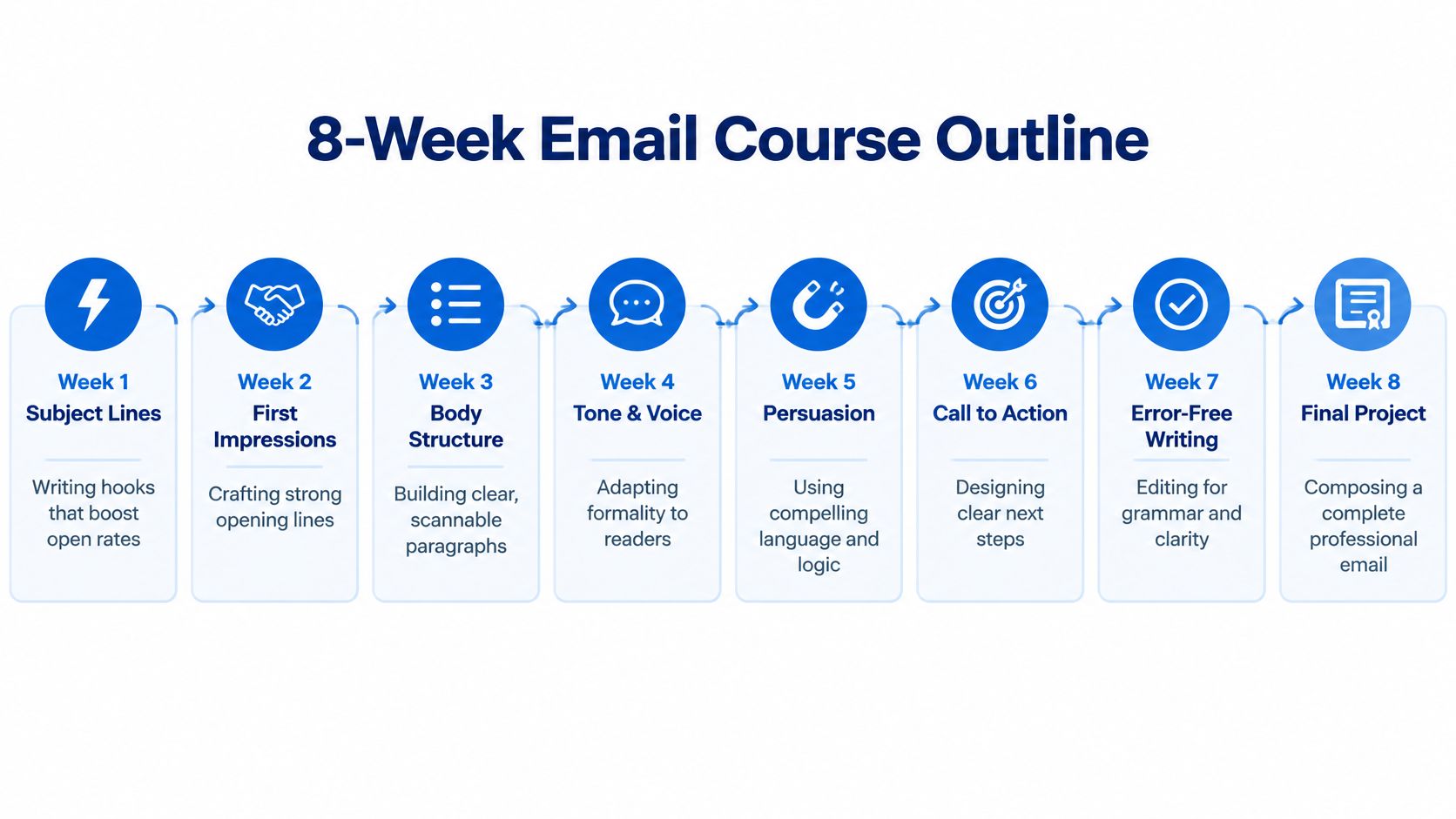
Week by Week
- Weeks 1 and 2: You start with subject lines, openings, and requests for information. The grammar focus is polite questions and modal verbs, and you submit a short request email.
- Weeks 3 and 4: You move to confirmations, logistics, and problem reports. You'll practice stating facts neutrally, then write a complaint that describes the issue without blaming the reader.
- Weeks 5 and 6: Follow ups, reminders, and meeting coordination come next. The speaking element often involves rehearsing the call or meeting the email sets up, so your written and spoken English reinforce each other.
- Weeks 7 and 8: You handle disagreement and cross cultural tone, then complete a capstone task. The final piece might be a full email chain where you respond to a difficult reply.
Why the Draft Cycle Matters
Each task follows the same loop. You draft, your teacher or peers annotate, you revise, and you submit a final version. Feedback should name specific things, such as a buried request, a mismatched closing, or a deadline that never appears.
Practical rule: If nobody ever marks your actual drafts, you're studying about email, not learning to write it.
That cycle is also how progress becomes visible. Compare your week one request with your week eight version and the difference is concrete. You'll see shorter paragraphs, earlier purpose statements, and requests a reader can answer in one reply. Vocabulary grows inside real tasks too, because phrases like "please find attached" or "I look forward to your reply" stick when you've used them to do something real.
Four Email Templates Worth Memorizing and Why
Templates help when you understand why each line exists. Copying blindly produces stiff messages, but four well built patterns cover a large share of daily workplace writing. Learn the logic and you can adjust any of them.
Request for Information and Polite Complaint
Request. "Dear Ms. Benali, I'm writing to ask whether the training certificate can be sent by email. Could you please let me know what information you need from me? Thank you for your help." The purpose lands in sentence one, and the question needs only one clear answer.
Complaint. "Dear Support Team, I ordered a replacement charger on 3 March, but I received the wrong model. Could you please confirm how I can exchange it? I've attached the invoice for reference." Facts come before feelings, and the requested action is unmistakable.
Follow Up and Meeting Scheduling
Follow up. "Dear Mr. Haddad, I'm following up on my message from last Thursday about the internship dates. Could you please confirm whether the proposed start date works for your team?" It references the earlier message without sounding passive aggressive or apologetic.
Scheduling. "Dear Dr. Mansour, I'd like to schedule a short meeting to discuss my thesis outline. Would Tuesday at 10 a.m. or Wednesday at 2 p.m. suit you? Please let me know which you prefer." Offering two options makes replying easy.
Formal vs Informal Email Elements
| Element | Formal Register | Informal Register |
|---|---|---|
| Greeting | Dear Sir or Madam | Hi Sam |
| Request style | Please let me know when you will arrive | When will you arrive? |
| Closing | Yours faithfully | Best wishes |
| Sentence style | Complete, measured sentences | Shorter sentences and contractions |
The British Council guidance on starting and finishing emails explains matching greeting and closing formality, including comma placement and layout. Before sending any template based draft, run a quick edit. Put the purpose near the top, keep one primary request, name the deadline, and delete anything the reader doesn't need in order to act.
Self-Paced Apps vs Group Courses vs Private Coaching
Format changes what kind of feedback you get, and feedback is where email writing improves. An app can mark a verb tense. It usually can't tell you that your reminder sounds annoyed, or that your opening belongs in a letter from decades ago.

How the Three Formats Compare
- Self paced apps: Flexibility is high and cost is usually low. Feedback stays generic, accountability depends entirely on you, and progress often shows as completed exercises rather than better real emails.
- Live small group courses: You get teacher feedback, peer examples, and fixed sessions that keep you consistent. Reading classmates' drafts teaches you to spot problems in your own, which solo study rarely does.
- Private coaching: Every task can mirror your job, your industry, and your upcoming deadlines. Scheduling control is strongest here, but you'll write for one reader only, so you lose the variety of peer styles.
If you're weighing the last two options, comparing group and private English classes breaks down attention, pace, and cost in more detail.
Who Each Format Suits
Choose an app if you're building a daily habit and your emails are low stakes. Choose a group course if you're a working professional who wants steady live practice and honest correction at a sustainable pace. Choose private coaching if you're preparing for something specific, such as a negotiation thread, a client escalation, or a round of job applications.
Be clear about limits too. Apps don't calibrate tone for a sensitive message. Group courses don't rebuild the syllabus around your company. Private lessons cost more per hour and still require you to write between sessions. The best format is the one whose feedback loop matches the emails you send.
How to Pick the Right Course for Your Situation
Course quality matters because email eats real working time. McKinsey Global Institute's 2012 analysis reported that knowledge workers spend about 28% of their workweek reading, writing, and responding to email, equal to roughly 11.2 hours in a 40 hour week, as reported in email overload statistics summarizing the McKinsey analysis. Training that shaves confusion from that work pays off repeatedly, which is why feedback loops deserve scrutiny before you enroll.
Six Questions to Ask Before You Pay
- Does the syllabus name your email types? Requests, complaints, follow ups, and scheduling should appear explicitly.
- Will a teacher read your drafts? Written feedback on your own messages is the core service, not a bonus.
- Is there live speaking practice? Emails often prepare for or follow up meetings, so the skills should connect.
- Does it map to CEFR levels? You need a placement point and a target you can verify.
- Does the schedule fit your real week? A course you miss regularly teaches nothing.
- Is pricing transparent in your currency? You should see the full cost before any trial converts into enrollment.
Warning Signs Worth Taking Seriously
Vague labels like "business English" with no task list should slow you down. So should a provider that never mentions feedback, skips level assessment, or can't explain who teaches the course. Template packs sold as complete training are another red flag, since memorizing fifty model emails won't teach you to handle the fifty first situation.
Judge a course by what you'll produce each week and who will correct it.
Use the checklist on two or three real options, side by side. The differences usually become obvious within minutes, especially around feedback and level structure. A course that answers all six questions plainly is telling you something about how it teaches.
Choosing a Course That Fits Learners in Morocco
Email is worth training seriously because it isn't going away. The Radicati Group estimated approximately 376.4 billion emails sent and received worldwide per day in 2025, with about 4.59 billion users, as reported in global email volume figures from the Radicati series. For learners in Morocco writing to international universities, clients, and employers, that traffic is the environment your messages compete in.
Who Benefits Most
University students applying abroad need precise, polite administrative emails. Early career professionals need requests and follow ups that keep work moving across borders. Adult learners targeting remote roles need job application and interview messages that sound capable without sounding translated.
What these learners share is a practical test. Your English works when a stranger in another country reads once and responds correctly. Everything in a course, from level placement to the final capstone, should point at that outcome.
What a Fitting Option Looks Like Locally
Englify runs live online classes through Google Meet, with small groups of up to six learners, 60 minute sessions three times a week in 3 month terms, and CEFR aligned levels from A0 to C1. It offers a free placement test, a free trial session, session recordings, learner reports, and personalized content, with published pricing in MAD including 3 month plans from 650 MAD and private classes from 100 MAD per hour.
Treat those details as a benchmark for any provider you consider. Then take the low risk step first. Sit the placement test, attend a trial session, and ask how your email drafts will be corrected. You'll know quickly whether the course teaches performance or just hands you templates.
If your inbox involves international clients, universities, or employers, put your current writing to the test before committing to anything. Visit Englify to take the free placement test and book a free trial session, then bring a real email you're struggling with and see how the feedback works in practice.