Knowledge hub
English for Office Communication: A Step-by-Step Plan
Build English for Office Communication with a weekly plan: pick priority skills, practice emails, meetings and calls, and track real progress.
It's Tuesday morning. There's a client email you've opened three times without answering, a project update you have to give in twenty minutes, and a supplier call after lunch. You know the grammar. You did the exercises. What you don't have is a plan for the English your actual week demands.
That gap between knowing English and running an office in it is what English for office communication means in practice. It closes with a short list of tasks you can name, practise and measure, not a longer list of tenses.
Table of Contents
- Choose the Office Skills to Practice First
- Weekly Practice Routine and Timed Roleplays
- Emails and Messages That Get a Reply
- Meeting Phrases for Speaking Up and Clarifying
- Group or Private Classes and Progress Tracking
- Book Your Free Placement Test This Week
Choose the Office Skills to Practice First
Which English task cost you most this week? Not in embarrassment, in minutes and risk. A misread delivery date costs a company money. Rewriting a three-line email four times costs you an hour. Rank by that, not by whatever your grammar book says comes next.
The demand behind the ranking is real. EF Education First reported in 2024 that 85% of multinational companies use English as a business language (EF Education First). Most professionals in Morocco and the Gulf meet English inside inboxes, meetings and calls every week rather than in written exercises.
The ranking exercise takes one page. List every English task from the last seven days: the client reply, the stand-up update, the supplier call, the slide deck, the message to a colleague abroad. Score each one twice, from 1 to 5, for how often it happens and for what a misunderstanding would cost. Multiply the two scores and sort. The top two become your priority skills for the next three months.
Then write one line per skill describing what finished looks like. Not improve meetings, but open a meeting with the purpose in one sentence and confirm three decisions before it ends. Attach a level next. The table below gives indicative CEFR targets for five common office situations: treat them as working targets a trainer would set, not official thresholds or exam requirements.
| Office task | What success looks like | Priority | Indicative CEFR band |
|---|---|---|---|
| Emails and written messages | Clear subject, one request, reply or timing stated | High | B1 for routine, B2 for complex |
| Meetings and discussions | Speak up, clarify, confirm decisions | High | B1 to B2 |
| Presentations | Clear purpose, two or three points, a conclusion with the next step | Medium | B2 |
| Phone calls | Identify yourself, handle details, take a message | Medium | B1 |
| Small talk | Open, follow up with a question, close politely | Lower | A2 to B1 |
If you can't name your starting point, that's a measurement problem rather than a motivation problem. Englify's free CEFR placement test includes a spoken part, so you get a level before you commit to anything.
Learners who skip this step tend to practise what feels comfortable, usually written grammar, and leave the meeting that worried them exactly as it was. Your output from this page is two priority skills, one target level each, and one sentence per skill explaining why it matters in your week.
Weekly Practice Routine and Timed Roleplays
Twenty minutes a day, five days, one saved artefact per task. That's the whole routine, and it beats a three-hour session once a month, because a skill you use briefly and often stays available in the moment you need it.
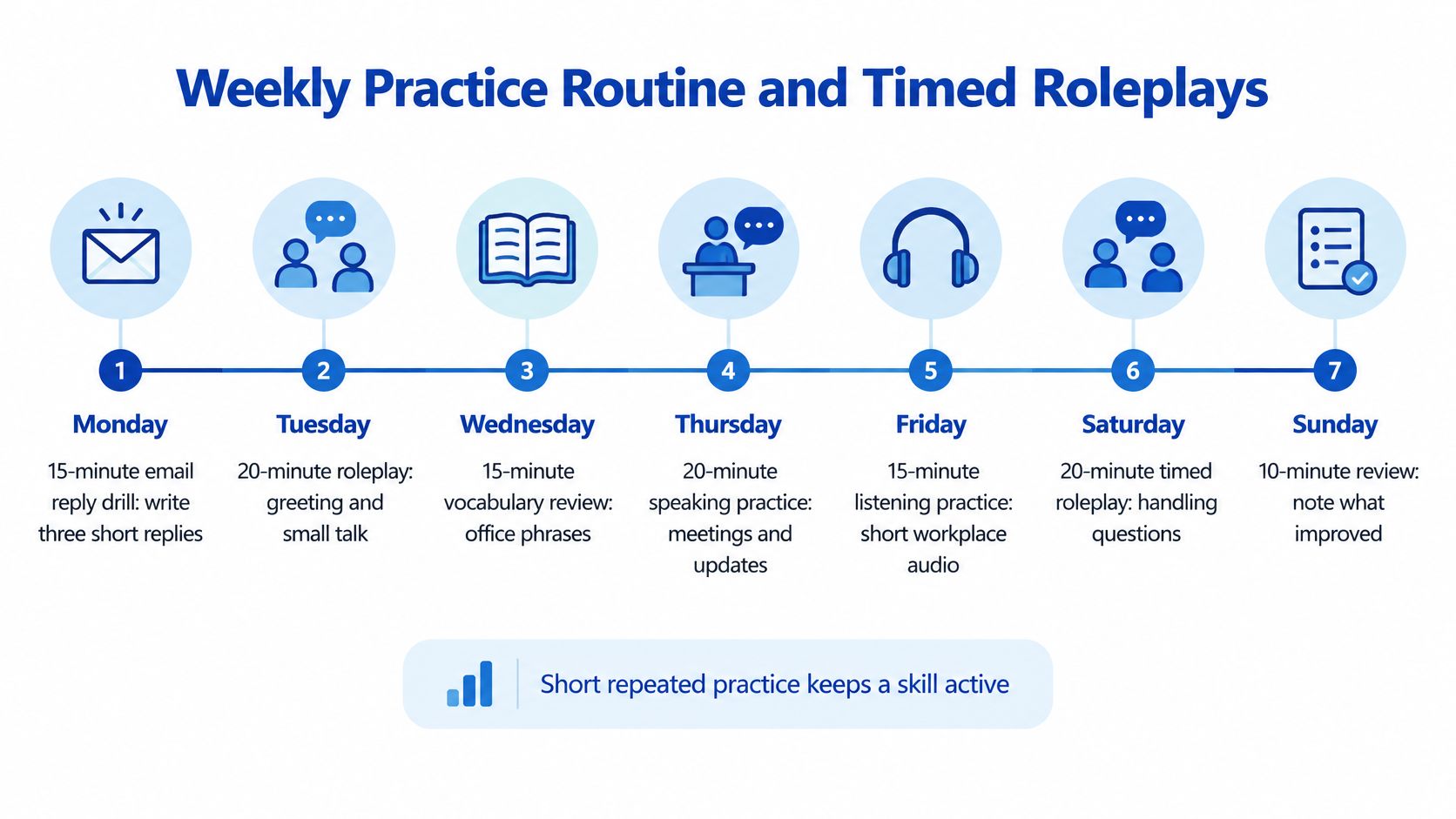
| Day | Micro-task | Time | What to keep |
|---|---|---|---|
| Monday | Rewrite one email from last week with a clear subject line and first-line request | 15 min | Before and after versions |
| Tuesday | Say three meeting opening phrases aloud, such as The purpose of today's meeting is… | 20 min | Phrase cards |
| Wednesday | Record a 60-second project update and time it | 20 min | Recording and timing |
| Thursday | Practise opening and closing a phone call with a partner | 20 min | Two scripts you can adapt |
| Friday | Turn five words you could not use this week into sentence cards | 15 min | Five sentences |
| Weekend | Replay one small-talk exchange and note one question to ask next time | 20 min | One question |
Why the week beats the weekend
Every row produces something you can read again: the before-and-after email, the recording, the sentence cards. A long weekend class leaves a memory of having spoken well. Six small artefacts leave evidence you can compare in a month, and comparison is what shows progress.
Timed roleplays that force compression
Toastmasters' timing guidance puts a standard prepared speech at 5 to 7 minutes, with a 30-second flexibility margin that produces an operating range of roughly 4 minutes 30 seconds to 7 minutes 30 seconds; impromptu responses run 1 to 2 minutes, or about 1 minute to 2 minutes 30 seconds in practice (Toastmasters). Borrow the mechanic for interviews, project updates and meeting contributions.
- Write the purpose in one line at the top of the page.
- Choose two or three supporting points and cut everything else to notes.
- Close with a conclusion that restates the decision you want.
- Deliver against a timer, out loud, standing if you can.
- When you run over, delete the weakest point instead of speaking faster.
Practical rule: prepare a 60-second version of every update you give. Meetings get interrupted, and the person who can compress on request is the one who gets asked again.
Phone calls need three rehearsed moments
The opening identifies you and the reason: Good morning, this is Sara from the finance team calling about invoice 4471. The detail check is where calls fail, so spell names back, repeat numbers and dates aloud, and ask for the confirmation sentence. The close names the next action: I'll send the confirmation by email today. Rehearse a supplier callback and the message you'd leave for an unavailable colleague, since both are short and both are usually improvised badly.
Log each run with the date and one sentence about what got easier. Review the log on Friday. Two lines of honest notes teach you more than a page of vocabulary that never came up.
Emails and Messages That Get a Reply
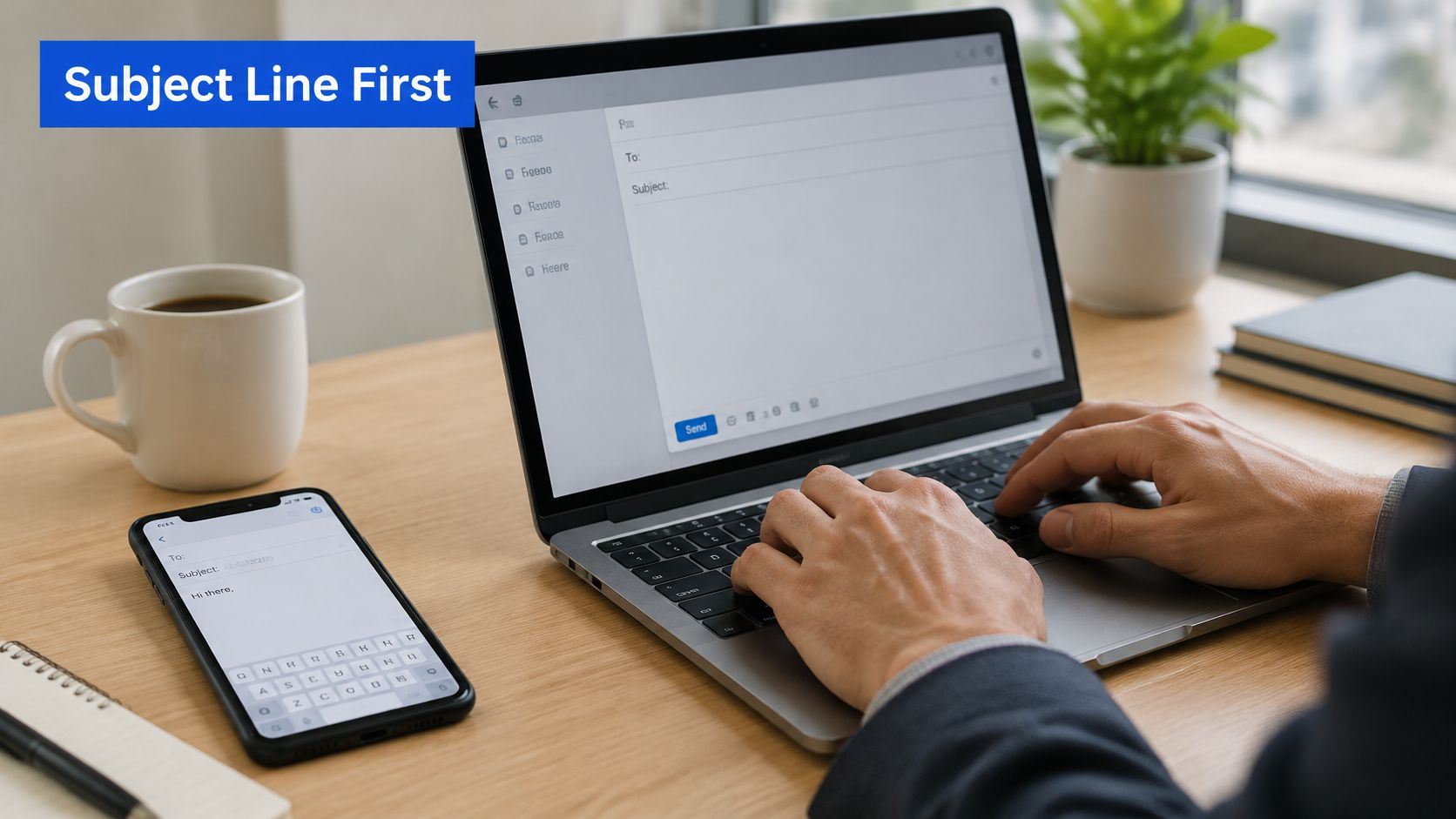
The subject line decides whether your email gets read today or next week. Most learners pour their effort into the body and improvise the subject, which is backwards.
Use a three-part pattern: topic, action, date. Q3 supplier review, confirm Thursday or Friday slot tells the reader the file, the decision and the deadline before they open anything. Microsoft's Outlook guidance recommends a descriptive, action-oriented subject line stating what the message concerns and what action is needed, and suggests labels such as FYI or Action Required where they fit (Microsoft Outlook email best practices).
A four-step structure that survives forwarding
- Subject line names the topic and the action.
- First line states the purpose in one sentence, so nobody hunts for it.
- One request with a date or time attached. Two requests in one email usually earn you one answer.
- Close with the next step and your name, so the thread has an owner.
When you can't answer yet
Silence gets read as agreement or as neglect, depending on the reader. Acknowledge receipt and commit to a time. Thank you for sending this. I am checking the figures and will come back to you by Wednesday at 3 pm. If the matter can't wait at all, don't send email. Call or send an instant message, because a ringing phone beats a flagged email.
Here's the same message twice. The weak version carries the subject Question, three lines of background, the request buried in the middle and no deadline. The clear version reads: subject Invoice 4471, confirm quantities by Thursday. First line: I need to confirm the quantities on invoice 4471 before we release payment. Request: Could you check lines 3 and 4 against the delivery note and reply by Thursday 12:00? Close: If anything is unclear, call me on the same number.
Three phrases do most of the work: Could you confirm…? for a yes/no check, I'll come back to you by… for a commitment with a time, and Just so I understand, you need…? for a request you suspect is ambiguous. For more on structure and tone, these tips for clearer email requests are worth reading alongside our guide to writing a professional email in English.
Meeting Phrases for Speaking Up and Clarifying
Open with the outcome, not the agenda. Harvard Business Review describes agenda theater as the effort spent building detailed agendas that make a meeting look organised without improving how it works, and recommends defining what the meeting must accomplish instead (Harvard Business School). That principle gives you your first sentence of any meeting you lead or join.
By the end of this meeting, we need to decide which supplier handles the Q3 order.
Four clarification moves, grouped by situation
- You missed a word: Could you say that again, please?
- You think you understood: So what you're saying is the delivery moves to the 14th?
- A decision is forming: Just to confirm, we agree that the trial order stays at 200 units.
- You need it in writing: Could you send the decision points by email after the call?
To interrupt without derailing, use a bridge: Sorry to interrupt, could I add one point? Then stop talking and let the room make space. In video meetings, wait for a half-second pause, say the person's name first, and check whether remote colleagues have spoken before you move on. Visible participation matters too: a short I'd like to add one thing tells the room you're contributing, even before your content lands.
The repair skill nobody teaches
Listening is where most of the damage happens. EF's analysis of the business English skills gap puts listening comprehension more than 20 points behind reading proficiency globally (EF Corporate Learning). If your written English is stronger than your meeting English, that's the normal pattern, not a personal failing.
When you lose the thread, say so immediately: Sorry, I didn't catch the last point. Could you repeat it? or Could you put that figure in the chat? Asking a colleague to restate a decision afterwards is slower and less professional than asking in the room.
Set your aim at being understood rather than sounding native. Clear rhythm, stressed key words and confirmed actions matter more in most meetings than a flawless accent. Your one-line note before you close the laptop: decision, owner, date. For more phrasing by situation, see our guide to business English for meetings.
Group or Private Classes and Progress Tracking
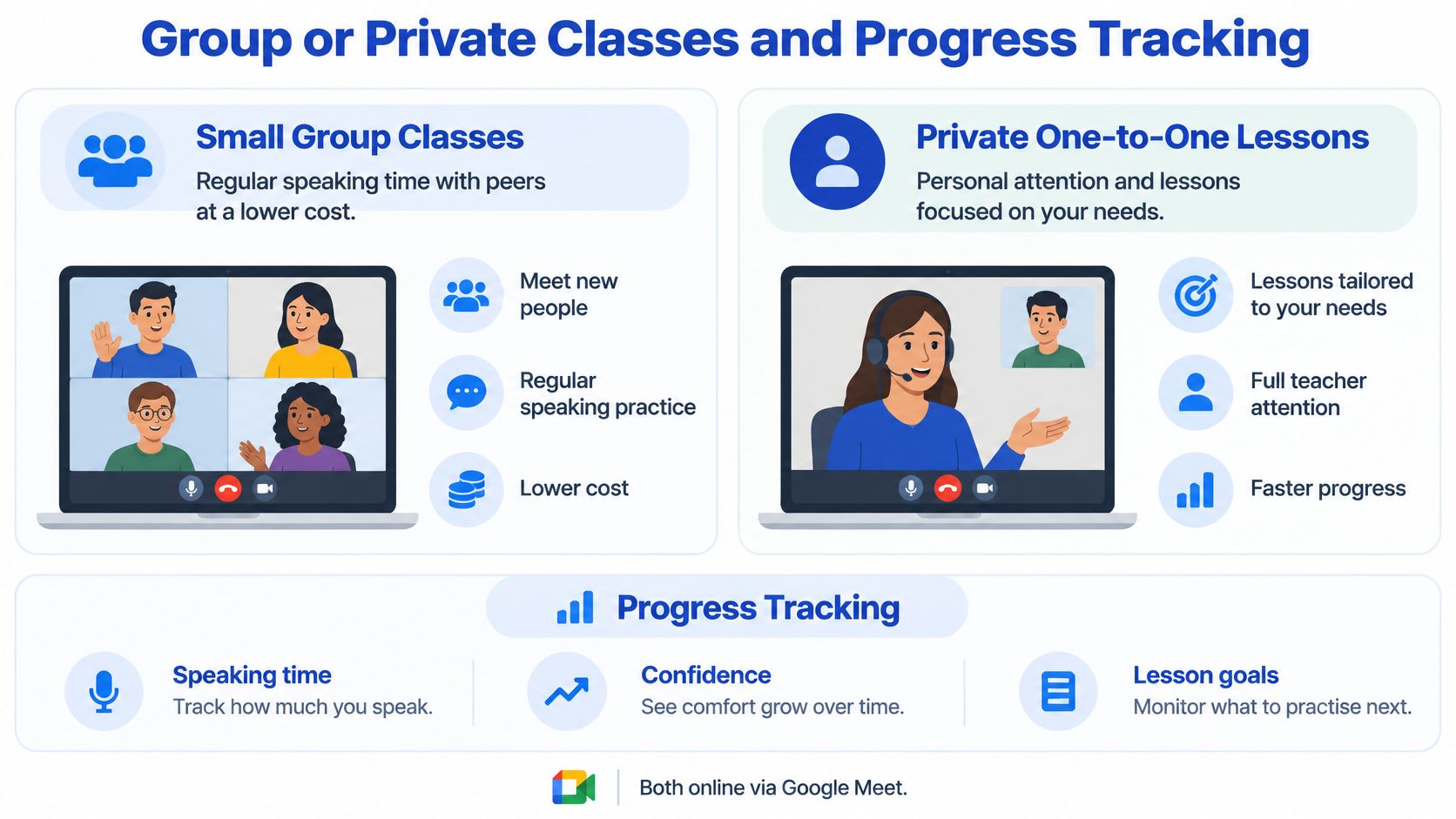
Choose a class format around the task you need to complete and the kind of practice you are missing. A group gives you peer interaction; a private lesson lets you focus more closely on your own work.
| Format | Best for | What it gives you | Trade-off |
|---|---|---|---|
| Small group class | Learners at a similar level who want regular speaking practice | Peer conversation and shared activities | Less individual attention than a private lesson |
| Private one-to-one | Focused practice for an interview, presentation or supplier call | Lessons tailored to your goals, level and pace | Less practice responding to peers |
Englify offers live English classes on Google Meet, with small groups capped at six learners and private one-to-one lessons. In a group, practise responding to different speakers and keeping a conversation moving. In a private class, bring a presentation or email and work on the language needed to complete that task clearly. Companies can also arrange group programmes for support teams on a shared schedule. Read more about choosing between group and private English classes.
Four checks that show real progress
Measure what you can do, not just how confident you feel.
- Unaided tasks: List the office tasks you can complete without help or a prepared script.
- Consistent ratings: Score clarity, interaction, accuracy and repair strategies out of five, using the same criteria each time.
- Real usage: Count the emails and meetings you handled in English, alongside practice exercises.
- Delayed recheck: Repeat a task after a few weeks to see which skills stayed with you.
Englify's CEFR-aligned courses run from A0 to C1. A free trial includes a detailed evaluation, and written session reports are provided to parents after each class. Use task completion as your practical measure: for example, can you write a clear reply, ask for clarification in a meeting, or explain a delay without losing the thread?
Book Your Free Placement Test This Week
Turn the plan into a first week with four actions.
- Pick your two priority skills from the first table and write the target level beside each.
- Book Englify's free placement test to confirm your starting CEFR level between A0 and C1.
- Book a free trial class and tell your teacher which tasks matter most right now: emails, meetings, presentations, calls or small talk.
- Start Monday's micro-task the same week, before you feel ready, because the feeling never arrives first.
Classes run live on Google Meet with a speaking-first focus, so your practice happens in real time with someone responding to you rather than on a worksheet you mark yourself. If you're unsure whether a small group or one-to-one lessons suit you better, ask during the placement test or the trial.
Then set one measurable target for the next four weeks: one clearly structured email each working day, or speaking first in one meeting each week. Write it down today. Check it on the first Friday of your routine, and let the result decide what the next four weeks look like.
Englify is an online language academy teaching live English classes on Google Meet, with small groups capped at six learners and private one-to-one lessons built around your own meetings, emails and calls. If your priority list came out as written messages and meetings, that is exactly what our Business English lessons are organised around. Visit Englify to take the free placement test and book a free trial session, and bring one real email and one real meeting to your first class.