Knowledge hub
English Speaking Classes for Adults: A Practical Guide
Compare English speaking classes for adults by format, CEFR level, teacher credentials and price. Use this checklist to choose a course that fits.
Why can you understand English for years, pass written tests, and still freeze when someone asks you a simple question? That gap isn't usually a grammar problem. It's a speaking practice problem, and confidence won't fix itself if a course waits for grammar to improve first. English speaking classes for adults should be designed for real situations from lesson one, including meetings, interviews, travel, and everyday conversation, with clear checks you can run before you pay.
Table of Contents
- What Adult English Speaking Classes Include
- CEFR Levels and What You Can Say at Each One
- Speaking Skills Adults Should Expect to Build
- Online or In-Person Classes and Which Fits Your Life
- Check the Teacher, Placement and Trial Class
- Schedule and Pricing to Compare Before You Pay
- Frequently Asked Questions About English Speaking Classes
- Choose Your Level and Book a Free Trial
What Adult English Speaking Classes Include
An adult English speaking class is a scheduled course where you practise spoken English through live tasks, such as introducing yourself, handling a phone call, joining a meeting, or answering interview questions, while a teacher models language and corrects errors. That's the core test. If you're mostly listening, reading, or completing worksheets, you're not in a speaking class, whatever the course title says.
A grammar lesson works differently. Most time goes to rules, examples on a board, and written exercises, which can help accuracy but won't teach you to respond under time pressure. An informal conversation club is different again, because there's often no defined goal, no level grouping, and no record of what you've improved. You might chat pleasantly for months and repeat the same mistakes.
Who Usually Enrols
Typical learners include university students who studied English for years but still freeze when speaking, and professionals preparing for interviews or team meetings. Others need English for travel, daily life, customer contact, or work abroad. Arabic-speaking learners in Morocco and abroad often join because they understand far more than they can say, and they need regular, low pressure speaking time with specific correction.
What a Credible Class Should Show You
- Level placement: A check that places you by what you can say, not only by a written quiz.
- Speaking task syllabus: Lessons built around tasks you'll face, not only grammar chapters.
- Mostly speaking time: Most of each lesson spent with learners talking, in pairs, small groups, or with the teacher.
- Specific feedback: Corrections that name the exact pronunciation, grammar, or vocabulary problem.
- Written progress record: Notes you can reread later, showing what improved and what to practise next.
Englify's format gives you a concrete comparison point. Lessons run live for 60 minutes on Google Meet, three sessions per week in three-month terms, with small groups of up to six learners or private one-to-one classes. You don't have to choose that exact structure, but any provider should be able to state lesson length, frequency, and group size this clearly.
Simple listing test: If a course page can't say what you'll be able to do by the end of a term, it isn't yet a speaking class you can judge.
Ask for end of term outcomes in plain language, such as giving a short work update, handling a hotel problem, or answering common interview questions without long pauses. Vague promises about fluency don't let you compare courses, measure progress, or know when to change level.
CEFR Levels and What You Can Say at Each One
CEFR describes ability through can-do statements rather than vague labels such as beginner or advanced, so each level tells you what a learner can do in conversation. The Council of Europe CEFR descriptors search shows that an A1 learner can interact when the other person speaks slowly, repeats or rephrases information, and helps formulate answers, and can ask and answer basic questions about immediate needs and familiar topics.
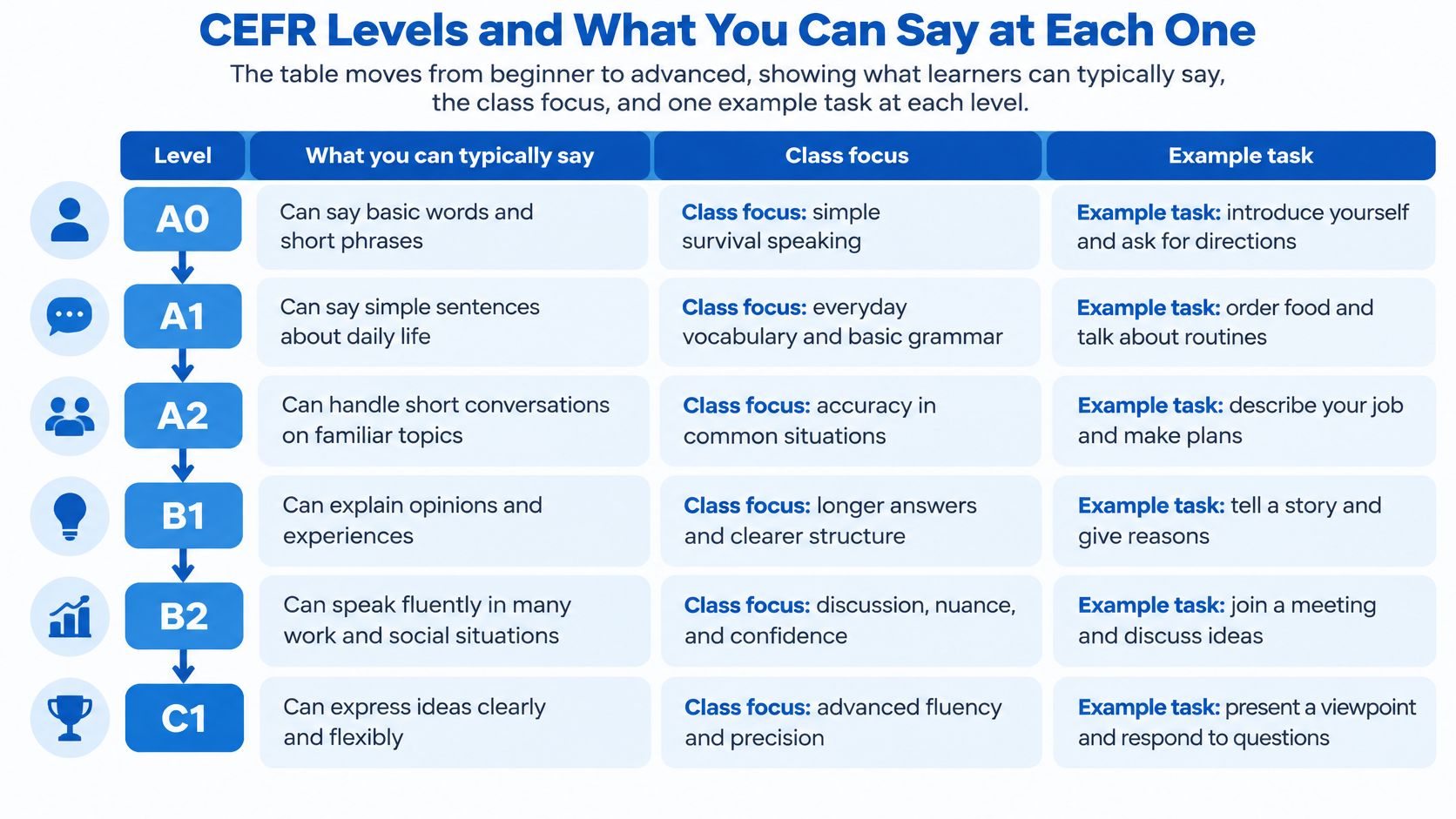
| CEFR level | What you can typically say | Typical class focus | Example task |
|---|---|---|---|
| A0 | Memorised words and greetings, little connected speech | Core phrases, numbers, confidence with short replies | Say your name, where you are from, and ask someone to repeat |
| A1 | Simple interaction when the other person speaks slowly and helps | Basic questions about immediate needs, familiar topics | Order a meal and ask the price |
| A2 | Short, routine exchanges on familiar topics | Shopping, travel, describing routines, handling unfamiliar situations | Explain your daily routine and book a hotel room |
| B1 | Copes with most travel situations and familiar work topics, gives reasons briefly | Work and study conversation, giving opinions and reasons | Explain a problem at work and suggest a solution |
| B2 | Interacts with reasonable fluency and spontaneity on general and professional topics | Meetings, presentations, negotiating and defending a view | Join a team meeting and respond to a challenge to your proposal |
| C1 | Expresses ideas fluently and spontaneously, with flexible use of language | Nuance, precision, complex professional and academic speaking | Lead a presentation and handle detailed questions |
How to Find Your Row
Find the row where you can complete most example tasks without preparation, not after rehearsing a script. Then test one row higher and notice where you struggle, hesitate, or switch to another language. That boundary is usually your working level. If you want context on how long level progress can take in another European language system, the German Cultural Association Hong Kong guide to study hours for each level is a useful comparison, though your pace will depend on attendance and practice.
Read the levels with their common plateaus in mind. A0 learners need phrase level drills and confidence before full sentences, so short, repeated replies are progress, not failure. A2 learners often plateau because they can shop and order food but freeze in unfamiliar conversations where memorised phrases run out.
B1 is the usual threshold for work and study conversation, where you can explain, give reasons, and keep going despite errors. At B2, meeting participation and presentations become realistic goals, because you can react, clarify, and defend a view. C1 focuses on nuance, precision, and spontaneous speech, such as choosing a softer phrase for disagreement or summarising a complex point quickly.
These descriptions are general summaries, not a diagnosis. Confirm placement with a speaking check rather than self rating alone, since self rating often reflects reading ability. For a fuller walkthrough, see this guide to CEFR English levels explained in detail before you book.
Speaking Skills Adults Should Expect to Build
A speaking class should build three separate, measurable things, and your progress report should name each one. First is intelligibility, meaning stress, rhythm, intonation, and connected speech that don't force your listener to work hard. Second is fluency, with fewer unnatural pauses, false starts, and repetitions, plus natural self correction when you notice an error. Third is range and accuracy, enough vocabulary and grammar to say what you mean without errors that block meaning.
Think of speaking as a three legged stool. If only one leg grows, you stay unsteady in real conversation, because accuracy without clarity still confuses people, and speed without intelligibility creates more misunderstanding. A good teacher therefore corrects in layers, sometimes targeting word stress in one task and sentence range in the next.
A learner can be grammatically correct and still hard to follow, or fluent and hard to understand, so track all three.
Speaking also includes interaction, not just producing sentences alone. The Council of Europe CEFR Companion Volume organises speaking into activities including conversation, informal discussion, formal meetings, goal oriented cooperation, information exchange, service encounters, interviews, and telecommunications, and adds strategy scales for taking the floor, cooperating, and asking for clarification. In practice, that means you should practise entering a discussion, holding your turn, asking someone to repeat, and reaching an outcome, not only answering teacher questions.
Confidence Needs Its Own Design
Many adults understand English but freeze when they have to speak, because nervousness, fear of criticism, and limited vocabulary often arrive together. Telling an anxious learner to relax doesn't solve that. Course design has to lower risk at the start and raise challenge gradually.
- Preparation time: A minute to note key words before a task, so you're not inventing ideas and language at once.
- Pair practice first: Optional low risk rehearsal with one partner before speaking to the whole group.
- Delayed correction: Feedback after a turn ends, instead of interruption after every sentence.
- Rehearsed to spontaneous progression: The same function practised with support first, then with less help.
Progress tracking should report separate evidence for interaction management, intelligibility, vocabulary range, grammatical control, and task completion. As an example outcome, not a promise, a learner after a term might introduce a project in a meeting and answer two follow up questions. The report should say which criterion improved, for example clearer word stress, and which still needs work, such as past tense accuracy during longer answers.
Online or In-Person Classes and Which Fits Your Life
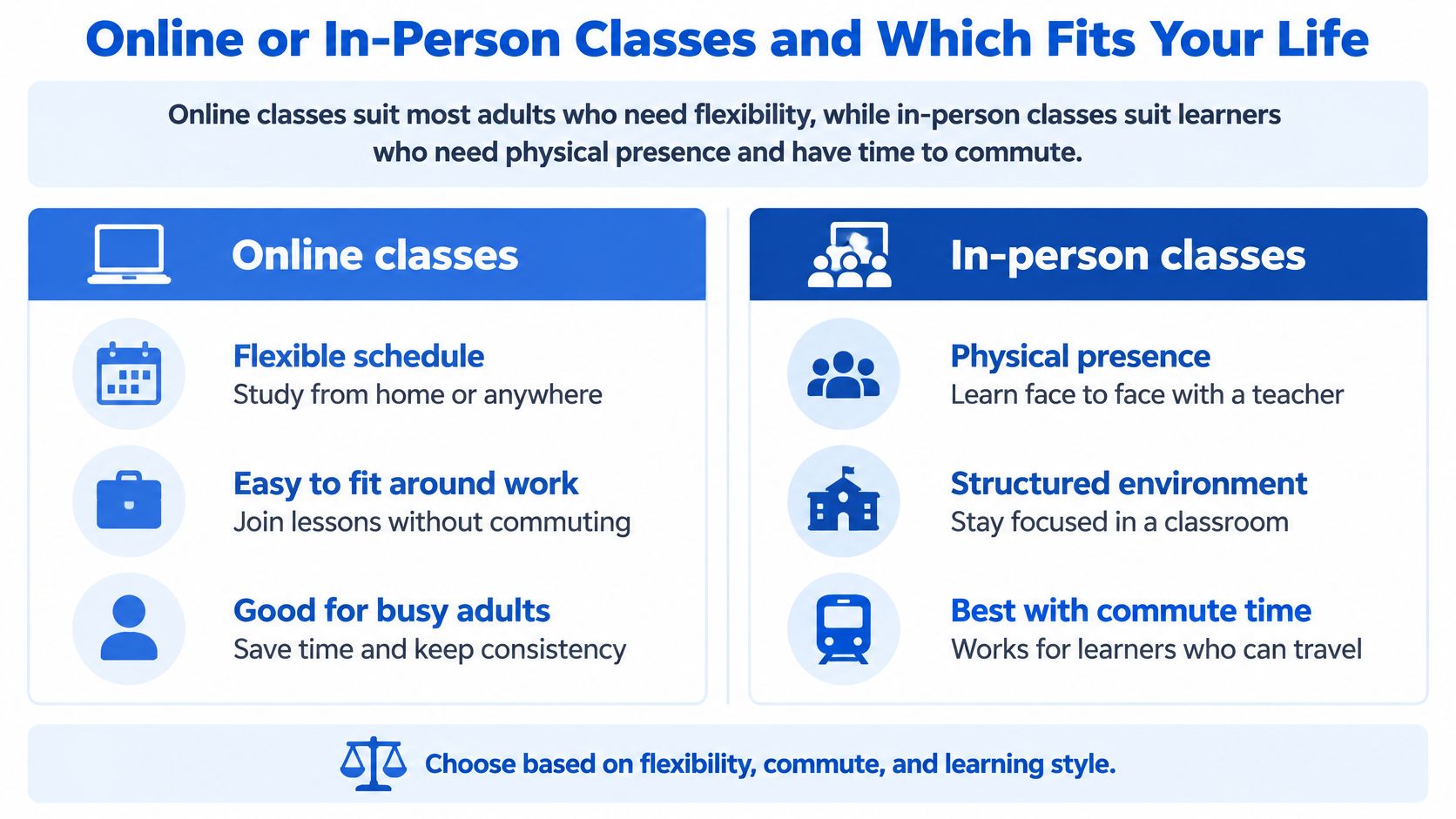
Online classes suit most adults who need flexibility, while in-person classes suit learners who need physical presence and have time to commute. Neither format improves speaking by itself. What matters is whether you'll attend consistently and speak for a large share of every lesson.
Online Classes
- Advantages: No commute, easier fitting around shifts or travel, more time slots across mornings, afternoons, and evenings, and lessons from home or work.
- Drawbacks: Connection problems, household distractions, harder reading of body language, and less informal contact with classmates before and after class.
In-Person Classes
- Advantages: A stronger routine, easier face to face questions, fewer technical issues, and a classroom setting that some learners find easier for focus.
- Drawbacks: Travel time that can be significant in busy cities, fixed timetables, and fewer options outside large cities.
Match the format to your situation first. A professional working shifts in a large Moroccan city usually benefits from online classes, because removing the commute protects attendance on tiring days. A school leaver with a daily routine near a language centre may prefer in-person lessons and the social routine they create. A Moroccan living abroad or a Maghreb professional needing evening English should check time zone fit first, before comparing teaching details.
If your goal is work related, it also helps to read how providers frame English skills for career progression in terms of interviews, meetings, and workplace tasks, then ask whether the format lets you rehearse those exact situations. A group versus private decision sits inside that choice, and this comparison of group or private English classes can help you weigh speaking time against cost.
Online Readiness Check
- Connection: Stable internet that holds a video call without repeated dropouts.
- Equipment: Working camera and microphone, tested before your first lesson.
- Space: A quiet room where you can speak at normal volume.
- Device: A phone, tablet, or computer that runs Google Meet well.
Englify teaches live on Google Meet in small groups and private classes, so confirm available time slots on the booking page for your time zone. Use this rule of thumb: choose the format you'll attend every week, because attendance drives speaking practice more than format itself.
Check the Teacher, Placement and Trial Class
A certificate confirms training, but it does not reveal how much you will speak, how corrections feel, or whether tasks match your goal. Ask for direct answers in writing before you enrol, then use the placement and trial to test those answers.
The Council of Europe CEFR descriptors page organises its self-assessment grid around listening, reading, spoken interaction, spoken production, and writing. A placement test based only on grammar or multiple-choice vocabulary can therefore misclassify learners who understand rules but cannot respond spontaneously. An oral assessment should sample both speaking and interaction, such as explaining a work situation, answering follow-up questions, and handling an everyday conversation.
Six Questions to Ask in Writing
- Task design: Who designed the speaking tasks, and how do they match meetings, interviews, or daily conversation?
- Speaking time: How much of each 60-minute lesson is learner speaking time?
- Level decision: How is my level decided, and is it reassessed?
- Correction style: Are corrections immediate and specific on pronunciation, grammar, and vocabulary?
- Progress reports: Are reports tied to CEFR can-do statements?
- Group formation: How are groups formed by level, and what is the maximum size?
A clear answer gives numbers and examples. For instance, a 60-minute lesson might use about 10 minutes for a diagnostic warm-up, 15 minutes for targeted language input, 25 minutes for paired or small-group tasks, and 10 minutes for feedback and an individual action target. The exact split can vary, but speaking should occupy the centre of the lesson rather than the final five minutes. Englify caps small groups at six learners, which makes it easier for each adult to receive regular turns and correction.
How to Use a Trial Properly
- Take the placement: Complete the free online placement test and check that it includes a speaking element, not only a written quiz.
- Note your level: Receive your CEFR level from A0 to C1 and ask what evidence placed you there.
- Attend live: Join the free trial session on Google Meet and treat it as a test of the provider.
- Judge the experience: Notice whether you spoke for most of the lesson, whether corrections were specific, and whether the teacher adjusted tasks when you struggled.
- Read the evaluation: Check the written trial evaluation for level, strengths, and next steps before paying.
This guide to a free trial English class explains what to expect from that first session. If you are placed too high, ask for a second check and try the lower group for a few sessions. If you are placed too low, request harder speaking tasks and a review date. If you froze, say so directly and ask for more preparation time next session.
Red flags: Promises of fluency within a fixed time, no trial session, grammar-only plans, and unclear group sizes.
Englify describes its teaching team as TEFL/TESOL certified, but still confirm who will teach you, what training they have completed, and whether you will keep the same teacher. Continuity matters because a familiar teacher can track recurring pronunciation, grammar, and vocabulary errors across sessions.
Schedule and Pricing to Compare Before You Pay
Start with what's included, not the headline price. Englify publishes its format openly: 60-minute live lessons on Google Meet, three sessions per week, organized in 3-month terms, with small groups capped at 6 learners. Private classes start from 100 MAD/hour and 3-month plans from 650 MAD. Morning, afternoon and evening slots exist, so confirm current times when you book.
| Option | Schedule | Best for |
|---|---|---|
| Small group | 60-minute live lessons on Google Meet, three sessions a week, maximum 6 learners | Peer practice at a lower cost |
| Private one-to-one | Times set around your week, with flexible rescheduling when commitments shift | Interview preparation, specific goals, faster correction |
| Three-month term | 3-month terms of 60-minute lessons, three sessions per week | Learners committing to a full term |
Convert Every Offer to Cost per Lesson
Compare fairly by converting every offer into cost per 60-minute lesson rather than comparing headline monthly figures. Divide the total term price by the number of lessons in the term. A term of three sessions a week over roughly 13 weeks gives 39 lessons, so you divide the term price by 39. At Englify's published entry point, a 3-month plan from 650 MAD comes to roughly 17 MAD per lesson at that starting rate.
Apply the same method to any school's offer, including in-person centres. A low monthly price with one short lesson a week can cost more per speaking hour than a higher priced course with frequent lessons. Also weigh realistic speaking time in your head, since a large group gives you fewer turns than a group of six.
When Private or Group Makes Sense
Private classes justify a higher hourly rate when you have a specific goal such as interview preparation, a short deadline, or a need for heavy correction on pronunciation or presentation language. You get every turn, and the teacher can rebuild tasks around your job. The trade off is cost and less practice reacting to different speakers.
Groups make sense when budget is tighter, when you value peer practice, or when you're shy and speak more safely with others at the same level. Hearing classmates handle the same task also gives you useful phrases. The trade off is shared attention, so confirm maximum group size in writing.
Questions to Ask Before Paying
- Total term price: What's the full amount, including any extra fees?
- Sessions included: How many lessons, and how long is each one?
- Rescheduling rules: How much notice do you need to move a private lesson?
- Cancellation terms: What happens if you stop mid term?
- Carry over: Do unused sessions carry over, and for how long?
- Trial payment: Does the free trial require any payment or card details?
Be wary of offers that show a low price but don't state the schedule or number of lessons. Without those two facts, you can't calculate cost per lesson or judge value. Get answers in writing, by email or message, so there's no confusion later.
Frequently Asked Questions About English Speaking Classes
Can I start with no English at all?
Yes. At A0, the first goal is controlled speech: greetings, numbers, short answers, and simple survival phrases. A placement check should keep you with true beginners, because mixed early groups often let stronger speakers do all the talking while quieter learners stay silent.
Is online speaking practice as good as a classroom?
It can be, provided the lesson is built around learner turns rather than long teacher explanation. Judge the mechanics: stable connection, camera on, quiet room, pair work, and feedback while you speak. A nearby class you miss because of traffic gives less practice than a live online lesson you attend consistently.
How soon will I feel more confident?
Confidence usually appears task by task before it feels global. Expect earlier wins in predictable exchanges, then harder gains in open discussion, interruptions, and follow-up questions. Look for reports that name tasks you handled, errors that repeated, and the next step. Fluency promised by a calendar date is a warning sign.
Do I need strong grammar before joining?
No. Adults often understand more than they can say, and a speaking class is designed for exactly that gap. The sequence should move from preparation time and sentence frames to pair rehearsal, then toward unscripted speech. If every activity rewards perfect written accuracy, the course is training grammar more than conversation.
Can my level change during a term?
It can. Ask whether reassessment happens at term end, on teacher recommendation, or both, and what evidence counts. Useful evidence is completing higher level tasks without rehearsal, handling follow-up questions, and sustaining a turn under time pressure. Finishing worksheets alone is thin evidence for a move.
What should I watch in a free trial?
Treat the trial as a speaking audit. Count how many minutes you talk, whether correction is immediate, and whether activities resemble meetings, interviews, or everyday conversation you need. Leave with your CEFR estimate, your strengths, and one concrete weakness to work on next.
Are there classes for Arabic-speaking learners?
Englify teaches learners across Morocco, with WhatsApp support in Arabic and French and teachers who also speak Darija, so ask about group availability for your level and preferred time. Booking support can happen in Arabic or French; lesson time stays focused on English speaking practice.
Choose Your Level and Book a Free Trial
Match your goal to a starting point before you compare prices or schedules. For everyday conversation and travel, a small group around A2 to B1 is often a sensible start, because you'll practise routine exchanges and learn to handle unfamiliar moments without switching language. You'll also hear peers solve the same problems aloud, which builds useful phrases quickly.
For job interviews and team meetings, a B1 to B2 path with more private speaking time suits many learners. Private sessions let you rehearse your actual interview answers, project updates, and meeting contributions, with correction on clarity and word choice. For exam preparation, look for a course with explicit exam task practice, timed speaking, and feedback against exam-style criteria rather than general conversation only.
Three Decisions to Make in Order
- Level: Use a placement check with a speaking element, not self-rating alone.
- Format: Choose online or in-person, group or private, based on commute, schedule, and speaking time.
- Weekly rhythm: Pick a schedule you'll keep for a full term, including busy work weeks.
Englify offers small group and private one-to-one classes, CEFR-based levels from A0 to C1, live speaking practice on Google Meet, and written learner reports after trial sessions and ongoing classes. Those reports turn a single lesson into a record you can act on, covering strengths, errors, and next practice targets, so progress shows as evidence instead of vague encouragement.
Don't decide from a course page alone. Take the free placement test or book the free trial session through englifyacademy.online, then read the written trial evaluation before committing to a term. During the trial, judge three things: how much of the hour you spoke, whether corrections were specific enough to repeat correctly, and whether the teacher adjusted when you struggled.
You should leave the trial knowing your level, your strongest speaking skill, and your next two practice targets.
If the evaluation gives you those three things, you can compare it fairly against any other provider. If it doesn't, ask follow-up questions in writing before paying. A calm start, with clear evidence, beats an urgent discount every time.
Englify runs live English speaking classes for adults on Google Meet, in small groups and private one-to-one formats, with CEFR levels from A0 to C1 and written learner reports to track your speaking. Take the free placement test or book a free trial session, read your written evaluation, and then decide on a term with clear evidence. Visit Englify to check current schedules and start your placement today.