Knowledge hub
Live Online English Classes: Formats and How to Choose
Live online English classes explained: how they work, benefits over recorded lessons, group vs 1:1 formats, Google Meet and how to choose.

Live online English classes are scheduled lessons where a teacher and learners meet in real time by video, speak, and receive correction during the lesson.
You might understand an English video but freeze when someone asks you a question. Or you might be choosing a course for your child and wondering whether another screen-based activity will involve meaningful learning. The useful question isn't whether a teacher appears on screen. It's how much the learner speaks, what feedback they receive, and what they can do afterwards.
Table of Contents
- What Live Online English Classes Are and How They Run
- Live Versus Recorded English Lessons Compared
- Where Live Classes Make the Biggest Difference
- Choosing Between Group and One-to-One Live Classes
- What You Need for Smooth Google Meet English Lessons
- Keeping Children's Live Lessons Active Rather Than Passive
- Matching a Live Program to Your Level and Goal
What Live Online English Classes Are and How They Run
A live class is a coached rehearsal, while a recorded course is someone else's rehearsal that you watch alone. During the coached version, the teacher can notice a misunderstanding, change the question, and help you try again.
Online learning itself is widespread: Eurostat reported that 18% of EU internet users participated in structured online courses in 2024. That measure includes subjects and formats beyond live English instruction, so it shouldn't be mistaken for evidence of language-learning results.
What happens during a session
A well-organized learning cycle looks like this:
- Check your starting level. Complete a placement check so the teacher can choose suitable language and tasks.
- Join Google Meet at the booked time. Open your materials and check that you can hear the teacher.
- Warm up with a familiar question. You might discuss your weekend, school day, or current work.
- Complete a speaking task. Exchange information with a partner, solve a problem, or rehearse a conversation.
- Use the teacher's corrections. Practise a clearer pronunciation, more accurate sentence, or better word choice.
- Review the written feedback. Identify what went well and what to practise before the next session.
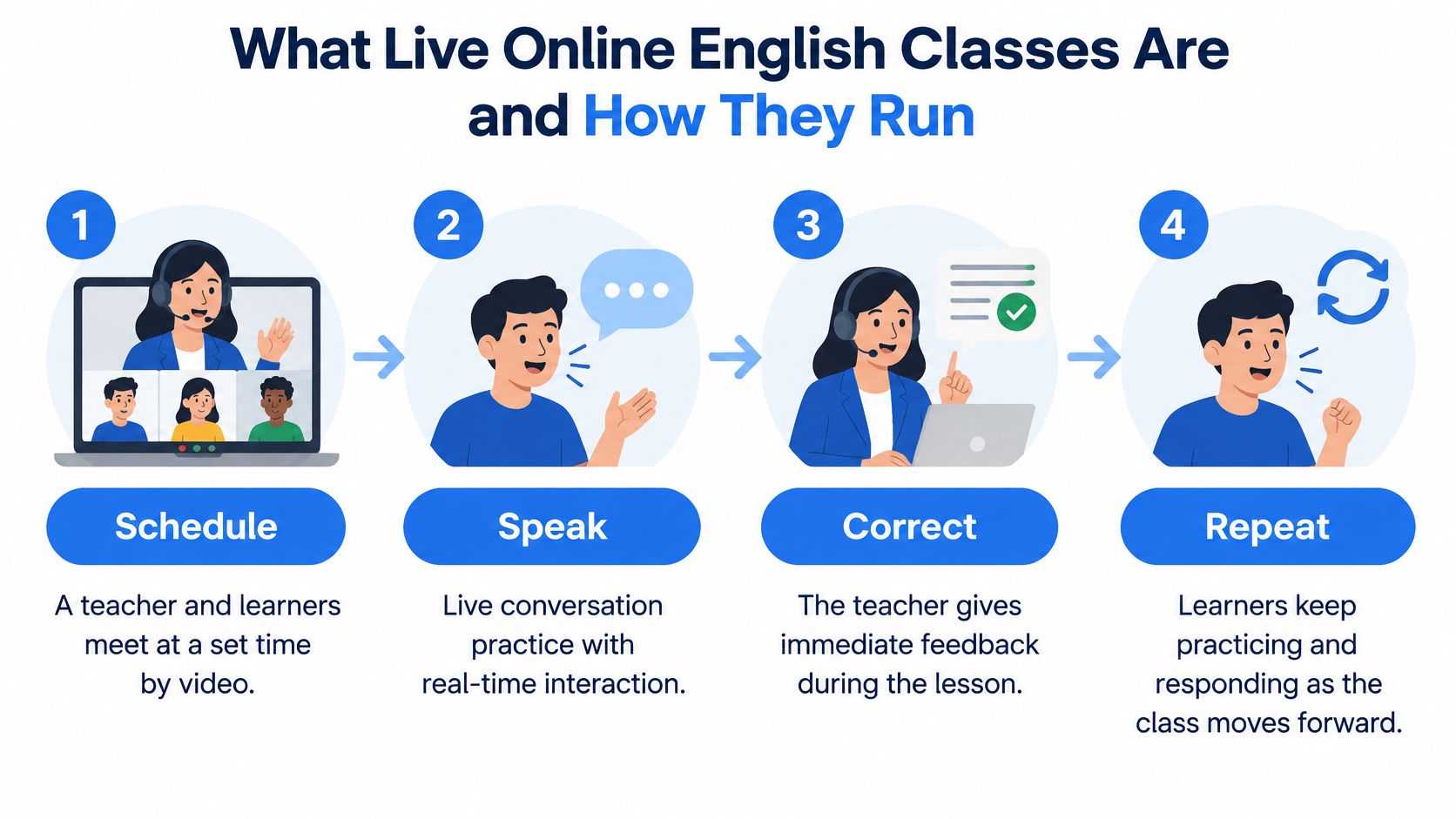
For example, a learner describes a recent weekend and uses go when describing a past event. The teacher models went, asks the learner to repeat the sentence, and then asks a follow-up question that requires the same form.
That final question matters. Hearing a correction isn't the same as using it independently. A productive session gives the learner another opportunity to apply the correction, rather than moving straight to a new topic.
Live Versus Recorded English Lessons Compared
| Criterion | Live online classes | Recorded lessons |
|---|---|---|
| Speaking time | In a speaking-focused class, learners spend substantial time speaking; check your individual share | Only when the learner pauses and repeats aloud |
| Feedback | Teacher corrects pronunciation and grammar during the lesson | Self-check against a model, if one is provided |
| Interaction | Pair work, group tasks, and teacher questions | No interaction with others within the recording |
| Schedule | Fixed, booked times | Any time, at the learner's own pace |
| Pace | Teacher adjusts to the group or learner | Learner pauses, rewinds, and repeats |
| Accountability | Attendance and reports support a routine | Relies on the learner's own study routine |
| Best use | Speaking, listening under pressure, and exam speaking practice | Grammar explanations, vocabulary review, and revision between lessons |
Speaking time, usable feedback, and accountability are the differences worth examining most closely. A live label alone doesn't establish any of them.
During a trial, keep a rough record of how long you speak. Don't count the teacher's explanations, another learner's answer, or time spent watching a shared video. In a group, ask whether partner activities happen simultaneously or whether everyone waits while learners answer individually.
When a recording is enough
A recorded lesson can be enough to start understanding a grammar point, reviewing vocabulary, or revisiting a pronunciation model. You can pause an explanation, write examples, and replay a difficult passage without feeling rushed.
Self-paced learners with strong routines can make useful progress this way. A recording becomes more active when you stop it, answer aloud before hearing the model, and then compare your response.
Live teaching offers a different opportunity: the teacher can respond to your particular mistake. Useful feedback should leave you knowing what to change and give you a chance to try the improved version, rather than hearing that an answer was wrong.
Before paying: Ask what you'll be expected to say, how the teacher will correct you, and what you'll receive after the lesson.
AmaJova's resource on setting lesson expectations before payment concerns music tuition, but the purchasing principle transfers well: clarify what instruction and feedback include.
The evidence cited here doesn't directly compare live and recorded English-learning outcomes. Live instruction is therefore a better fit for interactive speaking goals, not a proven superior choice for every learner or task.
Decision rule: If your goal is to be understood in conversation, make live practice central; if your goal is to study a grammar point at your own pace, recorded material can be enough to start.
Where Live Classes Make the Biggest Difference
Live classes matter most when you need to understand speech and respond while the conversation is still happening. Reading a report comfortably doesn't necessarily mean you can follow an unexpected question about it.
The EF analysis of the English skills gap, drawing on the 2025 EF English Proficiency Index's analysis of 2.2 million adults in 123 countries, reports that listening comprehension globally trails reading proficiency by more than 20 points. That's a reason to assess listening separately rather than treating reading ability as proof of conversational readiness.

Practise the situation you actually face
Different speaking goals require different classroom tasks:
- Job interviews. The teacher changes direction after your prepared introduction. You practise understanding the new question and giving a relevant answer without reciting a memorized script.
- Team meetings. Classmates introduce competing suggestions or interrupt politely. You practise entering the discussion, clarifying a point, and finishing your contribution.
- University seminars. You explain an opinion and receive a follow-up question. The challenge is to develop your answer, not repeat your original sentence.
- Hotels and airports. A partner gives information at a natural pace. You practise identifying the essential details and asking for repetition when necessary.
For a professional in Morocco working with overseas clients, useful personalized content might involve explaining a delayed delivery. A learner working in the UAE might instead rehearse handling a customer's request or contributing to a multilingual team meeting. The teacher should choose the situation from the learner's actual responsibilities, not assumptions about where they live.
For Arabic-speaking learners, translation can sometimes become a preparation habit that slows responses. A teacher can check whether that's happening for the individual learner and practise short, reusable response patterns without assuming that every Arabic speaker has the same difficulties.
Correction should support another attempt
A teacher doesn't need to interrupt every sentence. During accuracy practice, an immediate correction can help the learner notice a target form; during a longer role-play, brief notes followed by a second attempt may preserve the flow better.
Useful progress measures include whether you answer the question asked, request clarification appropriately, take your turn, and make yourself understood. Grammar accuracy matters, but it isn't the only evidence of successful communication.
A learner who mostly watches can remain passive even when the lesson is live.
During a trial, check whether you're invited to speak near the beginning rather than after a long explanation. Afterwards, look for a report that names the speaking task, describes what you managed, and identifies what needs another attempt. Attendance alone doesn't show communication progress.
Choosing Between Group and One-to-One Live Classes
| Factor | Small group | One-to-one |
|---|---|---|
| Speaking turns | Shared among learners, so fewer individual turns | Most speaking opportunities are directed to the learner |
| Cost per learner | Usually lower when tuition is shared | Usually higher for exclusive teacher attention |
| Pace | Set around the group's common level | Set around the learner's goal and speed |
| Comfort with mistakes | Hearing peers make mistakes can ease nerves | Mistakes stay within the private lesson |
| Best for | Peer practice, teenagers, children, and general conversation | Interview, exam, or presentation goals, and individually arranged schedules |
Private lessons concentrate teacher attention; small groups introduce more conversation partners. Neither format automatically produces a better lesson.
The central trade-off is access to turns and correction. In a private session, the teacher can spend longer on a difficulty that affects only you. In a group, the teacher must balance individual needs with activities that remain useful for everyone.
Choose by the practice you need
A small group can suit a teenager who needs to exchange opinions, ask follow-up questions, and become comfortable speaking around peers. Children can also benefit from partner games and shared tasks, provided the activities match their age and language level.
Group work shouldn't mean taking turns delivering unrelated answers to the teacher. Ask whether learners respond to one another, complete information-gap activities, or work towards a shared outcome. Those tasks create a reason to listen as well as speak.
Private instruction makes particular sense when you have a narrow target:
- Interview preparation. Rehearse answers connected to your experience and receive focused follow-up questions.
- Presentation rehearsal. Practise your own slides, explanations, and audience questions.
- Exam speaking. Work on the task types and weaknesses relevant to your preparation.
- Uneven availability. Ask whether individual booking arrangements can fit your commitments.
A private lesson can still become teacher-heavy. Likewise, a well-managed group can offer substantial partner practice, so observe the teaching rather than judging only the format name.
For a fuller decision checklist, use this guide to choosing group or private English classes. Before enrolling, confirm the actual group size, current fees, cancellation conditions, and rescheduling rules; don't assume that a private booking includes unlimited flexibility.
Format rule: Match the lesson to the goal, then check whether the price and timetable are sustainable.
If you need focused correction on a recurring pronunciation difficulty, choose a format that permits repeated individual attempts. If your priority is becoming comfortable with different speakers, make sure your course includes genuine peer interaction.
What You Need for Smooth Google Meet English Lessons
| Item | What to check | Why it matters |
|---|---|---|
| Device | Phone, tablet, or laptop with a working camera and microphone | The teacher can see your mouth and hear your pronunciation |
| Connection | Stable internet, tested before the first class | Dropped audio interrupts speaking practice and feedback |
| Google Meet access | Updated browser or Meet app, plus the booked session link | Avoids preventable delays when joining |
| Headphones | Earphones or a headset with clear sound | Reduces echo and makes corrections easier to hear |
| Quiet space | Limited background noise and light on your face | Helps both participants follow speech and visual cues |
| Backup plan | Mobile data fallback or an agreed audio-only option | Provides an alternative when the connection weakens |
You don't need an elaborate home classroom. You need clear two-way audio, reliable access, and materials you can use while speaking.
Test the setup in the place where you'll study. A connection that works beside the router may behave differently in a bedroom, and a microphone that records clearly in silence may pick up distracting noise during a busy evening.
Prepare for imperfect access
The UNESCO Global Education Monitoring Report found that distance learning during COVID-19 school closures had a potential reach of more than 1 billion students, yet failed to reach at least 500 million learners. Platform availability alone wasn't enough to ensure participation.
For learners in rural Morocco or the wider Maghreb, and anyone relying on mobile data, a fallback deserves attention before enrolment. Discuss what happens if the video freezes but audio remains usable, or if you disconnect during a speaking task.
- Test the sound. Ask someone to listen while you speak at your normal volume through the headphones you'll use.
- Prepare the materials. Download or open the worksheet before joining so you aren't searching for it mid-conversation.
- Agree on a recovery method. Know whether to rejoin the same meeting, send a message, or continue temporarily without video.
- Check the time zone. Learners joining from Morocco, the UAE, or abroad should confirm which local time the booking displays.
Video can help a teacher demonstrate mouth position, but understandable audio is essential for listening and pronunciation feedback. If bandwidth becomes limited, an agreed audio-only activity may preserve useful practice better than repeatedly restarting frozen video.
Session recordings can support revision where they're offered, but ask about access, consent, and availability. A recording helps you revisit what happened; it doesn't replace the speaking turns lost during a disconnected lesson.
Keeping Children's Live Lessons Active Rather Than Passive
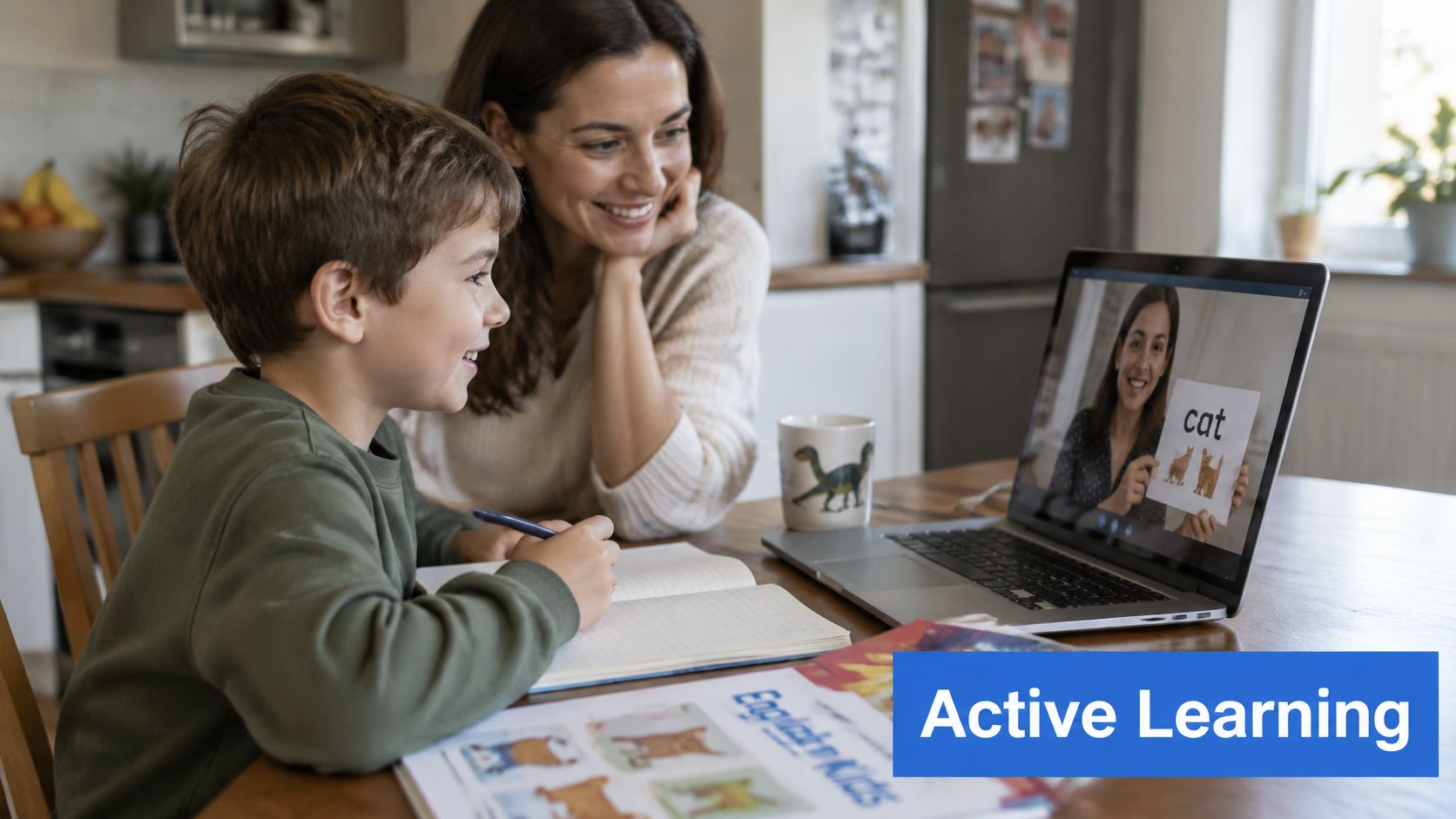
Not all screen time involves the same activity. A child answering questions, acting out instructions, and describing a drawing is doing something different from watching an uninterrupted video.
Online learning isn't automatically harmful or beneficial. Parents should judge the lesson design, supervision, and whether class time displaces sleep, play, reading, or social contact.
A 2025 scoping review indexed by ERIC identifies parental involvement as a major factor shaping children's digital habits and development. That supports paying attention to the home routine, but it doesn't establish a universal safe screen-time limit for English lessons.
A practical first-week check
- Watch for active participation. Your child should answer, choose, ask, describe, or move in response to the teacher, not stare at slides.
- Add an offline follow-up. Ask your child to find household objects and name them in English, or draw something to describe at the next lesson.
- Agree on expectations. Discuss camera use, movement breaks, and what to do when your child needs help before the class begins.
- Ask for age-appropriate guidance. A young beginner may need a parent nearby to manage the device; an older child may need privacy and a clear independent routine.
- Read the learning report. Look for participation, completed speaking tasks, and a specific next step, rather than attendance alone.
Don't answer every question for your child. Allow thinking time, then let the teacher provide a prompt or simpler question if needed.
When evaluating online English classes for children, ask how groups are matched by age and level. Use the trial to see whether your child understands the instructions and gets opportunities to respond.
Written reports after classes are particularly useful when they distinguish between repeating a teacher's model and speaking independently. Both can be appropriate learning stages, but they aren't the same achievement.
Matching a Live Program to Your Level and Goal
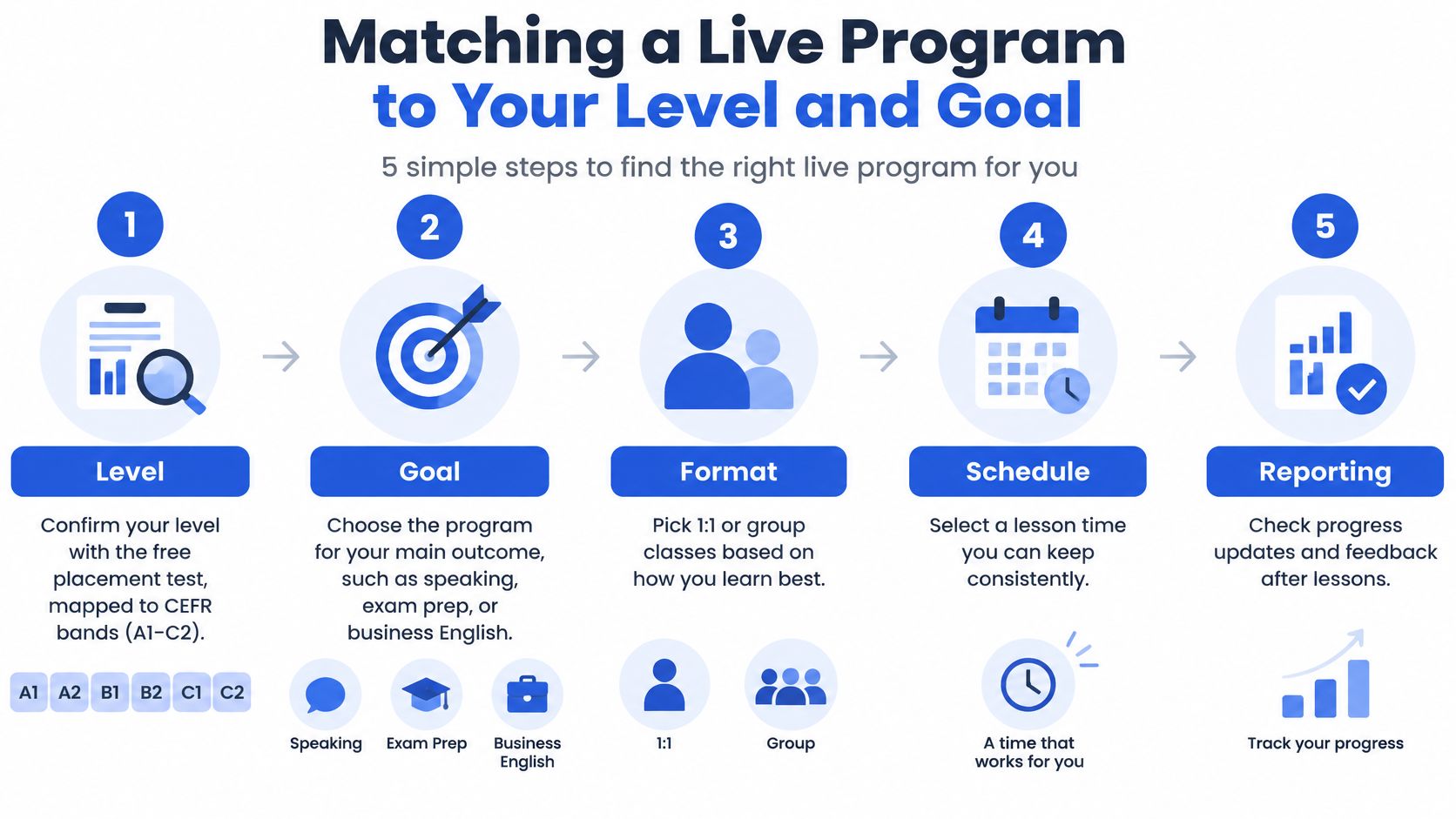
Choose by level and goal first, then check format, timetable, and reporting. A convenient class won't be useful if its tasks are too difficult, too easy, or unrelated to what you need.
- Confirm your level. Use the free online English placement test as a starting point, then check your spoken performance during the trial.
- Name the goal precisely. Replace a broad wish to improve English with a practical outcome, such as answering interview follow-ups or handling everyday travel questions.
- Select the format. Decide whether your next priority requires concentrated individual feedback or interaction with peers.
- Check the commitment. Confirm lesson length, weekly frequency, term length, available time slots, and the booking time zone.
- Examine the reporting. Ask whether feedback identifies speaking tasks, strengths, and next steps.
- Take the trial. Observe the lesson before making a longer commitment.
Turn a level label into an observable goal
The Council of Europe's CEFR framework defines six main proficiency levels, A1, A2, B1, B2, C1, and C2, through can-do descriptors rather than course hours alone. This lets you ask what you'll be able to accomplish, not just which textbook you'll finish.
A program may use A0 as an introductory label for absolute beginners. Ask how that label connects to its CEFR-aligned pathway, because it isn't one of the framework's main levels.
Say a learner handles familiar everyday questions but struggles to sustain a discussion. A suitable next target might be explaining a choice and answering a follow-up, rather than repeating introductions indefinitely.
For a young child, readiness also includes attention, device independence, and comfort responding to an unfamiliar adult. Parents can compare English lessons for six-year-olds through Talkio Kids to identify age-specific questions to ask alongside the language-level check.
After the first few sessions, compare the written feedback with your original goal. If you enrolled to participate in meetings, the evidence should eventually include relevant discussion tasks, not just completed grammar exercises.
Englify offers live English classes through Google Meet in small groups or private sessions, with personalized content, CEFR-based learning, and learner reports. Visit Englify to take the free placement test and book a free trial session, then judge the experience by your speaking opportunities and the feedback you can use.